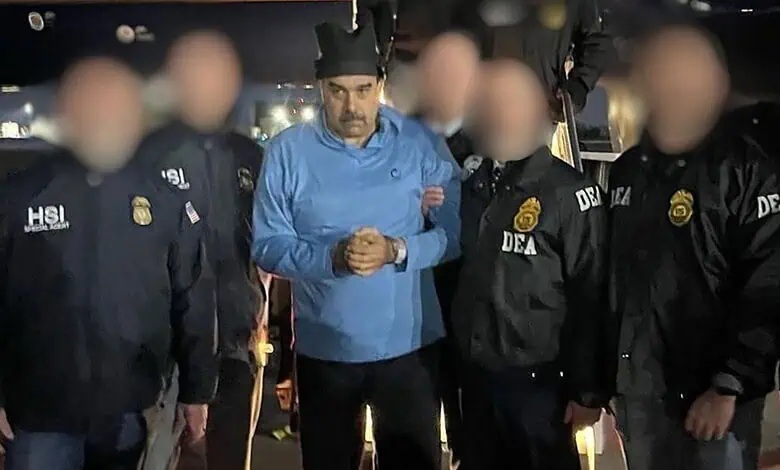
Let’s not avoid the uncomfortable question on everyone’s mind, but rather face it head-on: has so-called international law become the last refuge of the dictator and the autocrat? Has it, under the guise of neutrality and legal integrity, become the faithful ally of those who steal elections, enslave peoples, and hold states hostage?
By Oscar Hammerstein
For no sooner had Venezuelan tyrant Nicolás Maduro been arrested than the familiar chorus of voices rose. Left-wing media and self-proclaimed guardians of the world order chanted in unison that this act was “illegal.”
Foreign leaders, including the far-left Spanish Prime Minister Pedro Sánchez, spoke with lofty indignation about a violation of international law—as interpreted by a ruling complex of professors, including Gert-Jan Knoops and Larissa van Herik, aided by NGOs, conference halls full of moral certainties, and multilateral bureaucrats operating far from the battlefield.
The Secretary-General of the United Nations declared himself “deeply concerned.” As if his concern had ever stopped a tyrant. He received support from the usual suspects: European leaders safely sheltered behind seas and protocols; China, which called it a “serious violation”; Russia, which warned with brazen brazenness against “armed aggression”; and Cuba, which provided an army of bodyguards and soldiers to prop up Maduro, but now shed crocodile tears over sovereignty and independence.
One would like to believe that we live in a world where law orders, restrains, and ennobles relations between states. But that is not the world we live in. It is a pleasant dream, but a dangerous dream. The closest we came to that dream was after the end of the Cold War, when the United States, supported by its allies, had the power to enforce norms: in the deserts of Kuwait and on the battlefields of the Balkans.
Today, that era is over.
Rogue states are advancing, and international law—along with the institutions that are supposed to uphold it—is increasingly proving not to be the sword of justice, but the shield of the lawbreaker. Just as liars have hijacked freedom of speech.
No one in their right mind advocates destroying the entire edifice of international law. Too much has been contributed to it, too much blood and effort have been invested. But what can no longer be ignored is its systematic distortion. Rogue regimes use the law not to bind themselves, but to paralyse democracies.
The law has become their weapon, hypocrisy their ammunition.
Article 2, paragraph 4, of the UN Charter is cited repeatedly as a sacred text: the prohibition of violence against the territorial integrity or political independence of states. But those who merely quote and fail to think obscure the truth. The core question is carefully avoided.
Is there a violation of sovereignty when a country's legitimate authority agrees to intervene? Edmundo González, elected by the Venezuelan people in 2024, spoke unequivocally in favour of the operation. The Maduro regime, which stole those elections and violently suppressed them, lacks any democratic legitimacy. Sovereignty without legitimacy is not a right, but a smokescreen.
The United States correctly determined that Maduro was not a legitimate president. He hosted Hezbollah, sought support from the ayatollahs in Tehran, and used Cuban troops to enforce his power. Havana itself acknowledged that dozens of Cubans died defending this tyrant.
If the world interprets Article 2 to allow foreign powers to maintain an unelected dictator forcibly, but prohibits their removal, what does that say about the morality of that world order? Article 2 is no longer a guarantee of peace, but a shield for crime.
This raises the second question, which is equally persistently avoided: can this action be considered self-defence? Against large-scale drug trafficking, against narco-terrorism, against the cynical use of migration as a weapon?
This was precisely the argument made during the arrest of Panamanian dictator Manuel Noriega. And not without reason. A US Department of Justice advisory opinion at the time stated that the decision to use force is among a nation's most fundamental political choices—choices that cannot be delegated to judges unaccountable to the people.
Yet, a flock of left-wing commentators warns that this operation would give Putin and Xi "free rein." As if they ever expected legal footnotes. Putin invades a neighbouring country whenever he pleases. Xi is building his navy and army, not his pleas. China ignored international rulings in the South China Sea. Russia and China have paralysed the Security Council with their vetoes.
The International Criminal Court has targeted democracies that fight terrorism, but hasn't lifted a finger against the narco-terrorist Maduro. Let us not pretend, then, that paper is stronger than steel.
The only valid defence against global rogue states is deterrence: the credible threat of Western military power. That power was demonstrated with surgical precision in Maduro's arrest. That single signal carries more weight than a thousand UN resolutions. It protects the free world and forces Moscow, Beijing, Tehran, and other rogue states to reflect on their actions.
Liberal internationalism fails—morally and politically—when it no longer distinguishes between aggressor and enforcer, between imperial plunder and law enforcement. It fails when it equates an American action to arrest a lawless dictator with the expansionism of Russia and China.
For Maduro is not a head of state in the classical sense, but the de facto leader of the Cartel de los Soles: a narco-regime conspiring against the West with Hezbollah and the rogues of Tehran. And those who dare not acknowledge this are not choosing justice—but cowardice.

I heartily concur with this author's well expressed views.
Thak you for sharing them.
Thanks !