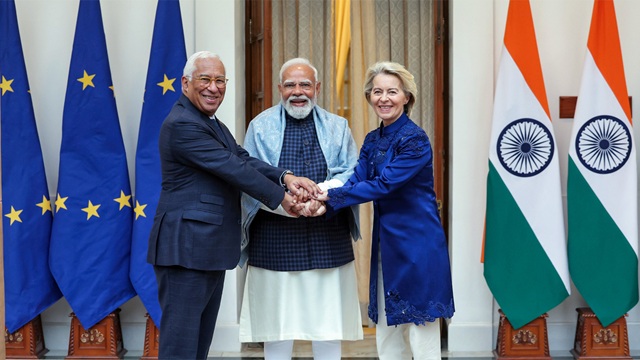
Regardless of who occupies the White House, US strategy in the Middle East shows clear continuity: reduce direct military burdens, shift greater responsibility to allies, and build new regional architectures, such as IMEC, that weaken China’s Belt and Road footprint. Implemented through Indian, European and Gulf instruments rather than branded as a US megaproject. And as EU Commission President Ursula Von Der Leyen said to describe the India-EU Free Trade Agreement: “This is only the beginning”.
By Ahmad Ghosn
On 27 January 2026, the European Union (27 countries) and India signed a landmark free trade agreement in New Delhi, creating one of the most significant trade agreements in history. Although some might read the deal as a reaction to the Trump administration’s tariffs and tariff threats, that interpretation is misleading, since discussions on an EU–India partnership have been underway for at least three decades:
1993: (EC - India Cooperation Agreement 1993), which establishes a broad legal framework for political, economic, and development cooperation between India and the European Community. Since 1976, the European Commission has committed around €2 billion of development cooperation to India.
2005: (Political declaration on the India-EU strategic partnership 2005) an acknowledgement of the Strategic Partnership and the shared responsibility to contribute to international peace, security and prosperity, and adopting a comprehensive and forward-looking Action Plan.
2020: (India–EU Strategic Partnership: A Roadmap to 2025), a comprehensive blueprint that organised the relationship around key pillars: trade and investment, climate and clean energy, digital transition, connectivity, security and defence, and people‑to‑people links.
2021: A resumption of the agreements for an FTA was agreed upon, along with the start of negotiations between the EU and India on an investment protection agreement.
2022: (EU-India Trade and Technology Council 2022), was invented to increase bilateral cooperation, boost bilateral trade and investment, and capitalise on both parties' strengths to ensure their technological and industrial leadership.
2023: (India–Middle East–Europe Economic Corridor 2023) on the margins of the G20 in New Delhi, linking India, the EU and Gulf partners into a long‑term infrastructure and trade vision.
2026: (India-EU Free Trade Agreement 2026), The joint statement welcomes progress on the India–Middle East–Europe Economic Corridor and commits the EU and India to advance IMEC through high-standard connectivity and trilateral cooperation projects in areas like energy, climate resilience, green mobility, and digitalisation.
EU–India relations have evolved from a broad-stroke symbolic alliance in the early 1990s to substantive cooperation in key industries, including technology, energy, and defence, in 2020. By early 2026, the political, economic, and institutional scaffolding was already in place between India and the EU; what was missing was the overarching agreement to integrate it, the EU-India FTA.

EU-India FTA: What’s in it?
The EU-India Free Trade Agreement covers a market of approximately 2 billion people and accounts for nearly 25% of global GDP, making it the largest agreement ever concluded by both partners. And, as mentioned in the wide India-EU Joint Statement 2026:
1- Both sides commit to progressively eliminate or reduce tariffs on the vast majority of bilateral trade in goods, with the headline ambition of liberalising over 90% of tariff lines and trade value over the implementation period.
2- Deepen strategic collaboration under the India-Middle East-Europe Economic Corridor (IMEC) aimed at boosting connectivity, trade and investment across a market of around 2 billion people.
3- Advance the EU-Africa-India Digital Corridor within the framework of IMEC, including through the Blue Raman submarine cable system to connect Italy and France to India via Israel.
4- Foresees regulatory cooperation and provisions on intellectual property, government procurement, competition policy and state‑owned enterprises to ensure a level playing field and foster technology and knowledge transfers.
5- Launch the first pilot European Legal Gateway Office as a one‑stop hub to provide information and support the movement of workers from India to the EU, starting with the ICT sector. (As of 2024, over 931,607 Indians resided in the EU, including 16,268 Blue Card holders. Over the past 20 years, more than 6,000 Indian students received Erasmus scholarships.
6- Sign an India–EU Security and Defence Partnership. It will deepen ties in maritime security, defence industry and technology, cyber and hybrid threats, space, and counter‑terrorism.
The Joint Comprehensive Strategic Agenda aims to accelerate progress across five key pillars: prosperity and sustainability, technology and innovation, security and defence, connectivity and global challenges, and enabling factors such as skills, mobility, business, and people-to-people ties.
What’s next?
Several forward‑looking milestones will shape relations between India and Europe, giving a clear picture of the emerging format and orientation of alliances in the region:
1- AI Impact Summit in New Delhi in February 2026 to drive concrete cooperation on AI governance, standards and applications.
2- Implementation of the EU–India Semiconductor Memorandum of Understanding and broader chip cooperation to build trusted semiconductor supply chains and joint R&D.
3- Deepening of the India–EU Water Partnership through regular joint work on water management, resilience and security.
4- Launch and institutionalisation of an annual EU–India Security and Defence Dialogue under the new Security and Defence Partnership.
5- Complete negotiations on an Investment Protection Agreement (IPA) and on an Agreement on Geographical Indications (GIs).
This may make more sense if we consider the National Security Strategy of the United States of America, November 2025, Page 23: “America should similarly enlist our European and Asian allies and partners, including India, to cement and improve our joint positions in the Western Hemisphere.”
Gulf buy-in
IMEC needs three pillars to succeed – a stable security architecture, Gulf buy-in, and a hard economic base. On the security side, the I2U2 initiative linking India, Israel, the UAE, and the United States has already begun. Economically, the EU–India FTA now provides a robust economic foundation that makes IMEC profitable and legitimate. Now, the decisive variable is Gulf buy‑in.
GCC states already have a structured strategic partnership with the EU, concluded at the EU–GCC 2025 summit, so IMEC only needs Saudi-Israeli normalisation to complete the corridor. If Saudi Arabia chooses to align, IMEC will not only see the light, but the corridor will achieve its core strategic objective: to erode and eventually eliminate the Belt and Road Initiative.
In this sense, the Indian Middle Eastern European Economic Corridor is the American Strategy in the Middle East.