The article argues that the tactic described by Joseph Goebbels in the 1930s — using democratic means to gain power and then abolishing democracy — is being applied today primarily by Islamist and jihadist movements. Goebbels openly stated that the Nazis wanted to use parliament as an instrument to ultimately destroy the democratic system. This strategy led to the concept of “militant democracy” (weerbare democratie), developed by the Dutch constitutional scholar George van den Bergh, who argued that democracies may defend themselves against parties seeking to abolish democracy. According to the author, this threat continued after Nazism through communism and, since the end of the Cold War, primarily through Islamism. Islamism is described as a political ideology that seeks to replace democracy with a theocracy. A distinction is made between violent jihadism and peaceful political infiltration. The Muslim Brotherhood is identified as the main organisational vehicle for this ideology. The author contends that European governments and media are mistakenly focusing primarily on combating “the far right.” At the same time, Islamism, in his view, constitutes the most important contemporary challenge to the democratic rule of law. Parties such as the PVV, FVD, and AfD are presented as opponents of Islamism, yet they are increasingly the target of proposals for party bans. This, he argues, risks a misguided application of the principle of militant democracy. Very repressive antidemocratic movements sometimes came to power through democratic means.
By Paul Cliteur
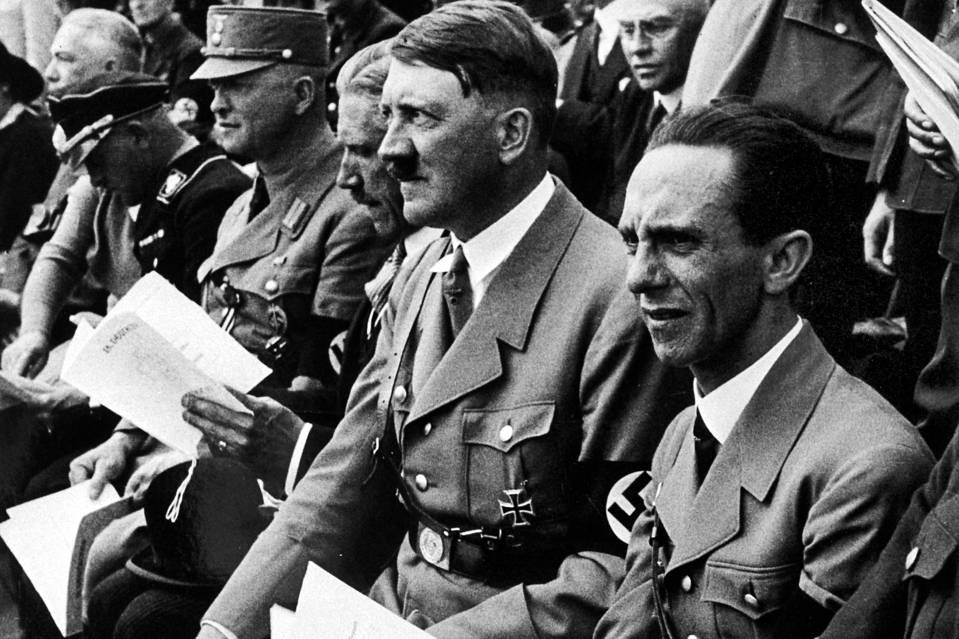
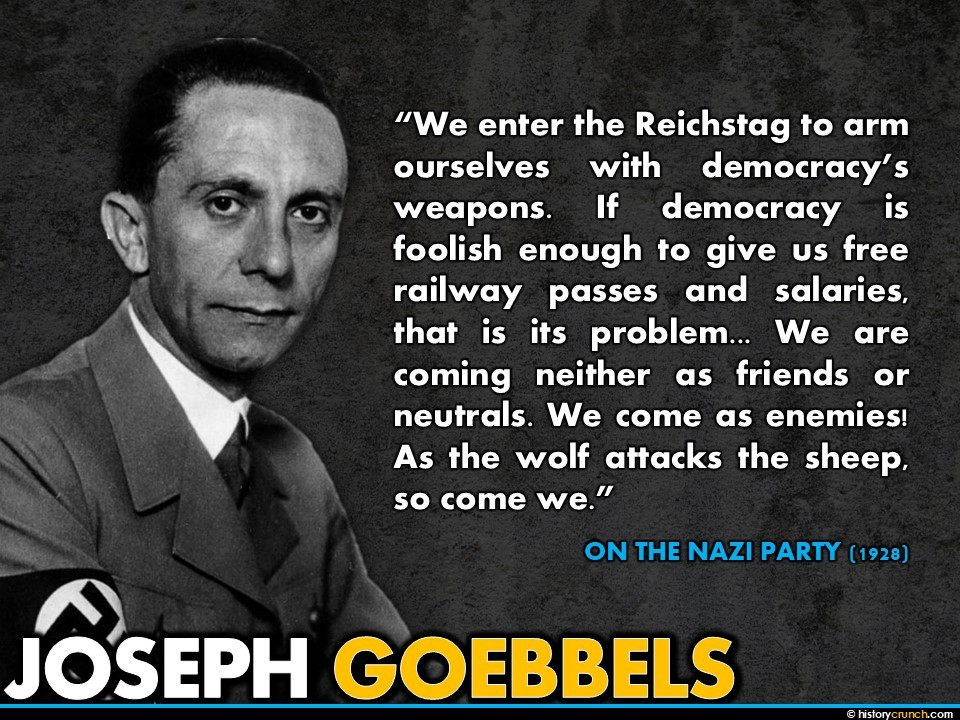
Highly repressive movements, such as fascism and communism, sometimes came to power via democratic channels. From the fascist or Nazi Joseph Goebbels (1897-1945), we have a quote in which he sarcastically draws attention to this. Goebbels said in 1928:
“We are an anti-parliamentarian party that for good reasons rejects the Weimar constitution and its republican institutions. We oppose a fake democracy that treats the intelligent and the foolish, the industrious and the lazy, in the same way. We see in the present system of majorities and organised irresponsibility the main cause of our steadily increasing miseries. So why do we want to be in the Reichstag?”
To this question Goebbels gave the following answer:
“We enter the Reichstag to arm ourselves with democracy’s weapons. If democracy is foolish enough to give us free railway passes and salaries, that is its problem. It does not concern us. Any way of bringing about the revolution is fine by us.”
He continued:
“We are coming neither as friends nor neutrals. We come as enemies! As the wolf attacks the sheep, so come we. You are no longer among your friends! You will not enjoy having us among you!”
In other words, Goebbels made it clear that although he was using democracy to enter parliament, once there he would not hesitate to abolish that parliament. So if the Nazis were in parliament, they would ban other parties and thereby end democracy. Like a wolf among the sheep. And those stupid sheep did not see it coming. What Goebbels advised in the 1930s was therefore: come to power through democratic means and then abolish democracy. This Goebbelsian tactic is also referred to as “One man, one vote, once” (or “one person, one vote, one time”).
Militant democracy as an answer to the Goebbels dilemma
To counter this, the concept of “militant democracy” was developed, among others by the Dutch constitutional scholar George van den Bergh (1889-1960). In 1936, van den Bergh gave a lecture in which he discussed the Goebbelsian problem at length. The title of that lecture was, very aptly, “What to Do with Anti-Democratic Parties?” What to do, then, with parties that had announced in advance that they would behave as Goebbels described in 1928. Van den Bergh’s answer was: such parties may be banned.
Here is van den Bergh’s lecture: Van den Bergh, George, “The Democratic State and the Non-Democratic Parties”, Oration, given upon the acceptance of a professorship at the University of Amsterdam on 28 September 1936, by Dr G. van den Bergh. His motive was that a democracy should be allowed to defend itself against movements or parties that seek to abolish it. “Democratic suicide” should be rejected.
Not only do fascist parties use the Goebbels tactic
How should we view van den Bergh’s position that a democracy may protect itself against democratic suicide? Many people understand this, I think. The problem, however (and this brings us to the core of what I want to argue in this article), is that people today think that the danger of abolishing democracy through democratic means comes only from fascist or Nazi parties. And that is not the case. At least, it is not the case that the parties we nowadays often label as “fascist” or “Nazi” — parties also referred to as “far-right” or “radical right” — constitute the most important problem for contemporary democracies.
Let me place this in a broader historical perspective. After the Second World War, when the Nazis were defeated, other anti-democratic movements came to the fore, namely communism. And communism also tried to gain power in Western countries by infiltrating democracies. The Goebbels dilemma arose again: what to do? Should communists be allowed to abolish democracy through democratic means? Should communist parties be allowed to abolish parliamentary democracy and replace it with what communists call the dictatorship of the proletariat?
The answer Van den Bergh gave regarding the Nazis can also be given regarding the communists. Just as a Nazi party could be banned in the 1930s, a communist party could also be banned in the 1970s. But just as Nazism was eventually defeated, so too was communism. The fall of the Berlin Wall in 1989 can be taken as a marker, or 1991, when the Soviet Union collapsed. Were all challenges to democracy then over in 1989? Had democracy overcome all anti-democratic forces? For a short time this was thought to be the case, including by Francis Fukuyama, who wrote an interesting essay on the subject (in 1989) that he later expanded into a book. What Fukuyama had missed, however, was that in 1989 an Iranian statesman and cleric issued a fatwa (death sentence) against the British writer Salman Rushdie. That fatwa stemmed from a new way of thinking, a new ideology. It is referred to as “Islamism”: a political expression of the religion of Islam. Khomeini was thus an Islamist. After 1989, Islamism developed as the most important anti-democratic force in the world. In short, Islamism aims to replace democracy with a theocracy, as Hamid Zanaz describes in L’impasse islamique: la religion contre la vie (2015). Khomeini also had a major influence in strengthening Islamism as a political force after he came to power in the Iranian Revolution of 1979, as described by Amir Taheri in The Persian Night: Iran under the Khomeinist Revolution (2009). This overthrow of democracy can be done in two ways: first, through violent actions. That is the path of jihadism. Jihadists are people who, through violent terrorist actions, try to destabilise Western democracies to the point of collapse. The second path is the peaceful one. Namely, through peaceful infiltration into Western democracies, first gaining support before attempting to abolish democracy — that is, replace it with a theocracy — as Bassam Tibi describes in Islamism and Islam (2012). The question that arose about the Nazis, and then about the communists, now arises about the Islamists. That question is: should we make room in democracy for the theocratic aspirations of the Islamists? Should Islamists be given equal political rights, with the risk that they may ultimately abolish democracy?
If one is looking for the contemporary equivalent of Goebbels from the 1930s, one should arrive at jihadism/Islamism. Hamed Abdel Samad rightly points this out in his book Der Islamische Faschismus (2014).
The Muslim Brotherhood as the vehicle of Islamism
Let us now look at the carriers of that Islamism. I already pointed to Khomeini. But one can also think of organisations. The organisation that puts the jihadist/Islamist ideology into practice and tries to gain ground is the Muslim Brotherhood. The EU is totally blind to this infiltration. As is argued in a recent article on this: while the Muslim Brotherhood is infiltrating European democracies, the EU spends millions to combat “islamophobia” and “populism”: Michiels, Filip, “While the Muslim Brotherhood Continues to Infiltrate, the EU Spends Millions Investigating ‘Islamophobia’ and ‘Populism’. Or, for those who want more detail: Frères musulmans et islamisme politique en France.
The Muslim Brotherhood (Arabic: al-Ikhwān al-Muslimūn) was founded in 1928 by Hassan al-Banna in Ismailia, Egypt. Hassan al-Banna (1906–1949) was an Egyptian teacher and Islamic activist. The Muslim Brotherhood is regarded as one of the most important organisations keeping Islamist resistance to secular democracies alive.
Islamism is therefore the most important contemporary challenge to democracy. Not fascism. Not communism. But Islamism.
How do we know that Islamism and Jihadism are so influential?
We can deduce this from the number of terrorist attacks carried out in the EU by jihadists. Jihadism is factor No. 1 for European attacks (24 attacks). Not “the far right” (1 attack).
Europol recently published a report on terrorist attacks in 2024. It also specified the backgrounds of those attacks. Those backgrounds were:
Source: Europol, European Union Terrorism Situation and Trend Report.
It is important to look at these European figures, not only those of the AIVD for the Netherlands, because, given the EU's open borders, everything that happens abroad is also relevant to the Netherlands. The influence of the Muslim Brotherhood in France (alarmingly large, according to a recent report: République Française) is therefore highly relevant to the Netherlands as well.
All this means that Europe is currently in a fatal misdiagnosis. Across Europe, so-called “far-right” or “radical-right” parties (PVV and FvD in the Netherlands, AfD in Germany) are being opposed. In other words, people think the danger comes from the parties that constituted the main challenge to democracies in the 1930s with the Nazis. But it may well be that future danger will come from other ideologies and forces. The Dutch writer Gerard Reve (1923-2006) wrote in a letter of 20 October 1971 to Simon Carmiggelt (1913-1987): “Do you know what Professor Jacques Presser said to me twenty-four years ago: ‘The new fascism will call itself anti-fascism.’” It is perhaps an apocryphal statement, and it appears to have no basis in the written work of the Dutch historian Presser (1899-1970). But Reve knew Presser personally, and it may be based on private conversations. Be that as it may, what matters is that the kind of challenge the Nazis posed to democracy in the 1930s is today being posed by other ideologies. In my view, that is the case. So, let me recapitulate: in the 1930s, Nazism and fascism were the main challenges to democracy. After the Second World War it was communism. And since 1989 it has been Islamism.
The same point regarding Islamism is made by the American public intellectual Sam Harris in a Substack contribution titled “Why I Won’t Debate Critics of Israel” (5 June 2026). Harris writes there: “I think militant Islam is ten times worse than you think it is. When I talk about ‘jihadists’ and their various groups – Hamas, Hezbollah, al-Qaeda, the Islamic State, the IRGC, etc. – I’m talking about people who I consider to be worse than Nazis (jihadists being, essentially, Nazis who are certain of Paradise).
When this point is made to someone on the left side of the political spectrum, the reaction is often: “Oh, so you’re saying all Muslims are Nazis?” Or, “Oh, so you’re saying the entire Islam is Nazi?” Harris, however, claims neither the first nor the second. He is talking about jihadists. Of course, there is a relationship between jihadists and Islam, and much could be said about that. But in the first instance Harris is talking about jihadists, and that is where the conversation must begin. Jihadists are Nazis who are convinced of (i) Paradise and (ii) that they will go there if they fall in their holy war against the secular democracies whose representatives they are prepared to liquidate. Preferably liquidate in an authentic way, such as by beheading.
How Islamism can be stopped
How can Islamism best be stopped in its advance through the world? Fascism was stopped in 1945 by military confrontation. An alliance of the Western world and communism (Russia) defeated Nazism on the battlefield. How was communism stopped in its advance? This happened mainly in a confrontation between Russia and the Western world on the economic front. Communism collapsed in 1991 simply because it went bankrupt. Fortunately, it did not escalate into a military clash between America, as the leader of the Western world, and Russia, the main communist superpower. The question now is how Islamism can best be combated. We must hope that this can be done through ideological confrontation. Non-Islamist parties will have to explain that non-Islamism is preferable to Islamism. In other words, in a culture war.
Two sides then stand opposite each other. On one side, the Muslim Brotherhood and intellectuals who defend the agenda of the Muslim Brotherhood, such as the now disgraced Tariq Ramadan. On the other side, the defenders of a secular democratic rule of law, such as Douglas Murray, Ayaan Hirsi Ali, Bassam Tibi and others.
But we can also look at explicit political parties that defend the perspective of a secular democratic rule of law against an Islamist theocracy. When we do that, a striking divide emerges. The divide between parties associated with the “right” and parties associated with the “left.” Strikingly, on the “left”, one now finds few defenders of the secular democratic rule of law. Parties on the right side of the political spectrum mainly defend the secular democratic rule of law. Parties on the left side of the political spectrum often support Islamism. In French, this is called islamo-gauchisme: “Islamo-leftism is the most important new ideology of our time”.
PVV, FcD, AfD
The parties most actively combating Islamism in my country, the Netherlands, are the PVV and FVD. In Germany, it is the AfD that is most active in combating Islamism. But a paradoxical process is now occurring. The mainstream political parties do not praise these parties for their resistance to Islamism, but criticise them. How “criticised”? Paradoxically, by linking these parties to Nazism and fascism of the 1930s. The PVV, FvD and AfD are said to be “far-right” or “radical-right” parties against which democracy should be on alert. And not only warned. There is increasing pressure to ban these parties. In other words, it is pretended that these parties are the problem. The instrument of militant democracy (van den Bergh) is not being used against Islamism, but against these parties that are precisely fighting Islamism.
Combating the PVV, FVD and AfD through the normal political process is proving very difficult. The AfD is rising in the polls in Germany. In the Netherlands, the PVV and FVD are rising. The incumbent political class is watching this with dismay and is now fantasising about party bans.
If that were to succeed, it would be disastrous. After all, the only parties now fighting jihadism/Islamism are precisely these parties. If you silence the parties that fight Islamism/jihadism, that would be fatal for the outcome of the culture war that must be waged against Islamists. If these parties were banned, the Muslim Brotherhood could continue undisturbed in preparing the revolution and further undermining Western democracies according to the Goebbels tactic.
What is also disturbing is that the mainstream media, such as the BBC in England or the National Broadcasting Corporation in the Netherlands, fully support the political establishment. That is to say: everywhere the fight is being waged against what is called “the far right” or “radical right,” while Islamism/jihadism is being downplayed everywhere.
Literature: