One of the greatest misunderstandings of our time is that the debate on Israel, antisemitism, and Islamism is still being conducted as a debate. It is not. The war has already begun. Not with tanks rolling through Europe or with armies crossing borders, but as a cultural war playing out in our universities, media, professional organisations, trade unions, schools, hospitals, and political parties.
By Oscar Hammerstein
Some will even say that it is a religious war. Not because every Muslim is participating in it, far from it, but because part of the battle is being fought from a religiously inspired ideology that does not view itself as one opinion alongside other opinions, but as an alternative model of civilisation.
While many Jews, liberals, and defenders of the democratic rule of law continue to appeal to facts, logic, consistency, and equal standards, their opponents are playing a completely different game. They are not trying to win an argument. They are trying to conquer institutions. That difference is fundamental.
When a Jew wonders why Israel is treated in medical journals, at universities, or within international organisations according to standards that are never applied to China, Iran, Syria, Qatar, or Turkey, he assumes that fairness and consistency are relevant. But what if the activists involved are not interested in fairness or consistency at all? What if their goal is not truth, but influence? Then the world suddenly looks very different.
Throughout the West, we see the same pattern. Not one large movement, but hundreds of small groups. Not one central organisation, but a network of activists who reinforce one another. They operate within football clubs, trade unions, universities, hospitals, political parties, media, and professional organisations. Their objectives often seem modest.
A huge Palestinian flag at a football match. A nurse with a watermelon badge. An anti-Israel resolution within a trade union. One article in The Lancet. An activist on a university board. A speaker at a conference. A training day for lawyers titled *Pleading for Palestine*, accredited by the Bar Association.
In themselves, these seem like insignificant events. But collectively, they form a strategy. Every flag, every badge, every motion, every publication, and every course sends out the same signal: we are everywhere. And that signal is often more important than the actual numbers.
For societal influence is not determined solely by how many people you represent. It is determined by the question of how many prestigious institutions repeat your message. An article in a top medical journal has more impact than a thousand demonstrations. A university has more authority than an action group. A professional organisation has more influence than an activist. That is precisely why these institutions have become the target.
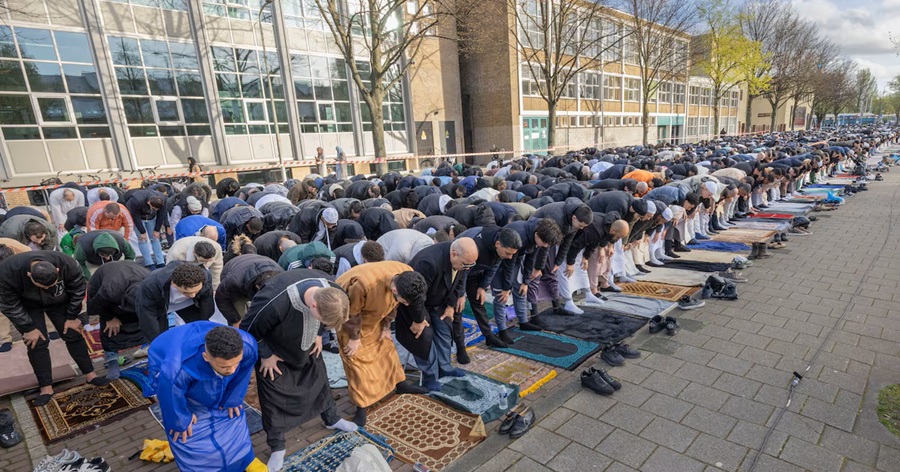
Take the continuous street prayers in cities like Rotterdam and Amsterdam. To outsiders, they might appear to be exclusively a religious expression. But they also have a political dimension.
They demonstrate presence, visibility, and self-confidence. They show politicians that an organised electorate stands here. They show supporters that the movement is growing. And they show opponents that the social landscape is changing.
The same applies to the long series of anti-Israel campaigns within universities, medical journals, cultural institutions, and professional organisations. Time and again, we see the same message coming at us from different directions. And time and again, the opponents respond with facts. That is understandable. But facts do not win a power struggle when the other party has no interest in facts at all.
The Islamist movement understands something its opponents often forget: institutions are more important than arguments. Whoever owns the university influences the students. Whoever owns the medical journal influences the doctors. Whoever owns the trade union influences the employees. Whoever owns the professional organisation influences the professional group.
And whoever influences enough institutions ultimately influences society. This is precisely why so many people feel that the West is slowly changing character. Not because one major revolution has taken place, but because thousands of small shifts point in the same direction.
A flag here. A boycott there. A resolution. A course. An appointment. An editorial board. A student association. Each step seems insignificant. Together, they change the cultural landscape.
That does not mean that every critic of Israel is an Islamist. That would be an absurd conclusion. Many people act out of genuine concern or humanitarian convictions. But it does mean that Islamist activists have proven extraordinarily effective in using broader progressive movements as a vehicle for their own agenda.
That is where their success lies. While their opponents debate definitions, footnotes, and resolutions, they patiently continue to build their position within committees, editorial boards, universities, political parties, and civil society organisations. One article. One flag. One course. One board position. One generation of students at a time.
That is why so many people today feel that the world around them has suddenly changed. In reality, that change did not happen suddenly. It was prepared for years, not by millions of people, but by small groups of activists who understood that the road to societal power does not run through the barricades, but through the institutions.
The great question of our time is therefore no longer who has the best argument. The great question is which model of civilisation will ultimately prevail. The liberal West, built on freedom of speech, individual rights, separation of church and state, and equality before the law? Or an ideology that views these values as obstacles to be overcome?
Anyone who looks honestly at the developments of the past twenty years must be prepared to face at least one uncomfortable thought: perhaps we are no longer living in the run-up to a cultural confrontation.
Perhaps we are already in the midst of it.