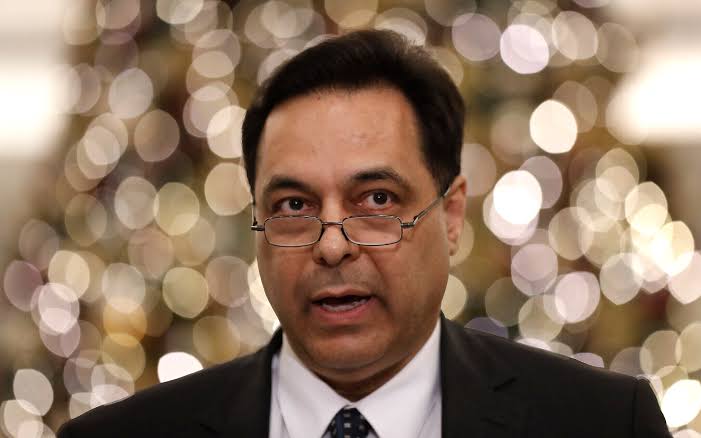
Lebanon’s caretaker Prime Minister, Hassan Diab, broke his silence on Saturday to condemn days of violent protest in Tripoli, the country’s most impoverished city, as “an assault on the state and its integrity.”
“Everyone who participated in the riots will be arrested,” Diab said.
His comments followed deadly clashes during the week when protests at Lebanon’s extended coronavirus lockdown and worsening economic crisis turned violent.
Frustrations boiled over after 30-year-old Omar Taibi was shot by security forces during protests. The ensuing clashes left more than 220 people injured.
Protesters set fire to several buildings in Tripoli on Thursday as outrage grew.
Violence escalated quickly as molotov cocktails, hand grenades and stones were launched at the security forces, who responded with tear gas, rubber bullets and then live ammunition.
However, that did not deter others from expressing their outrage with the caretaker government as protests spread to other parts of the country.
On Saturday, groups of female protesters blocked the highway linking Tripoli, Lebanon’s second-largest city, with Akkar. The women complained that they were no longer able to secure basic needs for their families.
SPEEDREAD
The political dispute between Saad Hariri and the Free Patriotic Movement, led by Gebran Bassil, worsened on Saturday as both men swapped accusations.
Another group of protesters marched to the Beirut home of Mohamed Fahmi, Lebanon’s interior minister, to voice their anger at the security forces’ handling of the Tripoli protests.
A shooting in Beirut’s Hamra commercial district late on Saturday sparked fears of worsening violence in the capital.
However, security forces described the attack as “an isolated incident.”
A security source told Arab News: “The problem started between a delivery driver and one of the residents. Young men from the Syrian Social Nationalist Party interfered and defended the Syrian delivery driver, then started shooting into the air.”
After nearby residents appeared on the street, troops arrived and cordoned off the site, the source said.
Meanwhile, former prime minister Fouad Siniora, the leader of the Future Movement’s parliamentary group, warned that the violence in Tripoli has deepened Lebanon’s political divisions, making the formation of a rescue government even more difficult.
“The most dangerous thing about the current situation is the inability of the political forces to take initiative in determining a national rescue destination,” he said.
“Every sectarian party is waging two battles: A fierce internal battle to impose itself as its sole representative, and a grinding battle against other sects to identify the sect’s quota in the government.”
The political dispute between Saad Al-Hariri, Lebanon’s prime minister-designate, and the Free Patriotic Movement (FPM), led by Gebran Bassil, worsened on Saturday as both men swapped accusations.
Bassil urged Al-Hariri to “head immediately to the Baabda Palace and form a government in agreement and full partnership with the president — a government that enjoys broad political and national support.”
The FPM described the demand for partnership in the government formation as “a right.”
However, the Future Movement responded later, accusing the FPM of “reducing the rights of Christians to the rights of a few men.”
Source: