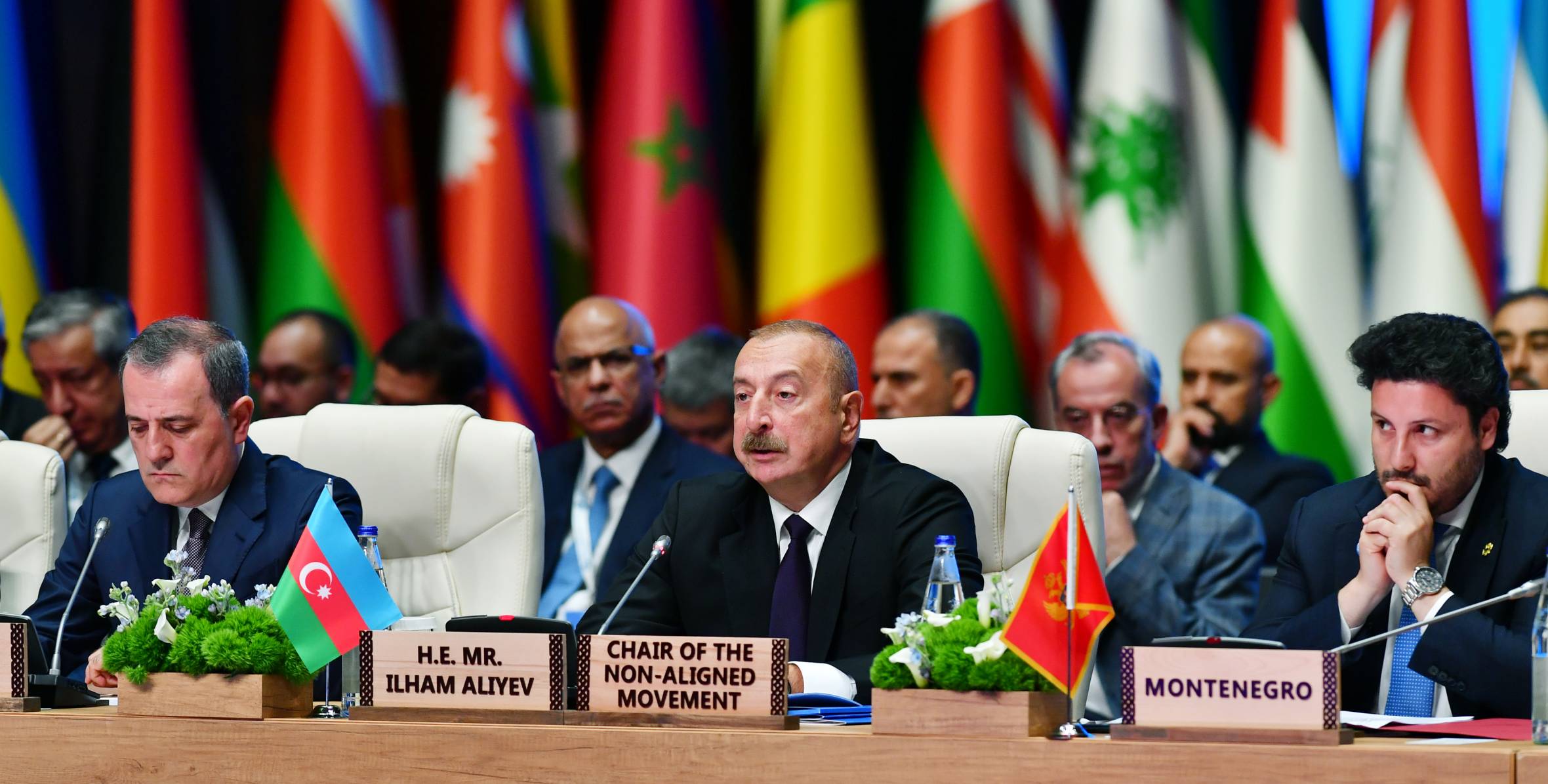
Azerbaijan’s decisive military victories in the Second Karabakh War (2020) and the Anti-Terror Operation (2023) concluded a three-decade-long conflict, liberating around twenty per cent of its formerly occupied territories from Armenian forces. These successful military triumphs transformed Baku’s regional role, shifting from passive non-alignment to “Active Non-Alignment” (ANA), which proactively leverages great-power rivalries to assert sovereignty and regional leadership.
By Farid Shukurlu and Joseph Shumunov
|Traditionally, non-alignment policies emerged during the Cold War, focusing on avoiding military alliances and bloc conflicts to advance national interests. However, Azerbaijan adopted this strategy with its accession to the Non-Aligned Movement (NAM) in 2011.
Following the Second Karabakh War, Baku shifted its foreign policy toward ANA, with initiatives such as the Middle Corridor and the inauguration of the Trump Route for International Peace and Prosperity (TRIPP) gaining prominence. Azerbaijan seeks to balance its ties with rivals to secure benefits, reduce dependence, and enhance multilateralism, as most Latin American and East Asian states do.
This assertive yet pragmatic policy is implemented at three levels: neighbourhood, regional, and systemic.
Neighborhood Dynamics
Geographically, Azerbaijan is situated in a challenging neighbourhood, where it must balance its relations with Turkey, Russia, Iran, and Armenia through assertive realism. Baku’s victory in 2020 enabled Azerbaijan to realise the “one nation, two states” concept through the Shusha Declaration, formalising an alliance between Azerbaijan and Turkey.
Such positive steps also marked the establishment of numerous defence and energy projects, such as exporting 1.2 bcm of gas annually to Syria via Türkiye’s Kilis-Aleppo pipeline in 2025. Azerbaijan also tried to diversify and deepen its ties with Moscow through a 2022 allied declaration, then used the distraction of the Ukraine War to secure the withdrawal of Russian peacekeepers from Karabakh, thereby derailing its regional hegemony.
Iran’s historical hostility did not cease after Azerbaijan’s victories and its ever-growing popularity in the East and West Azerbaijan provinces of the country. The Islamic Republic continued to oppose the Zangezur Corridor, rebranded as TRIPP. Still, it faced Azerbaijan’s confident neutrality, bolstered by closer, renewed ties among Azerbaijan’s close friends, Israel, Turkey, and Pakistan.
At the same time, Armenia transitioned from an adversary to a negotiating partner, as demonstrated by the Prague talks (2022), village returns (2024), and an American-brokered peace initiative at the White House (2025) that ultimately led to the dissolution of the OSCE Minsk Group, formally on 1 December 2025.
Regional Influence
Baku has formed a unique Arab–Israel–Azerbaijan triangle while consolidating the Organisation of Turkic States (OTS) by playing a pivotal bridge-building role between Turkey and Central Asian countries. The Jewish state’s military assistance proved vital in Karabakh, leading to the opening of Azerbaijan’s embassy in Tel Aviv (2023) after Iran conducted military drills close to the Azerbaijani border and issued threats.
Both countries acted in good faith during the Karabakh and Gaza wars, with Baku providing Jerusalem with energy and Israel supplying Azerbaijan with necessary equipment. President Trump’s return to the White House also resolved disagreements with Baku. At the same time, Arab engagement surged with Al Shaara’s state visit to Baku for natural gas deals (2025), the UAE’s renewed partnership with Azerbaijan, and Qatari involvement in military exercises in Azerbaijan.
Within the OTS, Azerbaijan emerged as an effective deal-maker through post-2020 projects such as the Common Alphabet and the Investment Fund, positioning itself as a Middle Corridor hub that rivals Russia and China in Central Asia within the Silk Road region.
Systemic Hedging
Azerbaijan pursues multivector hedging in a fragmenting order. In the post-war period, it has managed to strengthen strategic ties with the West, as Trump suspended Section 907 (2025), enabling aid. The EU doubled gas exports via the Southern Gas Corridor in response to Russian aggression against Ukraine, underscoring Azerbaijan’s importance and reliability as an energy supplier.
Russian influence plummeted after they shot down an Azerbaijani passenger aeroplane. At the same time, the Chinese Belt and Road Initiative was aligned with a 2025 Strategic Partnership Agreement and SCO dialogue status, with routes crisscrossing Baku.
Keystone Power Projection
Despite being relatively modest in size, Azerbaijan is now punching above its weight, negotiating from a position of confidence after two decisive victories against separatists. The restoration of its territorial integrity allows Baku to act as an emerging middle power, with projects such as TRIPP and a peace treaty on the horizon.
Baku has become indispensable for trade stability, mediation, and normalisation efforts between Israel, Turkey, and the Arab world. As Hikmat Hajiyev noted, “Azerbaijan won the war, and now Azerbaijan is winning the peace. This ANA doctrine, economically sustainable and politically diverse, ensures that Baku shapes norms amid great-power retrenchment.
NOTE:
The original article, "Azerbaijan’s Active Non-Alignment: How Baku is Pivoting to Greater Power," was authored by Farid Shukurlu and Joseph Shumunov and published in the Baku Dialogues Journal (9 December 2025).