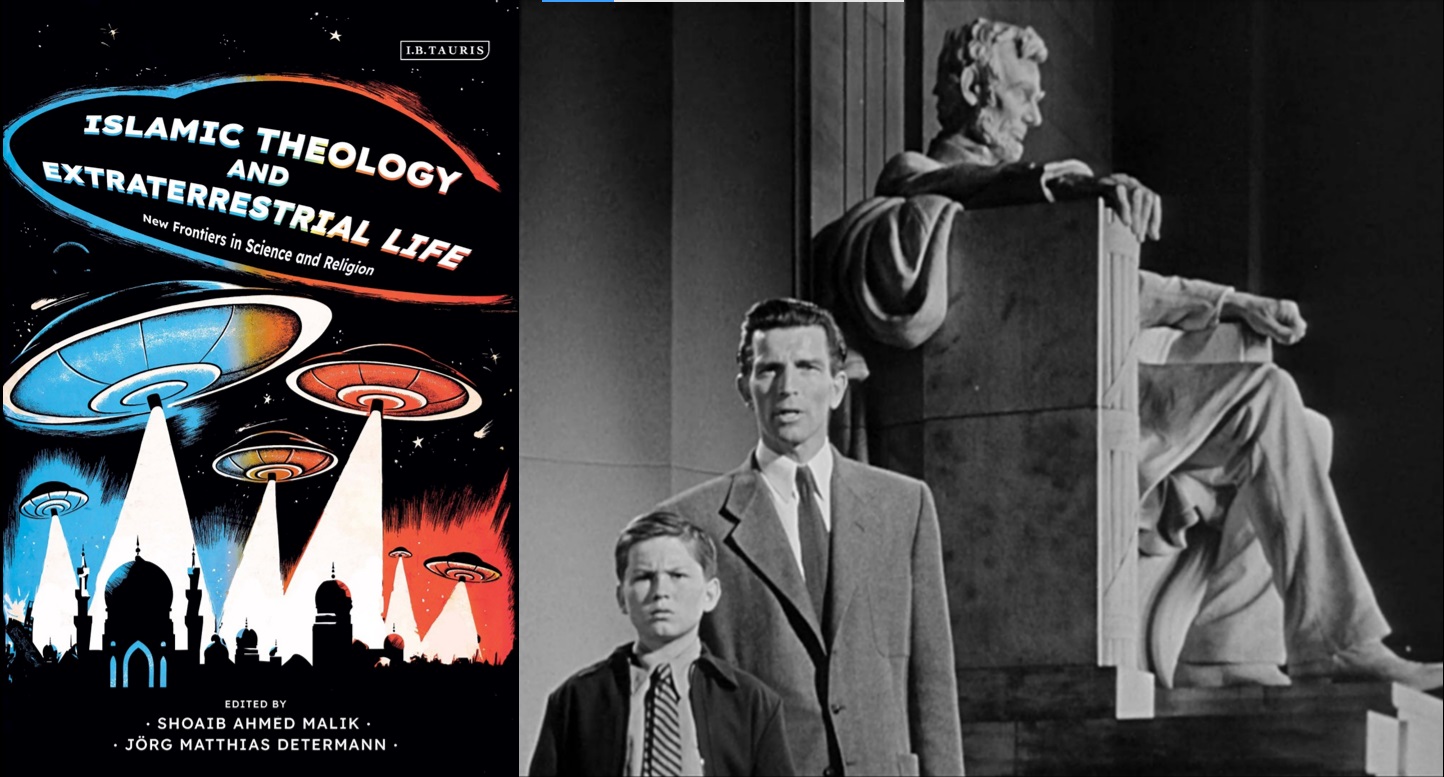
This is a long-overdue book review, to my considerable shame, since I’m an actual contributor to this supremely enlightening book by Jörg Matthias Determann and Shoaib Ahmed Malik. It’s fully titled Islamic Theology and Extraterrestrial Life: New Frontiers in Science and Religion (I.B. Tauris, 2024).
By Emad Aysha
I’ve written about exotheology in Arabic SF before on these pages, and I’m glad to say my suspicions were well-founded. It isn’t just that Egyptian and Arab and Muslim SF authors are open-minded about the existence of extraterrestrials; they’re downright eager for it to happen. And this doesn’t come out of a vacuum.
Islamic scholars throughout most of our history have been open-minded about it. The book consists of nine chapters and an intro by the two abovementioned editors. (My chapter is on exotheology in Egyptian SF, with some comparisons.)
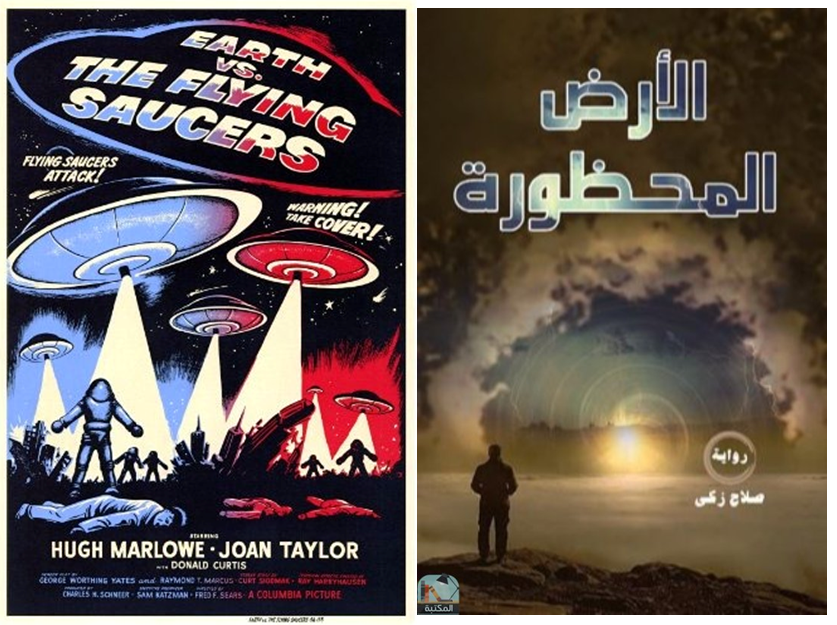
SIMIAN SIMILARITY: Classic poster for 'Earth vs. the Flying Saucers' (1956) [provided by Dr Determann] juxtaposed to the previously reviewed novel 'The Forbidden Zone' by Salah Zaki [right].
The main chapters that deal with how Muslim clerics, theologians, and jurists dealt with these apparently controversial questions are:
(2) “Does the Qurʾān Affirm Extraterrestrial life? A Hermeneutic Analysis of the of Sūrat al-Naḥl (Q. 16:8)” by Moamer Khalayleh
(3) “Islamic Sacred Resources on Extraterrestrials and Their Possible Eschatological Implications” by Mohammad Mahdi Montasseri
(4) “Extraterrestrials and Moral Accountability: Nonhuman Moral Personhood through the Lens of Classical Sunni Theology and Law” by David Solomon Jalajel
(5) “Classical Muslim Thought and the Theological Implications and Possibility of Non-Human Entities Bearing Higher Intelligence” by Faisal Abdullah
(6) “Extraterrestrial Intelligent Life and Islamic Beliefs: Investigating Six Potential Conflicts” by Shoaib Ahmed Malik
(7) “The Alien in the Lamp? The Jinn and Alien Life in Islamic Theology” by Richard Playford
My personal favourite is chapter 5, but the consensus view is essentially the same throughout. Something that has always befuddled Quran scholars are verses that hint at the existence of animals in the heavens and the possibility of morally accountable, sentient, intelligent beings who walked the earth before man.
All those who are accountable are bunched together on the Day of Judgment, not just man and the jinn. Not to mention discounting the supposed centrality of man as the ultimate in God’s creation, since he is only ‘of’ the best of his creations.
Some scholars did see man as the most blessed of beings because of freewill, in contrast to the animals and angels, true enough. Still, the Quran contains admonitions that, if God wanted to, He could create a better breed of being through the simple progression of generations.
The Quranic verses listed here are the same verses that have haunted and inspired the imaginations of so many of our authors, not least Dr Hosam Elzembely, founder and director of the Egyptian Society for Science Fiction.
On one occasion, Dr Elzembely went as far as describing the flight of the Prophet Muhammad to the heavens involving a kind of wormhole warpage of space-time, citing the Quranic phrasing itself – ‘folding’.
Then there are Hadiths, disputed in origin, that quite explicitly state that there are other beings in the universe who are better than us, not knowing of either Adam or Iblis (Satan). Better yet, these beings communicate across the reaches of the universe through ‘pillars of light’ (pp. 16, 82, 95)!
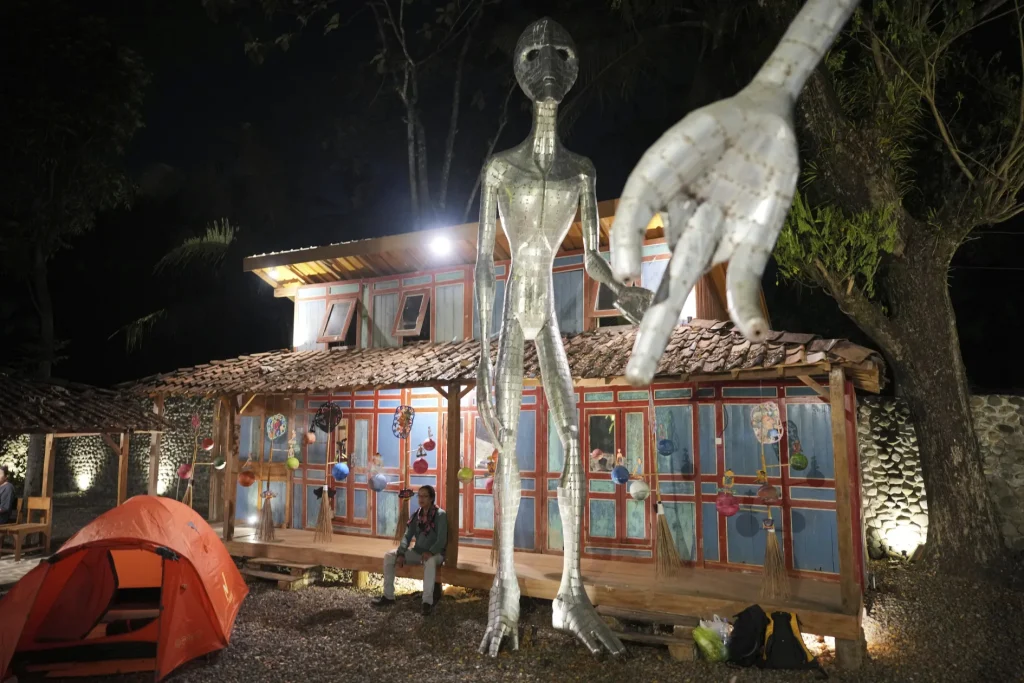
WELCOME PARTY: Alien effigies at the 'Indonesia UFO Festival', held at Yogyakarta, Indonesia on Thursday 24 July 2025.[AP Photo/Dita Alangkara]
Then there is chapter (8) “A Qurʾānic Ufology? Seven Exotheological Hypotheses of the Indonesian ‘Islamic UFO’ Community” by Ayub and Ilham Ibrahim. They have a crop circle controversy in their history, along with UFO sightings, well-developed UFO groups and their own breed of ancient astronaut theories.
They also cite the same Quranic verses, wondering why the angels disagreed with God over making man into the vice-regent on earth. How could they possibly have known man would corrupt the land and spill blood, if only Adam existed?
It could be that generations of men existed before one school, or that man had been created with the universe itself, and so developed amazing technologies that fouled up the earth, another view. If there are ancient astronauts, they may have been humans all along, travelling to the stars after being banished from Earth.
Indonesian researchers cite the descendants of Noah’s son, Japhet, as having anti-gravity technology and compare the Biblical figure to similar-sounding myths—namely, Japetus in Greek mythology and the Nepalese mythology of Javana (pp. 186).
The more conventional school is that the angels were worried man would be like the jinn, who were also banished for their arrogance and incredible powers – beings with intelligence, free will, and even religion.
Reading the book was a thrill, awakening the intellectual and spiritual adventurer inside me, long forgotten. For instance, as a kid, I never imagined paradise being above with hell being below, in the bowels of the earth.
It didn’t seem correct for a part of the afterlife to be below, in this life. Instead, I imagined it to be right next to paradise. (That whole way of thinking itself is pagan, from Hades, the Greek ‘underworld’).
Islamic scholars in the past had similar speculations because of the belief in seven heavens and the possibility of seven earths. Hell was in the lower earth, true enough, but when you go to a hotel and get a suite, it can be on the same floor as a regular room.
Some readings of Islamic theology have parallel earths, with Adams and Noahs existing side by side, as befits modern multiverse, alternate history, and parallel dimension theories. (Like the Salah Zaki novel above.)
I can add that the word earth or ‘ard’ (أرض) is probably not a reference to our world, but lands in the heavens, and so other planets. Ard is a generic term in Arabic, referring to our planet in the Quran, as well as to soil and territory (including wasteland).
What seemed to motivate these scholars more than theology or textual analysis was a deep desire not to be alone in the universe and to find beings capable of salvation. Either through conversion or by themselves.
These clerics were generous and selfless, not wanting the blessings of God (belief, moral accountability, entry into paradise) to be exclusive to humans. It seemed like a deeply selfish thing to them, and the same to our contemporary science fiction writers.
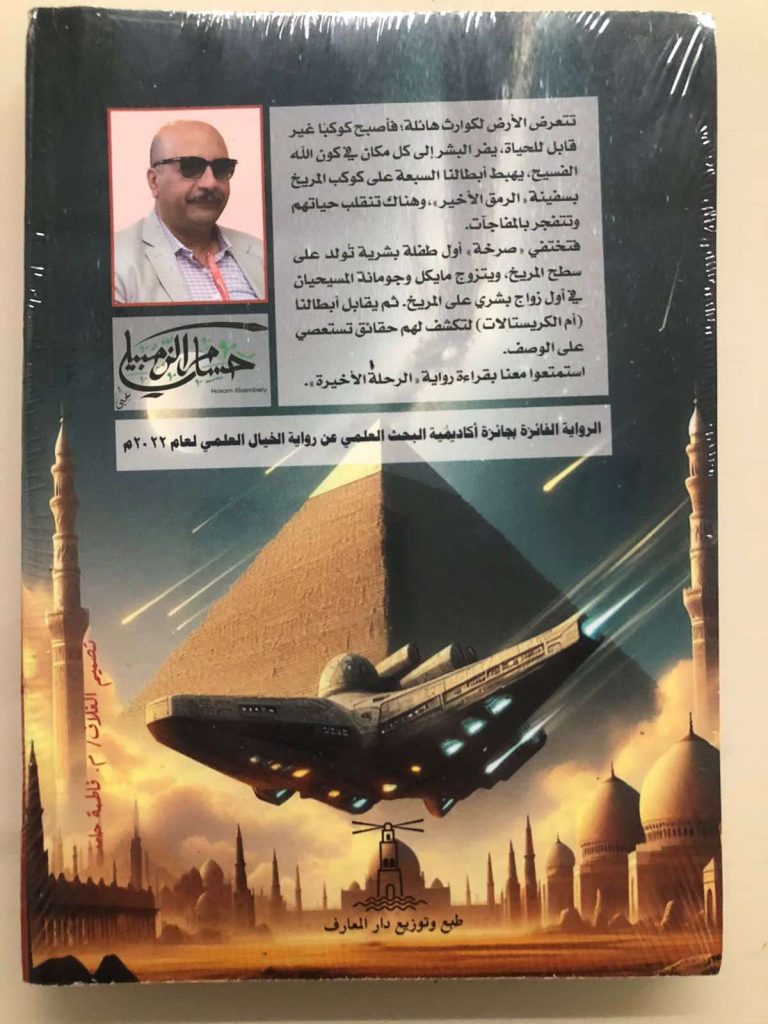
MONOTHEISTIC MELTING POT: This is the back cover of Dr Elzembely's 'Final Voyage' novel, set on Mars. Notice the mix of ancient Egyptian and Islamic Cairo imagery. The aliens in the story are believers in a Creator, as are the robots.[Image from Dr Elzembely's Facebook page]
We also have SF scenarios where the ancient Egyptians went into outer space. Our scholarly history might also explain why there seem to be prominent figures in the Catholic Church who believe in aliens. (Driven by the self-same redemption gut instinct?)
This dovetails with a new chapter contribution of mine in Saad Boulahnane’s Identity and the Dynamics of Border Crossing (IGI Global Scientific Publishing), pp. 315-338.
We don’t have an I/Other problem in Arabic SF. We’re all cosmopolitans at heart, and with a moral angle since our alien or robot enemies are of the ‘redeemable’ variety. And now, after reading this book, we know this was always true.