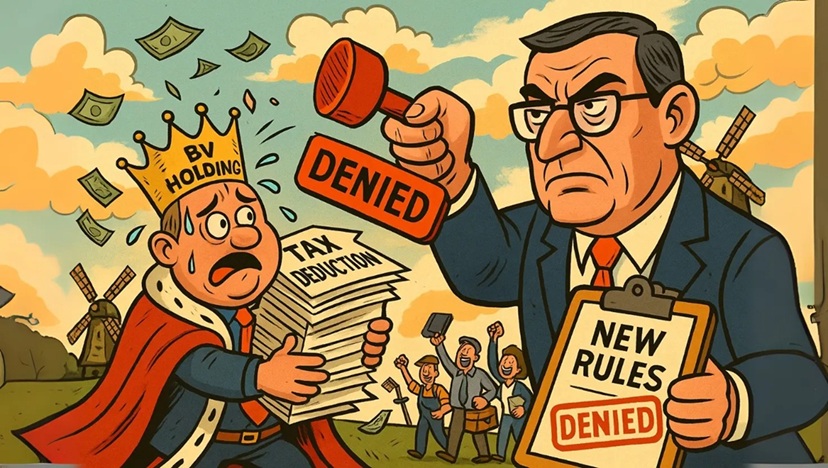
Nations rarely unravel through a single dramatic act. They erode when the foundations of trust, aspiration, and private security are gradually weakened in the name of fairness. In 2028, the Netherlands plans a 36 per cent tax on unrealised capital gains. The reform follows a 2021 ruling that found the previous system incompatible with property rights because it presumed fictional returns disconnected from reality.
The design appears technocratic and precise. A 36 per cent levy on actual annual returns. An exemption of roughly €1,800 per person. Losses are deductible against future gains above €500. Real estate and certain startup shares are taxed on realisation rather than on an annual basis. On paper, it appears to be an administrative refinement. In reality, it’s a structural shift in the moral architecture of the Dutch economy.
Dutch prosperity has long rested on a delicate equilibrium. From early joint-stock ventures in the seventeenth century to modern innovation corridors linking Eindhoven, Delft, and Amsterdam, it has been: private risk in exchange for predictable rules, personal thrift in exchange for long-term security, and moderate taxation in exchange for high-quality public goods.
Liberal governance in the Netherlands has never meant indifference to vulnerability. It has meant a disciplined state that protects property, enforces contracts, and refrains from undermining the base that finances collective ambitions. The proposed Box 3 regime crosses boundaries.
Taxing unrealised gains annually transforms the state into a co-owner of private balance sheets. When asset prices rise on paper, the treasury claims 36 per cent of that increase, regardless of whether liquidity exists! A family holding a diversified ETF portfolio for retirement may owe taxes on market volatility rather than realised income. An entrepreneur parking surplus capital in listed shares must either sell assets to meet the tax bill or divert cash from productive investment.
Macroeconomically, this matters. Capital formation underpins productivity growth and innovation. In an era defined by artificial intelligence, energy transition, geopolitical fragmentation, and demographic ageing, advanced economies compete on their ability to channel savings into high-risk, high-return ventures.
The Netherlands lacks the scale of the United States and the fiscal centralisation of China. It competes on reliability, rule of law, diversification, and a culture that rewards knowledge. Alter that calculus, and capital flows adjust quickly. Highly skilled migrants and globally mobile entrepreneurs compare tax regimes across jurisdictions.
The United States largely taxes capital gains at realisation. Several European countries offer more generous treatment for long-term holdings. If the Dutch system imposes an annual tax on unrealised appreciation at 36 per cent, it signals that the state claims priority over accumulated private prudence. The distinction between upper-class wealth and bourgeois security is blurred, decreasing fiscal sustainability.
The philosophical implications run deeper. Liberal democracy rests on a social contract. Citizens accept taxation in exchange for order, infrastructure, and shared goods. That contract presupposes boundaries. Property is not absolute but stable. When the state normalises annual claims on unrealised gains, ownership becomes conditional. Citizens become custodians of assets partially pre appropriated by political design.
Those who feel structurally expropriated disengage, relocate, or gravitate toward political extremes. Europe’s twentieth century offers sobering lessons about systems that subordinated private capital to moral narratives of equality! Such regimes expanded administrative control incrementally, each reform framed as rational and necessary. Illiberalism rarely announces itself loudly. It advances through procedural inevitability.
The Netherlands today faces real challenges. Climate adaptation demands investment. Artificial intelligence will displace certain jobs while rewarding those who own algorithms and data. Housing scarcity strains young people and families. Farmers face regulatory upheaval. Public discourse is increasingly polarised.
In such conditions, stability is essential. However imperfect, the current Box 3 framework still signals that future private accumulation remains legitimate. Remove that signal, and consequences may follow.
The Netherlands built its prosperity on trade, innovation, expertise in water management, and disciplined governance. It attracted talent by combining social solidarity with respect for private initiative. That equilibrium now faces strain. A 36 per cent annual claim on both realised and unrealised returns shifts the narrative from cultivating capital to steadily draining it.
A country can sustain high taxes if economic growth is strong and the rule of law is predictable. It struggles when policy signals suspicion toward the mechanisms that generate growth. The Netherlands stands at a crossroads. One path adapts liberal principles to modern realities, safeguarding property while ensuring fair contribution. The other normalises annual appropriation of paper gains, with potential consequences for capital mobility, social cohesion, and political stability.
The Netherlands may gradually hollow out. Capital moves. Talent moves faster. Commitment moves fastest of all when citizens are willing to assume risk and responsibility and conclude that their future lies elsewhere; the verdict becomes evident in economic data and demographic flows.
The constitutional decision now rests with the States General. In the Senate, deliberations will determine whether the reform can be enacted. In the House of Representatives, party leaders influence the broader direction of fiscal policy.
The outcome will shape more than a tax code. It will signal how the Netherlands balances fairness with freedom, redistribution with growth, and public ambition with private initiative.