April 4 was International Mine Awareness Day. For much of the world, it is just another regular day, or at best a moment of reflection, a calendar entry, perhaps a social media post. For Azerbaijan, it is something else entirely: a mirror held up to a reality that does not pause, does not yield, and does not forgive.
By Vasif Huseynov
Azerbaijan knows this day with particular intimacy. The country is living through the aftermath of a nearly three-decade-long Armenian occupation of its territories — an occupation that covered almost 20 per cent of Azerbaijan’s internationally recognised territories. Displacing up to 700,000 people from their historic homelands, and killing thousands of innocent civilians.
This unlawful occupation ended through military operations of Azerbaijan’s Armed Forces in 2020 and 2023.
In the following months and years, something historically rare unfolded. The two countries that fought bitterly for three decades have been, slowly but genuinely, making peace. On August 8, 2025, the two countries’ leaders – President Ilham Aliyev of Azerbaijan and Prime Minister Nikol Pashinyan of Armenia – met in Washington under U.S. mediation and initialled the text of the peace treaty, along with agreements on other key issues.
The symbolism was striking. Just a few months later, in February 2026, both leaders stood together in Abu Dhabi to jointly receive the Zayed Award for Human Fraternity. Pashinyan noted that only a few years ago, such a scene would have been unimaginable.
He was right.
Today, cargo trains carrying a variety of goods from third countries move through Azerbaijani territory to Armenia as a matter of routine. Azerbaijan exports petroleum products to Armenia. The two countries have exchanged lists of goods for bilateral trade. Energy grids may soon be linked.
In addition, they have launched a civil society dialogue within the program called “Peace Bridge Initiative”. Perhaps more importantly, for the first time since their independence in the early 1990s, their borders are at peace, with no clashes or casualties. The peace, in short, is real.
But peace, it turns out, is not the same as safety.
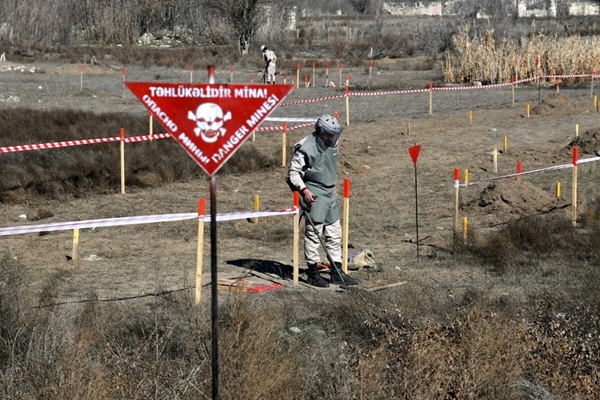
Beneath the liberated soil of Karabakh and the Eastern Zangazur region lies a different kind of war — one fought not with soldiers or artillery, but with 1.5 million landmines, silently waiting.
Armenian forces planted them across the formerly occupied territories of Azerbaijan during the occupation years, sowing them into farmland, roadsides, riverbeds, and the thresholds of homes that families once fled and now dream of returning to. They were not planted carelessly. They were planted strategically — to wound a future.
And wound it they have.
Since the ceasefire of November 2020, more than 400 Azerbaijanis — civilians, farmers, demining personnel — have been killed or gravely injured by mine explosions. These are not casualties of war. These are casualties of peace.
People who believed the danger had passed. Workers were clearing rubble so that someone's family could one day walk back into their village. Every explosion is a brutal reminder that the occupation did not end when the last soldier left — it merely changed form.
The numbers risk numbing us. So consider instead what they mean in human terms. A deminer loses his legs on a Tuesday morning. A family driving toward the home they have not seen in 30 years hits a mine on a road that looked, by every visible measure, like a road.
Thousands of people, including the author of this article and his family, who waited for three decades to return to their homeland, cannot yet set foot there without risking their lives. This is not a metaphor. This is the daily arithmetic of post-conflict Azerbaijan.
The physical destruction left behind by the occupation was itself staggering. The infrastructure was demolished. Forests cleared. Mosques — 65 of 67 in the region — were razed or desecrated. More than 400 cultural and religious monuments were destroyed, confirmed by Azerbaijan's Ministry of Culture. What was left behind was not merely a disputed territory. It was a scorched landscape engineered to be unlivable.
Azerbaijan has responded with ambition. Since the 2020 war until the end of 2025, the government has allocated over 22 billion Azerbaijani Manat (approximately $13 billion) toward reconstruction — building highways, railways, tunnels, three international airports, and entire new cities designed with smart infrastructure and green energy in mind. By the end of 2025, some 60,000 formerly displaced persons had returned to rebuild areas. Plans are in place to increase this number to 140,000 by the end of 2026.
But every kilometre of road built, every foundation laid, every plot of land prepared for a returning family must first be cleared of mines. And clearing them is neither fast nor cheap. International experts estimate the process could take up to 30 years and cost approximately $25 billion.
Armenia could not (or refused) to provide accurate minefield maps — a decision that, under any honest reading of international humanitarian law, constitutes a prolongation of harm if the Armenian government withdraws these maps.
The mines do not know the war is over. And without maps, neither do the deminers.
In January 2026, the Mine Action Agency of the Republic of Azerbaijan reported that 2,483.91 square kilometres of the liberated territories (8,780 square kilometres in total) had been cleared of landmines and other explosive materials since the end of the 2020 war.
Azerbaijan has received some international support for the mine action efforts. Germany, Belgium, Italy, China, and the UAE have contributed to these efforts. The European Union has brought its total demining contribution to approximately €23 million. These are meaningful contributions. Measured against the scale of contamination, they remain modest.
This is the uncomfortable paradox of this moment. The diplomatic architecture of peace is taking shape, with trade resuming, infrastructure advancing, and international awards being collected in Abu Dhabi. Yet the ground in Karabakh remains laced with weapons placed there deliberately, weapons that continue to kill and maim in what is now, formally, a time of peace.
Demining is not a technical footnote to reconstruction. It is its precondition. It is justice in its most elementary, physical form: the right of a person to walk on their own land without dying—the right of a family waiting for three decades to come home.
On this International Mine Awareness Day, the world is invited to look at Azerbaijan not as a post-conflict success story that has closed the file, but as a country still living day by day with the consequences of a conflict that headlines have largely moved past.
Peace is there. But so are the mines. Until they are gone, the consequences of the war are as well.