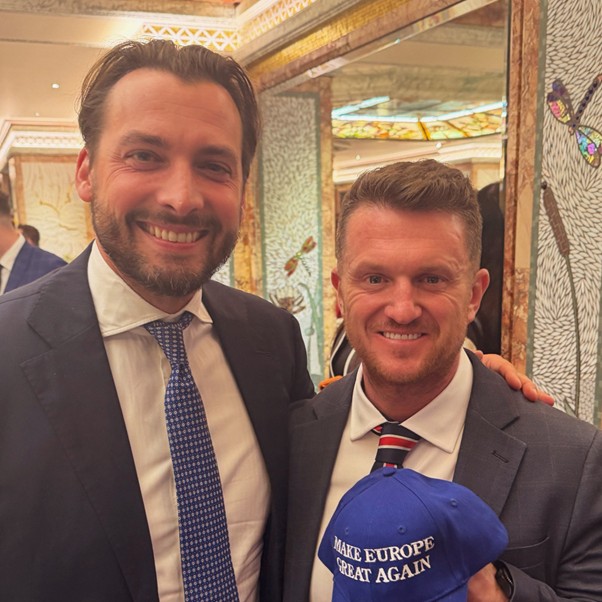
The photo that Thierry Baudet, founder of FvD (Forum for Democracy, a large Dutch political party), posted on X with Tommy Robinson caused a stir. Following social media posts in which he strongly criticised Israel, Baudet posed for a photo with Robinson, who is viewed by a large part of his constituency as Israel’s “lapdog”.
The background to this is that Robinson became known for leading the British people in protest marches against Islamisation, mass immigration, and the grooming of young white girls. Part of the constituency views Robinson's activism as a “distraction” from another problem: the influence of Israel on the culture and politics of Europe.
To put it bluntly: on the right, the focus remains on Muslims, and the problems immigration causes in terms of cultural tension and pressure on limited social services. Meanwhile, a part of the right-wing constituency views Israel as the great evil behind mass immigration to Europe. The plan, they argue, is to lower Europe’s IQ so that Europe would never again be able to threaten the Jewish people.
Israel and the Islamization of Europe
Personally, I see problems with this chain of thought. If countries like France and the United Kingdom do indeed become Islamised, you get nuclear powers hostile to Israel. And how does the high IQ in China and their growing geopolitical influence fit into this “Jewish world conspiracy”, including the Chinese Belt and Road network?
There is something to be said for the idea that the way Jews were treated in Europe during the Second World War led to revanchist sentiments. But what replaces it –Islamised states – will certainly not treat Israel any better. Furthermore, the rise of artificial intelligence means that it is no longer entirely clear what exactly a country’s average IQ means for its geopolitical influence.
God of the gaps
Additionally, certain aspects of the conspiracy theory cannot be true simultaneously. The Holocaust must have taken place for the Jews to feel revanchist about it. Israel needs the US to hold its own, if only against Iran. However, a US disintegrated by racial conflict is no longer able to assist Israel. The idea that Jews can only thrive in a ‘super-diverse’ world is at odds with China’s ambitions, because the regime actively maximises Han Chinese and minimises other forms of diversity (within its own sphere of influence).
Israel’s influence on European and American politics – and Israel’s attempts to gain and maintain influence over that politics – are not a conspiracy theory. But thinking in terms of Jewish power is becoming an increasingly abstract and mystical worldview, to the point where it blocks actual rational analyses. The Jewish world conspiracy serves as the “God of the gaps” – it becomes a metaphysical keystone to explain every uncomfortable uncertainty.
The photo of Baudet and Robinson sparked widespread criticism, and in response, the FvD founder posted a message on X. I quote it in full and will then analyse it in more detail.
“I see many divided reactions to my meeting with Tommy Robinson. The ‘right-wing bloc’ is clearly divided along fierce ideological lines. And that, in itself, is fine. But sometimes it can also be harmful to focus solely on those differences.
Tommy Robinson has done incredibly important work in exposing scandals like Rotherham—the grooming and rape of young white girls by criminal immigrant networks. The systematic turning of a blind eye by governments and authorities. The complicity, in some cases, even of the police.
He has made entire populations aware of the harmful consequences of mass immigration. And he mobilises more than 1 million Britons annually to protest for the preservation of their national identity.
Do we subsequently agree on everything? No. I would almost say, "of course not." And that is not necessary either.
On Israel’s actions, for example. On the Palestinians, Gaza, and the possibilities for stability in the Middle East. On the influence of cultural Marxist lobbies and commentators in Europe, who have made significant contributions to tabooing nationalism.
On the exclusive focus on ‘Islam’ as the *only* problem (instead of uncontrolled mass immigration in general). There are undoubtedly differences regarding economic policy as well, and so on.
But none of that detracts from the enormously inspiring work he has accomplished. And continues to do.
If we keep focusing on the differences, we will never achieve anything. At the same time, we stand against a bloc of establishment parties and movements that all want the borders to remain open, and who consider remigration a taboo subject!
It has always been FvD’s idea to cooperate where possible. We must form alliances. We must learn to focus on common ground. Join forces. Why can our opponents do that, while the ‘right’ always allows itself to be divided based on ideological hair-splitting? Time is running out. It is about saving – or losing – our countries.”
In the opening of the message, Baudet argues for nuance, for not drawing ideological lines that divide the right wing too sharply.
Right-wing Tolerance
He seems to advocate tolerance and building bridges across the right-wing spectrum, which I applaud in principle. After all, this is necessary to build a pillar on the right flank, where entrepreneurs, thinkers, and educators work together to sustain themselves socioeconomically in a society dominated by left-wing institutions.
In his other posts, however, Baudet constantly emphasises that systemic opposition takes precedence over policy opposition. The consequence is that political disputes quickly become highly ideologically charged, making it very difficult to find common ground in pragmatic compromises at the level of ‘political work’.
Subsequently, Baudet addresses the tabooing of nationalism and the promotion of Cultural Marxism within institutions. It is suggested that he and Robinson disagree on this, but the substance of the disagreement is left implicit. What exactly is he referring to?
Israel and immigration policy
Regarding foreign policy: when Israel began the current campaign following the attacks of October 7, 2023, Baudet stated, among other things, that this would lead to more instability in the Middle East, resulting in increased immigration to Europe. In the period that followed, Israel’s actions in Gaza were interpreted by the FvD through the lens of more immigrants to Europe.
My response on X at the time was to state that we in Europe should pursue our own immigration policy and set our own borders, independent of what any country in the Middle East, including Israel, does or does not do.
This led to an exchange on X with Camille Meloen, one of the anti-Israel hardliners within the FvD, who underscored the aforementioned position even more forcefully.
During this exchange, the influx of immigrants began to feel like an opportunistic argument to be against Israel, no matter what. For even without Israel, there are plenty of active and slumbering conflicts in the Middle East: think of Syria, Yemen, Turkey and Kurdistan. In any case, Europe must finally get that hard external border in order. One more Israeli campaign does not change that.
Consensus on mass immigration
Furthermore, I think that no one on the right – not Robinson, but also not, for example, Geert Wilders (PVV) – views Islamization as “the only problem.” Differences in culture and mores, and how this leads to a society of fragmented, loose atoms and tribal groups that can no longer integrate within a leading culture, are widely acknowledged. Broadly speaking, the right thinks the same way about this.
Still, the problem is and remains those left-wing societal institutions dominated by cultural Marxist thinking, which make it impossible to do anything practical about it.
I would stake my life on Tommy Robinson acknowledging this as well. And if not, he will soon read it in my book, What the World Can Learn from the Fall of the West (Academica 2026), which he received the same weekend.
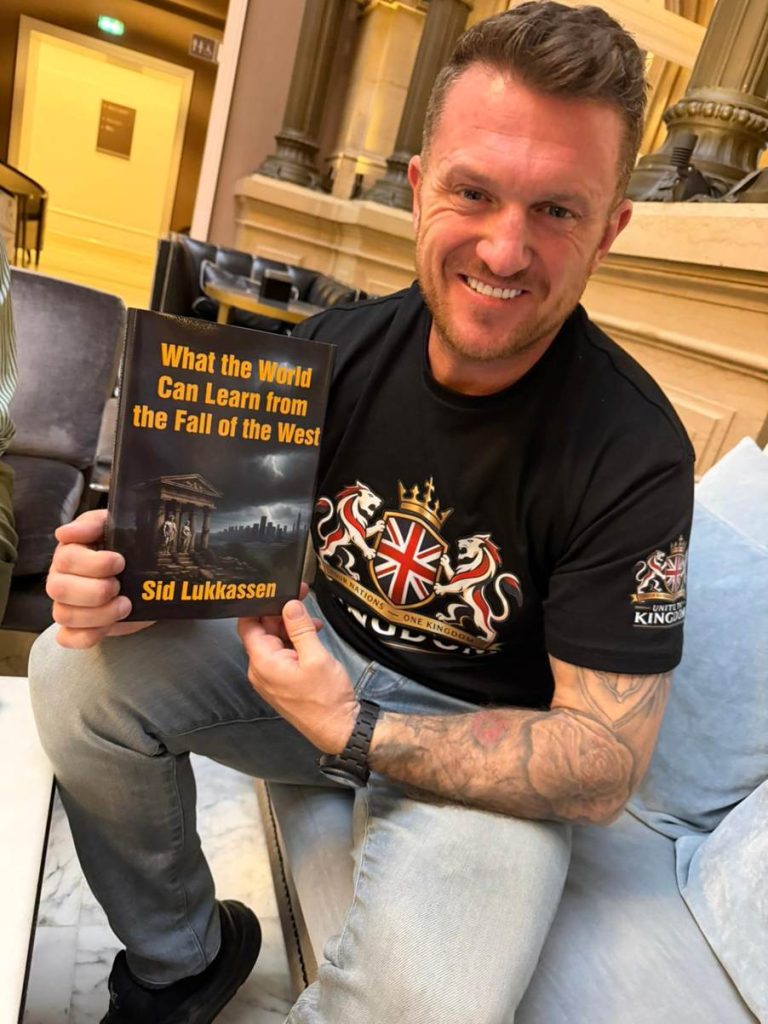
Robinson will certainly not say: “All Indians are allowed to come to Great Britain, as long as they aren’t Muslims.” He is more likely to say: “I have no problem with an Indian who runs a shop, does his best to contribute something to our country, and cooks a tasty curry for his customers. But that does not stop me from seeing and pointing out that too many people are coming here, that our system cannot handle it, and that the absorption capacity of our society is overstretched.”
The commotion now arising from the photo of Thierry Baudet and Tommy Robinson is a glass of wine from the same barrel that has been used for decades. Fifteen years ago, as an opinion maker, Baudet sought controversy and publicity by defending the controversial womaniser Julien Blanc.
A few years later, there was outrage because he dined with a racist professor from the US. Shortly after that, the focus shifted to Andrew Tate, who was presented as an example of masculinity and entrepreneurship.
Candace Owens stopped by a party convention, and now it is Tommy Robinson in the spotlight. The aura of controversial figures is constantly sought after: that is partly a marketing strategy and, above all, a desire to bask in that aura, to absorb that stimulating energy.
Baudet concludes his X-post with a plea to join forces on the right and to bridge ideological divides. While I applaud that – as stated above – I have my own thoughts on the matter. Being able to switch between pragmatic power politics and ideological purity with the right speed and fluidity requires political intuition. In this regard, I have found FvD often falls short. Certainly, in local politics, one cannot do without pragmatic compromises.
Practising politics out of reluctance
In local politics, media attention for philosophical interpretation is nil; if you want to remain visible and achieve something for your constituency, you will have to think critically and constructively with the municipal executive, as in this example. Baudet wanted me to be eligible to vote in the European elections in 2024, about which we had a heated telephone conversation. I had informed the party board that I wanted to withdraw my candidacy.
After all, I didn’t have an electable position anyway, and left-wing activists would scrutinise anything I might say in the media; they would try to damage me to hurt the party, and ultimately it would not get me anywhere. We had dealt with that phenomenon before.
Baudet’s response to this situation was that he only wants people in elective positions who engage in politics reluctantly. One should not view politics as a means to achieve anything, he said; one has to acknowledge that politics is pointless. My counter-argument was that this take is at odds with people’s motivation to run for local office: they hope to have an impact on their living environment and want to achieve something for their constituents.
We did not get any further in that conversation. My hope and enthusiasm for being politically active, against my better judgment, were met with his cynicism and boredom with politics in general. Eventually, some friendly words were exchanged, and at his request, I agreed to my candidacy for the European list after all.
Pain Points & Building Bridges
I consented in the hope that the underlying points of contention would be addressed in more detail after those elections. It was not without reason that I had not texted him personally about the matter. Instead, I had written a formal letter to the party leadership.
Subsequent personal correspondence did not return to the points raised but turned to new themes: namely, Israel, Judaism, and associated far-reaching theories. That was precisely not what I wanted to discuss. They seemed to me like themes with high political risks and minimal chances of success. I gave that honest answer, and this muddled our report. Joost van Wijhe was considering an attempt at reconciliation, but he has since passed away.
This history, therefore, forces itself upon me as I read about the push to build bridges across ideological divides and to be tolerant towards one another on the right flank. I cannot escape this history, which lives in the back of my mind when I read that.
Incidentally, that approach would be fully consistent with the founding principles of FvD, as also stated in Breach the party-cartel (2017). Namely, finding majorities on individual political points and sub-themes, instead of conducting politics through cartels and unyielding voting lists driven by crystallised ideologies.
Ultimately, no one is a saint. If Baudet says we should primarily look at the good contributions of inspirators like Robinson, who is successful in mobilising people socially, and emphasises that we unite our forces, then that is positive.
And if someone says, “You cannot criticise the influx of refugees without also considering the nations and the wars that cause those flows”, then the answer is: Muslims cause refugee flows simply by existing, and European welfare states cause refugee flows simply by existing.
Support Sid via BackMe or his email newsletter