There was a time when presidents tried to look presidential: a dark suit, a serious expression, a carefully framed flag in the background. Politics was built on restraint. Today, it is built on visibility, and in the digital age, visibility is increasingly cinematic. Modern leaders not only communicate policies but also construct visual identities. Few understand this transformation better than Donald Trump.
By Nadia Ahmad
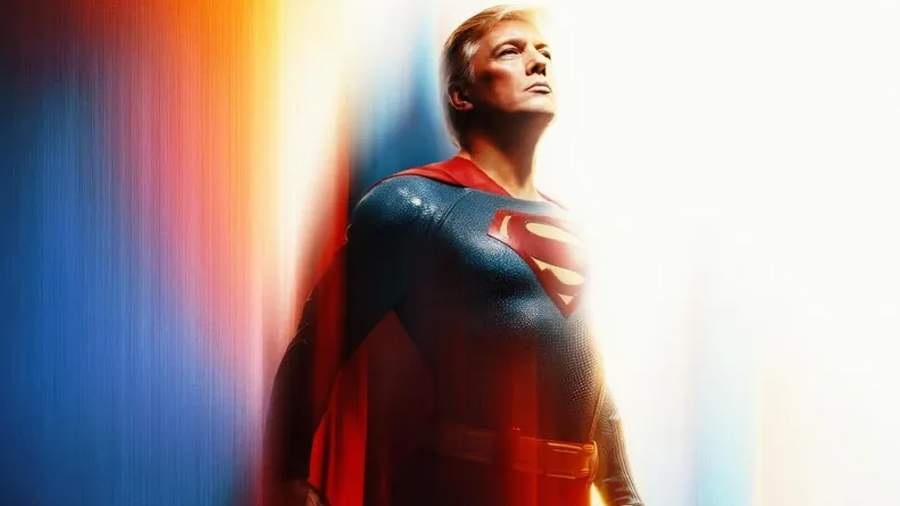
The American President's recent Superman-style imagery and AI-generated visual campaigns during moments of heightened tensions with Iran have turned political communication into something closer to a digital film universe than to traditional statecraft. Across official and affiliated online channels, Trump has been repeatedly portrayed in stylised AI-generated images and edited video montages that resemble superhero aesthetics, dramatic lighting, cape-like symbolism, heroic framing, and slogans evoking invincibility.
Some visuals echo the language of Superman mythology: strength, hope, unstoppable force. These are not traditional political posters. They are closer to cinematic trailers. And that is the key shift: we are no longer in the era of political portraits; we are in the era of political storytelling as spectacle.
The Superman reference is not accidental. Superman is not just a comic-book hero; he is one of the most powerful modern myths ever created, a figure who cannot be broken, cannot be stopped, and always arrives in time to restore order. He represents something deeply psychological, the desire for absolute certainty in a world built on instability. Ancient civilisations had gods, medieval societies had divine kings, modern culture created Superman, and now modern politics borrows him.
During recent geopolitical tensions involving Iran, this symbolic layer became even more visible as global audiences consumed constant streams of conflict footage, military analysis, and fragmented narratives. Online political communication itself began to shift tone; it no longer resembles institutional messaging alone but increasingly resembles cinematic construction.
Trump’s online ecosystem, especially through Truth Social, amplifies this dynamic. Posts are not simply statements; they are emotional events, visuals are not merely illustrations; they are identity projections. In this environment, even political messaging about conflict can take on the structure of a movie trailer, suspense escalation, climax, and certainty.
This is where phrases like “The Storm Is Coming” and “Nothing can stop what is coming” gain significance. They are not traditional diplomatic language. They are narrative triggers. They sound less like policy and more like lines spoken before a final cinematic confrontation.
The phrase “The Storm Is Coming,” in particular, functions as a condensed emotional signal: anticipation, pressure, inevitability. It does not explain policy; it constructs expectation.
Importantly, this is not unique to one individual; it reflects a broader transformation in political communication itself. In today’s political-media world, interpretation is no longer centralised. The “Lois Lane role” is no longer held by one person. In the classic Superman stories, Lois Lane is the journalist who tries to explain what seems extraordinary, translating myth into something the public can understand.
Today, that function is shared across multiple actors' official communication teams, such as the White House press and media offices, traditional journalists, and digital platforms that spread and amplify messages instantly. The important shift is that explanation no longer arrives from a single authoritative voice. It emerges from a network of competing interpretations that operate simultaneously.
In practical terms, this means political meaning is no longer “delivered” after the event. It is constructed during the event. Official statements, media commentary, and platform circulation all interact in real time, shaping how images are understood as they spread.
In the case of Trump’s Superman-style digital imagery, Truth Social acts as an immediate amplification layer, circulating, reinforcing, and extending symbolic framing at the same speed as the imagery itself. Traditional institutional communication does not disappear, but it no longer fully controls timing or interpretation.
So instead of one “Lois Lane” explaining reality, we now have a distributed system of interpretation where no single actor fully owns the final meaning. The journalist is no longer a single figure but a fragmented ecosystem.
This is also why Superman becomes such a natural reference point in modern politics. He is not just a fictional character; he is a psychological shortcut. He removes ambiguity. He simplifies chaos. He turns uncertainty into a story that feels controlled. No hesitation, no institutional delay, no compromise fatigue, just action. That clarity is powerful because it cuts through complexity in a way real governance never can.
And that is precisely what makes him so politically useful as a symbol. It also explains why modern leaders consciously or unconsciously drift toward similar aesthetics. The visual language of certainty works faster than the language of explanation.
The internet accelerates this transformation even further. In earlier eras, political symbolism was slow: statues, portraits, official speeches, and carefully curated broadcasts. Today, AI-generated visuals and edited video clips circulate globally in seconds. A single image can define a narrative faster than any institutional response can correct it.
Speed changes hierarchy. It rewards emotional clarity over institutional nuance, spectacle over explanation, and character over complexity. In that environment, Superman-like imagery becomes instantly legible across audiences with very different political views.
Supporters read it as a sign of strength and confidence. Critics read it as exaggeration or theatrical politics. But both reactions produce the same outcome: attention. And in the attention economy, attention is not just visibility; it is influence.
At the same time, something deeper is happening culturally. Modern societies are under sustained psychological pressure, ongoing wars, economic uncertainty, technological acceleration, and constant information overload. In such conditions, people gravitate toward symbolic simplification because complexity becomes emotionally exhausting.
Superheroes fulfil that role perfectly. They offer a narrative structure in which chaos has a visible master, uncertainty is absorbed by one exceptional figure, and the world becomes coherent again through a single presence. That is why Superman endures across generations not as entertainment alone but as emotional infrastructure.
And that is why political imagery that borrows his aesthetic resonates so strongly even when it is clearly symbolic. It connects directly to a shared psychological need: the desire for order that feels immediate, personal, and visible.
The irony is that real politics cannot function this way. Wars are not resolved in cinematic arcs, diplomacy is not a trailer, and governance is not a superhero narrative. But modern communication increasingly behaves as if it were.
This creates the central tension of our time: institutions still operate in reality while political perception increasingly operates in imagery. One system moves slowly through procedure, the other moves instantly through symbolism.
Which brings us back to the phrase itself: The Storm Is Coming. It works not because it explains but because it frames. It does not describe events; it prepares emotion. It creates anticipation before understanding.
Why does this archetype return again and again in modern politics? Because it solves, at least emotionally, the oldest problem in human civilisation: the fear that no one is fully in control.
Superman answers that fear with a simple image. A man in the sky. Unbroken. Certain. Above chaos. But reality remains less cinematic. And perhaps the real story is not that politics is becoming superhero-like. It is that modern societies, overwhelmed by complexity, are increasingly asking it to do so.