The post-Assad Levant is often described as another chapter in Syria’s long crisis, transition, or unfinished war, but this framing overlooks the real transformation underway. What is changing is not only Syria, but the entire strategic environment around Israel and the ideological assumptions through which that environment is interpreted.
By Nadia Ahmad
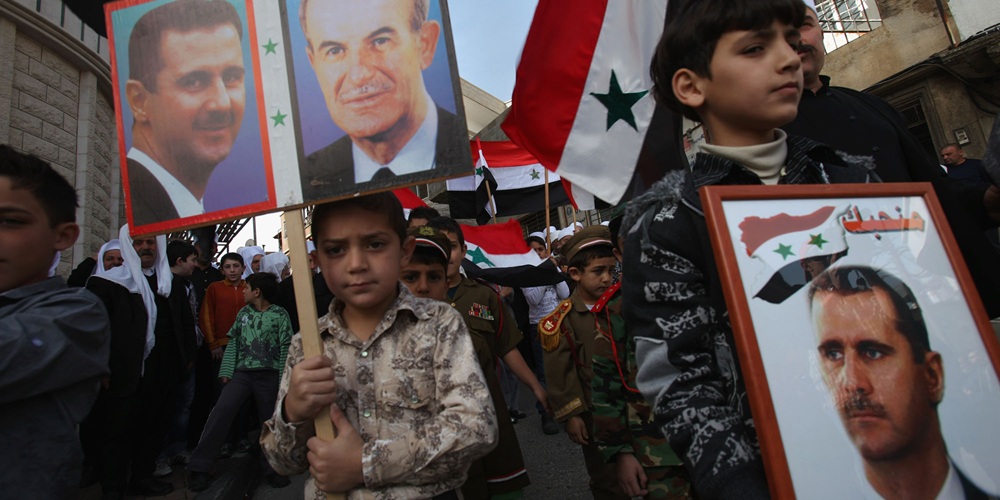
The exile of President Bashar al-Assad from Syria’s central political order marks more than a political rupture. It removes one of the last remaining secular Arab state structures that gave Israel’s northern frontier a degree of strategic predictability.
Whatever its brutality or repression, the Assad system represented something modern geopolitics understands very clearly: a centralised state with a defined chain of command, a rational security doctrine, and a controllable logic of deterrence. Not stable, not friendly, but readable. And in the Middle East, readability is power. That world is now weakening.
In the post-Assad environment, Syria no longer functions as a coherent state in the classical sense. It increasingly resembles a fragmented political arena in which authority is dispersed among local militias, external patrons, shifting alliances, and unstable internal balances. The language of sovereignty still exists, but the reality beneath it is more fractured than structured.
For Israel, this is not a Syrian internal issue. It is a structural shift in the regional system itself, and, more precisely, in the uncertainty on its northern frontier.
What is weakening is not only Assad’s regime, but an entire category of regional stability: the secular Arab buffer state. That category, imperfect as it was, included Syria under Assad, Iraq in its earlier republican form, and, to a lesser extent, Lebanon’s fragile institutional shell. These were not democratic systems, but they were states. And states, even authoritarian ones, impose structure on chaos.
That structure is now eroding.
The result is a Levant in which political legitimacy is increasingly shaped not by institutions but by identity: sectarian balance, militia power, religious mobilisation, and external sponsorship networks. Authority becomes conditional. Control becomes uneven. Borders remain on maps, but their meaning on the ground shifts continuously.
During the Assad era, Israel dealt with a hostile but predictable state actor. Syria was adversarial, but it operated within the logic of statecraft: deterrence, escalation control, and strategic signalling between centralised actors. That framework allowed calculation even in conflict.
In the post-Assad phase, that logic weakens.
Israel is no longer facing a single rationalised adversary, but a fluid environment where the question is not only what Syria will do, but which Syria exists at any given moment. This shift is decisive because security doctrine depends more on predictability than on ideology.
From a right-leaning European realist perspective, the core problem of post-state fragmentation is that it does not produce order; it produces volatility. And volatility is not neutral. It creates hierarchy, insecurity, and constant renegotiation of power.
Weakness in one part of the system does not dissolve conflict; it redistributes it. Israel is not outside this reality. It is one of the first regional actors forced to internalise it at scale.
This produces a structural paradox. Israel remains militarily dominant and technologically advanced, yet it operates in a region that is becoming less state-like and more identity-driven. The stronger Israel becomes in conventional terms, the more complex its political environment becomes. Power does not eliminate uncertainty. It exposes it. The shift is not military. It is categorical.
A centralised adversary, even a hostile one, is easier to model than a fragmented landscape where authority is dispersed, contested, and reversible. The post-Assad Levant replaces legible state logic with unstable configurations that evolve faster than traditional deterrence frameworks can process.
And this is where minority and majority dynamics return in a sharper form. Across the Levant, political identity is increasingly structured around majority claims and fragmented minority survival strategies.
Sunni political identity in Syria is no longer expressed through a unified state apparatus, but through competing currents ranging from local governance networks to ideological movements and armed factions. At the same time, minorities are adapting under pressure in ways that are different but structurally similar.
Alawites face the loss of centralised protection. Christians increasingly rely on diaspora networks and external guarantees. Druze communities prioritize local autonomy and negotiated survival arrangements. Kurdish actors operate through semi-institutional quasi-state structures. Shiite networks, particularly in Lebanon and parts of Syria, combine state participation where possible with independent deterrence logic when necessary.
What emerges is not a unified minority bloc, but a shared condition: survival is no longer guaranteed by the nation-state. And this is the ideological turning point.
The post-Assad Levant confirms a reality that right-leaning European realism has long emphasised. When centralised secular states lose coherence, they are not replaced by neutral pluralism but by fragmentation. And fragmentation produces instability, not equality. It produces actors forced into continuous adaptation, shifting alliances, and permanent survival logic.
Israel sits at the centre of this transformation, not as an anomaly, but as a reference point. It is a state that has always operated under strategic pressure, but now finds itself in a region where instability is no longer episodic — it is structural.
The exile of Assad from Syria’s political centre removed not only a government, but a category: the assumption that the Levant is composed of predictable, centralised states.
What replaces it is not a new order, but a condition—a region where authority is continuously renegotiated between fragmented actors with shifting loyalties and uneven control.
Even diplomatic engagement becomes more complex under these conditions. Agreements are no longer anchored to fully centralised enforcement structures, but to partial authorities whose internal coherence can shift under pressure. Continuity can no longer be assumed; it can only be monitored.
That is why intelligence, perception, and strategic anticipation gain more weight than formal treaties alone. In a fragmented Levant, the map matters less than the movement beneath it.
That is the final consequence of the post-Assad Levant: not the rise of a new enemy, but the erosion of the state as the primary unit of regional stability, and with it, the rise of a more volatile and less legible order.
It is within that order that Israel’s minority anxiety becomes visible, not as emotion, but as a structural strategic condition produced by the disappearance of predictability itself.