Syria is no longer defined by the dramatic frontlines and rapid territorial shifts that once dominated headlines. Instead, it has entered a quieter, more ambiguous phase—one in which the absence of large-scale war does not equate to peace. Beneath the surface, the country is balancing between fragile stabilisation and the constant risk of renewed fragmentation. What unfolds over the next two years will not be shaped by a single decisive event, but by the slow interaction of economic strain, political consolidation, and external pressure.
By Rafic Taleb
At first glance, the most plausible trajectory is one of authoritarian stabilisation. The central authority appears increasingly capable of containing internal rivals, projecting a degree of order that, while far from democratic, may be sufficient to prevent immediate collapse. Limited engagement from regional actors, particularly through cautious economic outreach, could reinforce this trend. In such a scenario,
Syria does not recover in any meaningful sense, but it stabilises just enough to function. Institutions operate, salaries—however inadequate—are paid intermittently, and daily life resumes under a system that prioritises survival over prosperity. For many Syrians, this would represent not success, but a tolerable stagnation.
Yet this apparent stability masks deeper vulnerabilities. The state’s ability to maintain control depends less on coercive power than on its capacity to sustain a minimum economic baseline. Should that baseline erode—through inflation spikes, fuel shortages, or the simple inability to pay public sector wages—the façade of control could weaken rapidly.
Syria today resembles a structure held together by pressure rather than strength; it does not require a dramatic shock to falter, only a gradual depletion of its remaining resources.
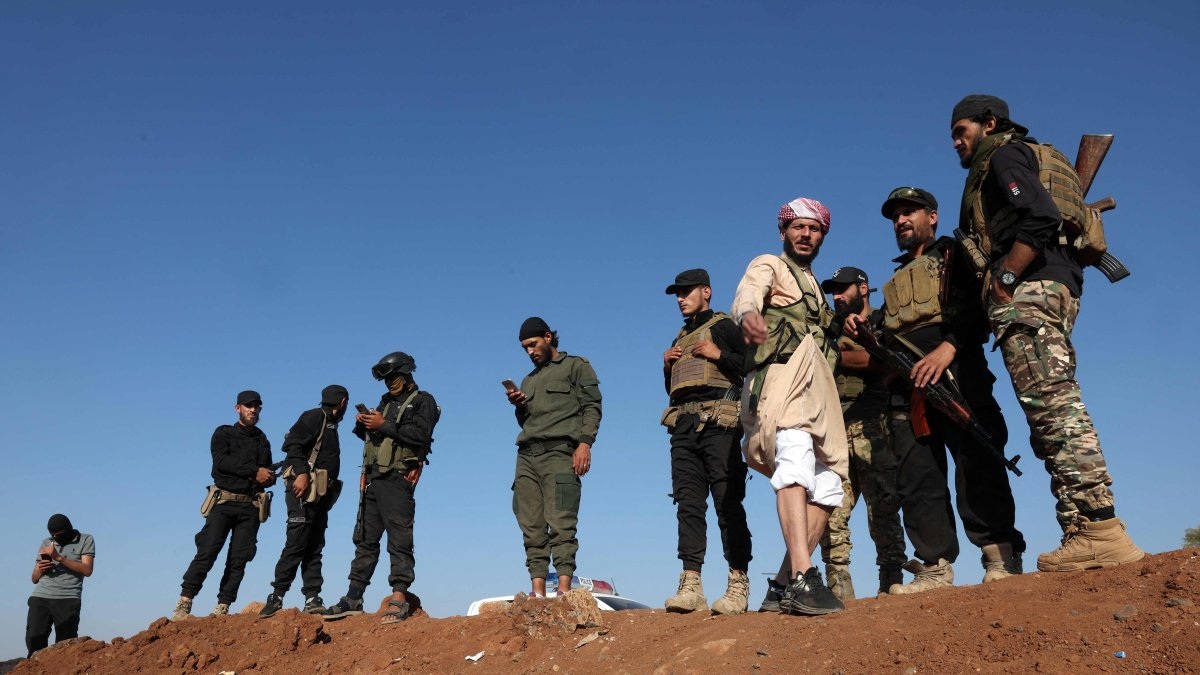
This opens the door to a second, more volatile possibility: internal fragmentation. If efforts to consolidate power provoke resistance from armed factions, or if the integration of these groups fails, localised instability could re-emerge.
Unlike the early years of the conflict, however, such fragmentation would likely be more complex and less ideological, driven by competing economic interests, local power dynamics, and survival imperatives. The result would not necessarily be a return to full-scale war, but rather a patchwork of insecurity—assassinations, sporadic clashes, and areas that fall partially outside central control.
Compounding these internal dynamics is the persistent risk of external escalation. Syria remains deeply embedded in a network of regional conflicts, particularly those involving Israel and Iran. While a full-scale war on Syrian soil remains unlikely, the continued airstrikes and strategic targeting of infrastructure could impose a steady cost on the state’s already limited capacity. Such pressures do not need to be catastrophic to be consequential; over time, they degrade institutions, deter investment, and reinforce a cycle of fragility.
Perhaps the most underappreciated scenario is not one of sudden collapse or renewed war, but of slow economic suffocation. In this trajectory, the state survives politically while hollowing out administratively. Public services deteriorate, informal economies expand, and governance increasingly shifts into the shadows.
Citizens adapt—as they have for years—but at the cost of long-term societal resilience. This is a form of stability that postpones crisis rather than resolving it, quietly accumulating the conditions for future upheaval.
A forced political transition, often imagined as the result of internal or external pressure, remains the least likely outcome in the near term. The current structure, despite its weaknesses, has shown endurance. There are no clear indications of an elite split significant enough to trigger systemic change, nor is there a coordinated external push capable of imposing one. Such a shift would require a convergence of pressures that, for now, remain unaligned.
What ultimately determines Syria’s direction is not ideology or even security dominance, but access to money, to legitimacy, and to external support. Economic flows, however limited, can stabilise; their absence can destabilise with equal force.
Public tolerance, often underestimated, is another critical variable. Syrians have endured extraordinary hardship, but endurance has limits. When those limits are reached, unrest is rarely gradual; it is sudden, concentrated, and difficult to predict.
In this sense, Syria is neither on the brink of imminent collapse nor on a credible path to recovery. It exists in a state of temporary equilibrium, where competing pressures cancel each other out just enough to delay decisive outcomes. This equilibrium may persist, but it is inherently unstable—less a resolution than a pause.
The most realistic expectation, then, is the continuation of this grey zone: a Syria that holds together without truly healing, that functions without truly recovering, and that remains vulnerable not to a single decisive moment, but to the cumulative weight of unresolved crises. For observers and policymakers alike, the challenge is not to anticipate a dramatic turning point, but to recognise how long such a delicate balance can realistically endure.