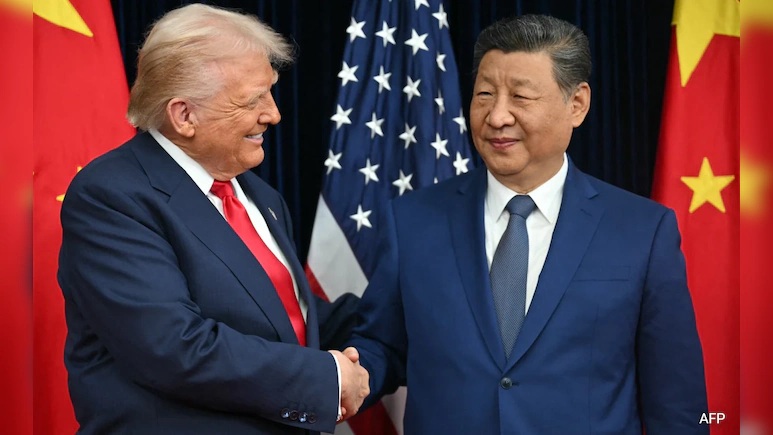
When Donald Trump arrived in Beijing for renewed negotiations with Xi Jinping, most observers focused on tariffs, industrial competition, semiconductor restrictions, and the latest chapter of the American-Chinese trade war. Television studios discussed percentages, exports, rare earth minerals, and market reactions. Economists debated supply chains while analysts attempted to decipher diplomatic gestures inside the ceremonial halls of Beijing. But the real story began long before Trump reached China. It began in Tehran.
By Nadia Ahmad
The road to Beijing passed through the deserts of the Middle East, the fractured geography of Syria, the pressure campaigns against Iran, and the silent struggle over the strategic arteries connecting Asia to Europe. Because beneath the visible trade dispute lies a far deeper confrontation: the battle over who will shape the geography of the twenty-first century.
For more than a decade, China’s grand geopolitical ambition rested upon the expansion of the Belt and Road Initiative, the modern reincarnation of the ancient Silk Roads that once connected imperial civilisations across Eurasia. Beijing’s vision was not merely economic. It was civilizational.
China sought to build a continental architecture stretching from the Pacific Ocean to the Mediterranean Sea: ports, railways, industrial corridors, pipelines, logistical hubs, and trade networks capable of linking Europe, the Middle East, Central Asia, and East Asia into a new Eurasian sphere increasingly centred on Beijing. At the heart of this strategy stood Iran.
Iran was not simply another Chinese partner. It was one of the indispensable geopolitical pillars of China’s westward horizon. Geographically, Iran sits at the crossroads of civilisations. It links Central Asia to the Gulf, the Caucasus to Mesopotamia, and the eastern Mediterranean to the Indian Ocean. Any Chinese dream of continental continuity toward Europe inevitably required Iranian stability. And for a time, history appeared to move in China’s favour.
American influence in the Middle East seemed exhausted after decades of war. Europe looked strategically fragmented. Chinese infrastructure diplomacy expanded aggressively. Beijing invested across Asia, Africa, and the Middle East with growing confidence. The Belt and Road Initiative was presented as the inevitable future of globalisation itself.
The atmosphere of the 2010s carried the scent of Chinese momentum. Then the map began to fracture. Syria collapsed into a prolonged war. Iraq remained unstable. Maritime insecurity expanded across multiple strategic chokepoints. Western suspicions toward Chinese investments intensified. Europe became increasingly cautious regarding Beijing’s infrastructure ambitions.
Most importantly, Washington launched a sustained pressure campaign against Iran.
Officially, the American strategy focused on nuclear concerns, sanctions enforcement, regional militancy, and energy security. But geopolitically, its consequences extended far beyond those immediate objectives. By economically weakening Iran and increasing instability across the surrounding region, the United States indirectly disrupted one of the key corridors sustaining China’s Eurasian vision.
This is where Trump’s geopolitical legacy becomes far more sophisticated than either his fiercest critics or his most enthusiastic supporters often recognise. Trump is frequently portrayed as impulsive, theatrical, or transactional. Yet history sometimes moves through unconventional personalities. Beneath the rhetoric and spectacle, his administration pursued policies that reshaped the strategic environment surrounding China itself.
The sanctions imposed on Iran did not merely weaken Tehran. They complicated the Chinese expansion westward. Chinese companies became increasingly hesitant to deepen investments exposed to American sanctions. Energy cooperation encountered obstacles. Infrastructure timelines slowed. Financial channels narrowed. Regional uncertainty discouraged long-term strategic planning. Gradually, the Belt and Road map that once appeared smooth and inevitable began to resemble a fractured geopolitical landscape. The consequences extended beyond Iran.
Syria, once imagined as a future Mediterranean outlet within China’s Eurasian architecture, became a symbol of paralysis and fragmentation. Iraq remained unstable. The eastern Mediterranean increasingly evolved into a zone of Western strategic coordination. New regional alignments emerged between Israel and several Arab states through the Abraham Accords. India rose as an alternative strategic partner for Gulf monarchies wary of overdependence on Beijing.
At the same time, Washington quietly strengthened maritime alliances stretching from the Indo-Pacific to the Mediterranean basin.
This matters because great powers do not compete solely through military force or economic size. They compete through corridors. Empires rise by controlling movement. Ancient Rome understood this. The Persian empires understood this. The Ottoman Empire understood this. The British Empire built global supremacy through maritime chokepoints stretching from Gibraltar to Suez and beyond. Modern America inherited much of that maritime logic after the Second World War.
China’s rise, however, depends heavily on something different: continental integration.
The Belt and Road Initiative was never merely about commerce. It represented an attempt to reorganise Eurasian geography itself around the gravitational pull of Chinese economic activity. Beijing understood that whoever shapes the routes connecting civilisations shapes the future balance of power.
Washington understood this as well.
And rather than confronting China exclusively in East Asia, the United States gradually increased pressure along the vulnerable arteries connecting China to the Middle East and Europe.
The result is visible today. A weakened Iran means a weakened Western anchor for Chinese expansion. A fractured Syria means uncertain access to the Mediterranean. Regional instability discourages massive long-term infrastructure investment.
The geopolitical ecosystem surrounding China’s continental ambitions became less reliable than Beijing expected during the optimistic years of early Belt and Road expansion.
This does not mean China has failed. Such conclusions would be premature and strategically naive.
China remains one of the greatest industrial powers in modern history. Its manufacturing capacity remains immense. Its technological ambitions continue expanding. Beijing still thinks strategically on a civilizational timescale that few Western democracies can consistently sustain. While many governments think in election cycles, China often thinks in decades. Yet something fundamental has nevertheless changed. The aura of inevitability surrounding Chinese expansion has faded.
A decade ago, many analysts openly predicted that the twenty-first century would become a Chinese century. The Belt and Road Initiative appeared unstoppable. American influence looked overstretched. Eurasia seemed increasingly vulnerable to Chinese economic absorption.
Today, the atmosphere feels different.
Globalisation itself is fragmenting. Supply chains are diversifying. Europe grows increasingly suspicious of strategic dependence on Beijing. Technological containment measures expand. Maritime competition intensifies across the Indo-Pacific. Even some Belt and Road projects now encounter political backlash, debt controversies, or local resistance. China still advances, but no longer across an uncontested map.
This is why Trump’s arrival in Beijing carries symbolism far beyond economics. He does not arrive merely as a negotiator discussing trade deficits or tariffs. He arrives representing a power that spent years reshaping the geopolitical terrain surrounding China’s western horizon.
By the time Trump landed in Beijing, the strategic environment itself had already changed.
And Xi Jinping undoubtedly understands this reality. Any concessions offered by Beijing today would therefore reflect more than short-term economic pragmatism. They would also reflect recognition that the geopolitical environment sustaining China’s continental ambitions has become harsher, more fragmented, and more dangerous than what Chinese planners envisioned during the previous decade.
The irony is profound. Many Western commentators dismissed Trump as strategically incoherent. Yet his administration’s policies toward Iran, sanctions networks, regional alliances, energy corridors, and geopolitical pressure collectively contributed to weakening one of the external ecosystems supporting China’s westward expansion.
Following the September 2023 state visit of Syrian President Bashar al-Assad to China, where coverage of his ceremonious welcome was noticeable in the shadow of a long war, an attack on Syrian graduating army officers by Chinese terrorists fighting in Syria left 80 wounded and killed. The state visit may have been the moment when Washington made a strategic decision to rid China of its ally, a move that holds geopolitical significance for the Chinese Belt and Road.
History often works through indirect consequences. A sanctions regime in Tehran eventually affects negotiations in Beijing. Instability in Syria alters logistical calculations across Eurasia.
The collapse of a corridor in the Levant reshapes strategic leverage between superpowers thousands of kilometres away. Geography itself becomes diplomacy.
In September of 2023, Syrian President Bashar al-Assad visited China, where he met with Xi Jinping and announced a “strategic partnership”.
This is the hidden architecture beneath today’s confrontation between Washington and Beijing.
The real struggle is not only about economics. It is about who controls the arteries of globalisation in an era when globalisation itself is beginning to fracture into competing civilizational spheres.
China seeks continental integration. America seeks to prevent any rival power from dominating the Eurasian landmass. That strategic doctrine has shaped American grand strategy since the twentieth century. Washington understands that no single power controlling both Europe and Asia could coexist comfortably with American maritime supremacy. This explains why the Middle East remains central despite repeated declarations about American withdrawal from the region.
The deserts of the Levant are not peripheral to global strategy. They sit near the connective tissue linking Asia, Europe, and Africa. Energy routes, maritime passages, pipelines, trade corridors, and military access points intersect there. Whoever influences that geography influences the architecture of the wider world, and China knows this. That is why Beijing invested so heavily in Eurasian connectivity. The Belt and Road Initiative represented an attempt to bypass American-controlled maritime vulnerabilities by constructing alternative continental pathways.
But those pathways now face pressure from multiple directions. Sanctions. Regional wars. Maritime instability. Competing corridors. Strategic realignments. Technological containment.
The modern Silk Roads no longer resemble the triumphant vision Beijing once projected to the world. Instead, they increasingly resemble contested imperial frontiers. The broader symbolism should not be ignored.
For centuries, great powers fought to dominate the seas, deserts, ports, and mountain passes because geography determines the flow of civilisation itself. The British Empire ruled the oceans. The Soviet Union sought continental depth. The United States mastered global maritime power after 1945.
China now seeks to reorganise Eurasia around its own gravitational centre. But history rarely grants smooth ascents to rising powers. Every emerging empire eventually encounters resistance from the established order. Somewhere between Tehran and Beijing, that resistance became visible.
The modern confrontation between America and China may ultimately be remembered not only through naval tensions in the Pacific or disputes over Taiwan, but through the silent geopolitical struggle over the corridors connecting East Asia to the Middle East and Europe, because the future of global power may depend less on speeches and summits than on routes, chokepoints, infrastructure, and strategic geography. Empires are sustained by movement. Whoever shapes the corridors shapes the century. And today, the road to Beijing still passes through Tehran.



The Foundation of Civilization is
the division of labor; work tasks.
And the division of labor
rides on the shoulders of
MONEY.
Silvio Gesell
timeless truth.
👍🔮 Trump Freedom Cities Worldwide, look for one in a neighborhood near you, even in Iran. Expect a Trump Tower. 🔎 How about an article on the one being built in Tbilisi, Georgia.
But first
Renovatio Monetarum
The $100 dollar bill that President Trump posted, front and back, the NEW one with his picture on it, put everyone, especially President Xi, and especially a lot of gangsters, and Iran, on notice:
Better make some deals QUICK to spend all of that SURPLUS, and hidden, old paper money US PAPER DOLLARS.