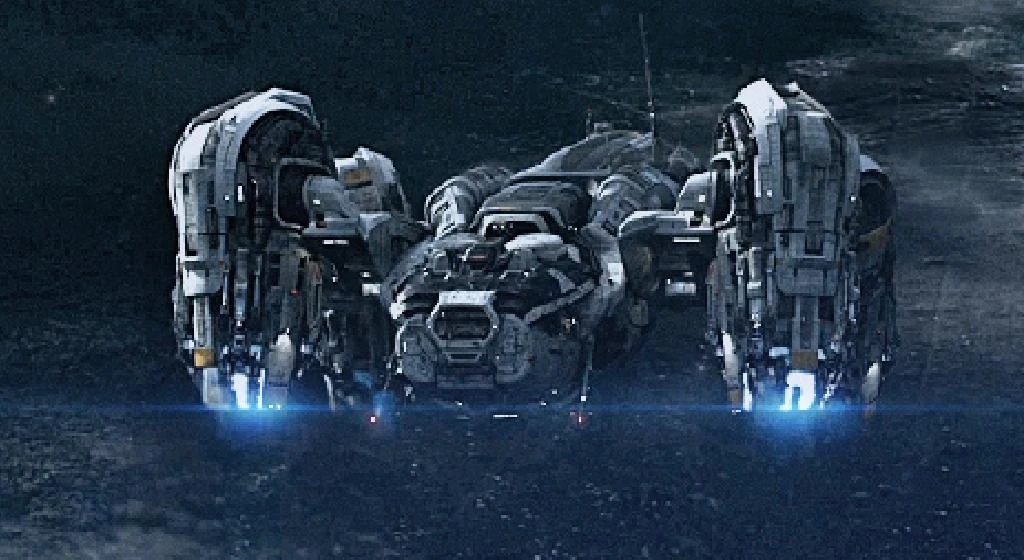
Elon Musk, the first private individual worth more than a thousand billion dollars (one trillion), launched SpaceX stock on the stock exchange late last week. The company's shares were sold at prices between $135 and $170, generating substantial proceeds. SpaceX's goal is to colonise space.
In this article, the social order needed to build an interplanetary civilisation and the question of whom that civilisation would ultimately serve will be explored.
Buying shares
The impetus for this question was a suggestion from my good friend Ricardo. He proposed buying shares, reasoning that if SpaceX eventually becomes a kind of Weyland-Yutani corporation, the buyer of these shares would become rich.
This name refers to a cooperative that leads the colonisation of space in the films and series of the Alien franchise. The philosopher Joris Bouwmeester (with whom I exchanged letters in Huis van de Muze (2024)) is not positive about this company:
“The workers in the [space] colony are exploited by the so-called megacorp, which is the real antagonist in this series. Here we see the actual, far greater evil than the xenomorphs' animalistic aggression, as the aliens are called. Unlike them, the large corporation where the characters in these films work is cold and ruthless in a more mechanical way. […] The aliens are chaotic evil, evil due to a lack of order and reason. It is a wild bloodlust. The mysterious corporation for which everyone works, on the other hand, is a very different kind of evil – it is evil due to an excess of order: it wants to subject everything and everyone to a cold rationality that walks over dead bodies.”
The rationale for buying SpaceX shares was that Musk's company would operate at a loss until it started offering commercial spaceflights and mining resources on the Moon and Mars. Ricardo argued that we will eventually finish mining on Earth, and that the search for new resources in the universe is therefore more or less inevitable for humanity's future.
Long-term goals versus the fragility of civilisations
This led to important analyses regarding the circumstances—economic, political, and ideological—under which people can unite to such hyper-ambitious long-term goals at all. I will examine these in more detail in this article, and before you read on, I would like to draw your attention to a new crowdfunding project I have started. The book I intend to publish is titled ‘Zin in Chaos’ (Meaning in Chaos): it deals with finding meaning and purpose in a disruptive time. In it, I explore lessons drawn by earlier philosophers who also lived in turbulent times. If the project succeeds, there will be a wonderful event where we can meet and raise a glass.
But before humanity reaches a stage where space mining is necessary, a gigantic civilizational collapse is also possible. American researchers around Trump and J.D. Vance have already projected a ‘Civilizational Erasure’ for Europe – as part of the official US ‘Natural Security Strategy’. Highly advanced civilisations collapse, replaced by Muslim enclaves, Mennonite colonies, and SGP villages.
This is a scenario I explore in What the World Can Learn from the Fall of the West (Academica, 2026). This scenario is plausible because urbanised civilisations are demographically unstable in terms of population growth compared with the groups just mentioned.
Eliminating scarcity
After all, those highly advanced civilisations drift very far away from what is needed to establish thriving families. The ‘Mice Utopia Experiment’ by John Calhoun in 1968 is telling. The mice were provided with everything they needed.
However, this abundance could not prevent the mice from succumbing to social and psychological pressures, whose intensity increased exponentially once physical scarcity disappeared.
Nevertheless – if a company indeed emerges that resembles what Weyland-Yutani represents, it is plausible that Musk will lead it and/or lay its foundation. He has so much money, connections, and influence that he will know how to mould existing institutions to make his initiative thrive and propel it past competing initiatives. The most plausible alternative is the creation of a space enterprise directly or indirectly owned by the Chinese government.
Space federalism
In response to these considerations, Ricardo answered that humanity must unite under one flag. Because this is better than wasting money, resources, and lives on wars, salvation should then come from something resembling the ‘United Earth Federation’ in Supreme Commander. This is a strategy game in which Earth is indeed united under one flag, and a galactic war rages against aliens and cyborgs.
My reaction to this is sceptical. What he describes resembles what the European Union is attempting, which does not appear to work very well. I reiterate my point: the larger and more cumbersome those Empires become, the more they drift away from what underpins demographic reproduction and thriving families.
It is telling that Guy Verhofstadt started speaking about the EU in terms of ‘Empire’ a few years ago. And China, to take another example, is also such a well-unifying concept for the Tibetans and Hong Kongers…
Relatively close-knit and manageable communities are necessary to thrive on a human scale. This brings us to the anthropologist Robin Dunbar and his research, which demonstrates that humans can only form a limited number of meaningful connections.
Humans are tribal beings – federations make those mutual bonds too fleeting and abstract. The more cosmopolitan and bureaucratic the federations become, the less happy people ultimately are, and the less inclined they are to reproduce. China sees this erosion reflected in the “lay down and let it rot” movement.
Top-down versus bottom-up
Here, Ricardo countered that demographic reproduction is not necessary to keep such a long-term objective as space exploitation viable. The Weyland-Yutani cooperative produces human clones and androids. He stated that as long as individual goals remain more important than the common goal, exploring and controlling space, humanity will perish hopelessly.
But doesn't what he proposes require a very top-down governance model? This question leads to the extremely important considerations announced at the beginning of this article. Such as:
* Who rules?
* Who will reap the benefits of that galactic expansion?
* That requires very much top-down thinking, and in Supreme Commander that is possible because the units are robots that follow a collective decision-making power.
* What he describes is more of an Asian way of thinking. The West operates more on a bottom-up basis: Vikings sailing through coves and bays to conduct their own raids, trade without paying taxes, and establish settlements outside central authority.
By definition, this leads to individual autonomy and, in turn, administrative fragmentation. The famous "Whose territory, whose prayer," from the Peace of Augsburg (1555), also demonstrates that regional autonomy is deeply ingrained in Western thinking about organisation.
Rawls’ original position
In theory, every human should naturally reap the benefits of space expansion under the federation rules. If we truly want to explore that scenario, we would first have to descend into the thought experiment of the philosopher John Rawls: the “original position.” We contemplate that Galactic Empire without knowing what position we will occupy within it.
If it is the position of the Sky Captain Overlord ruling over the colonisation of new planets, then it is likely epic. If you were such a “belter,” like in the series ‘The Expanse’—born in space as part of a working class to do dirty work, and with a skeleton too weak to even withstand the gravity of a walk on Earth… And out there, isolated and all alone in the universe, forced to mine asteroids for ore, of which he keeps perhaps 0.000001% of the value of his salary… Then the concept would likely be received with less enthusiasm.
Utopia versus reality
When it comes to the noble aspiration that every human being should benefit from the proceeds of space mining, we arrive at the realism that has been all too familiar since the fall of the Soviet Union. That lesson can be summarised as: Communist utopias – everything for ‘The Common Good’ – are usually not realised in practice in accordance with their underlying intentions.
Usually, the myth with which projects serving ‘the common good’ are launched turns out to be a new veneer with which a new ruling class justifies its new dominion.
Of course, Ricardo is not entirely wrong. In practice, the Rhineland cooperative economic approach has indeed proven possible – see the long-term successes of the Roman-Socialist coalition in the Netherlands.
This was a coalition of social democrats and Catholics: they ruled the Netherlands from 1945 to 1958. Their policy emphasised industrialisation, guided wage policy, and the development of social security. It was a polder-style consensus policy in which compromises were central. As a result, workers also gained a better and more prosperous existence.
High trust necessary for long-term cooperation
However, this approach could thrive only within a relatively monocultural, high-trust environment. And it is precisely that bureaucratic centralisation, Imperia, that breaks down that relative cultural familiarity and, at the same time, serves as a response, through bureaucracy and rules, to the chaos, lethargy, and vacuum that arise when those orderly communities disintegrate or scatter.
This is why Guy Verhofstadt’s answer to “more Europe” always comes down to “more Europe.” And where he says “Europe,” he means: EU.
Recap
All things considered, existing models of civilisation indeed clash with one another, thereby exhausting their resources and populations. See the wars in Iran and Ukraine as an example. Humanity could unite in: “Let us leave those regimes for what they are; we set a new point on the horizon.
Humanity unites to engage in space mining so that workers, too, will have a better life. So that there is enough for everyone. No longer led by nationalist, territorial, and bureaucratic regimes and governments. But now led by visionaries and private billionaires who have broken free from those stifling ties.”
But this is and remains a gambit. A risky undertaking, the outcome of which cannot be assessed to see if it aligns with the initial intentions.
The point remains that space colonisation requires an enormous institutional scale. On the scale depicted in science fiction, it requires even gigantic investments, multi-generational planning, long-term political stability, and very large organisations.
Historically, such projects have typically been carried out by states, empires, or state-backed enterprises. It is plausible that SpaceX will serve as a precursor to such structures. However, the question that remains is: “Would I still want this future if I didn’t know what position I would hold in it?”
After all, it makes quite a difference whether you will be an entrepreneur, pioneer, administrator, or colony leader, or a miner, engineer, indentured labourer, or genetically modified colonist.
I am currently raising funds to publish a brand-new book on purpose and finding meaning in a chaotic time. In it, works by earlier philosophers are examined to draw important lessons from them. Watch the video here! With your support, I can take a step further!