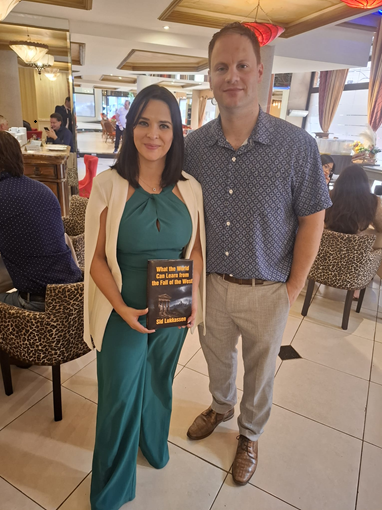
What the World Can Learn from the Fall of the West is a deep dive into the forces shaping the future of Western civilisation. Sid Lukkassen looks at politics, but also at history, culture, technology, economics, demographics, and geopolitics, to explain why the West is in a deeper crisis of identity. He examines how changing values, globalisation, digital media, weakening social cohesion, and shifting power dynamics have eroded the foundations that allowed Western societies to be resilient.
By Anthionette Gwen
During the discussion, Sid contends that many of today’s problems are interrelated rather than isolated. He looks at the impact of technology on democracy, the power of cultural narratives in shaping societies, the impact of demographic change and the increasing competition between the West and rising global powers.
The book asks what makes a civilisation last, and what happens when it loses faith in its identity and purpose. I liked the book’s readiness to address big questions. It doesn’t provide quick answers or easy solutions; instead, it encourages readers to think critically about the forces shaping the modern world.
One of Sid’s greatest strengths in the book is his ability to dissect a wide range of contemporary developments, such as political polarisation, technological change, demographic shifts, globalisation, media influence, and geopolitical competition, through a unified civilisational framework. The breadth of the book enabled me to see issues usually discussed in isolation as connected.
And I liked Sid's willingness to engage with long-term historical patterns.
His explanation about cultural identity, social cohesion, and institutional decline had me think about the deeper forces that shape societies over generations. In particular, I found the book noteworthy for its treatment of technology and media.
Sid asks important questions about how digital platforms shape public discourse, political participation, and individual psychology. These chapters are some of the most compelling and accessible parts of the book because they address challenges that affect people across the political spectrum.
Overall, it was wonderful to see him arguing his case with clarity and urgency, so the book is never remote or detached from the issues it explores.
I will recommend this book to readers interested in history, politics, culture, or the future of Western society because it is an engaging and intellectually stimulating read.
RATING: 5 / 5 Stars.
Anthionette Gwen is a distinguished book reviewer and editor with over three years of experience working with authors and publicists. She has reviewed more than 140 books across a wide range of genres and is recognised as the #1 Top Reviewer on Goodreads. Her reviews are known for being honest and in-depth, while her editorial work helps authors strengthen their manuscripts. She is dedicated to helping books reach and resonate with their readers.