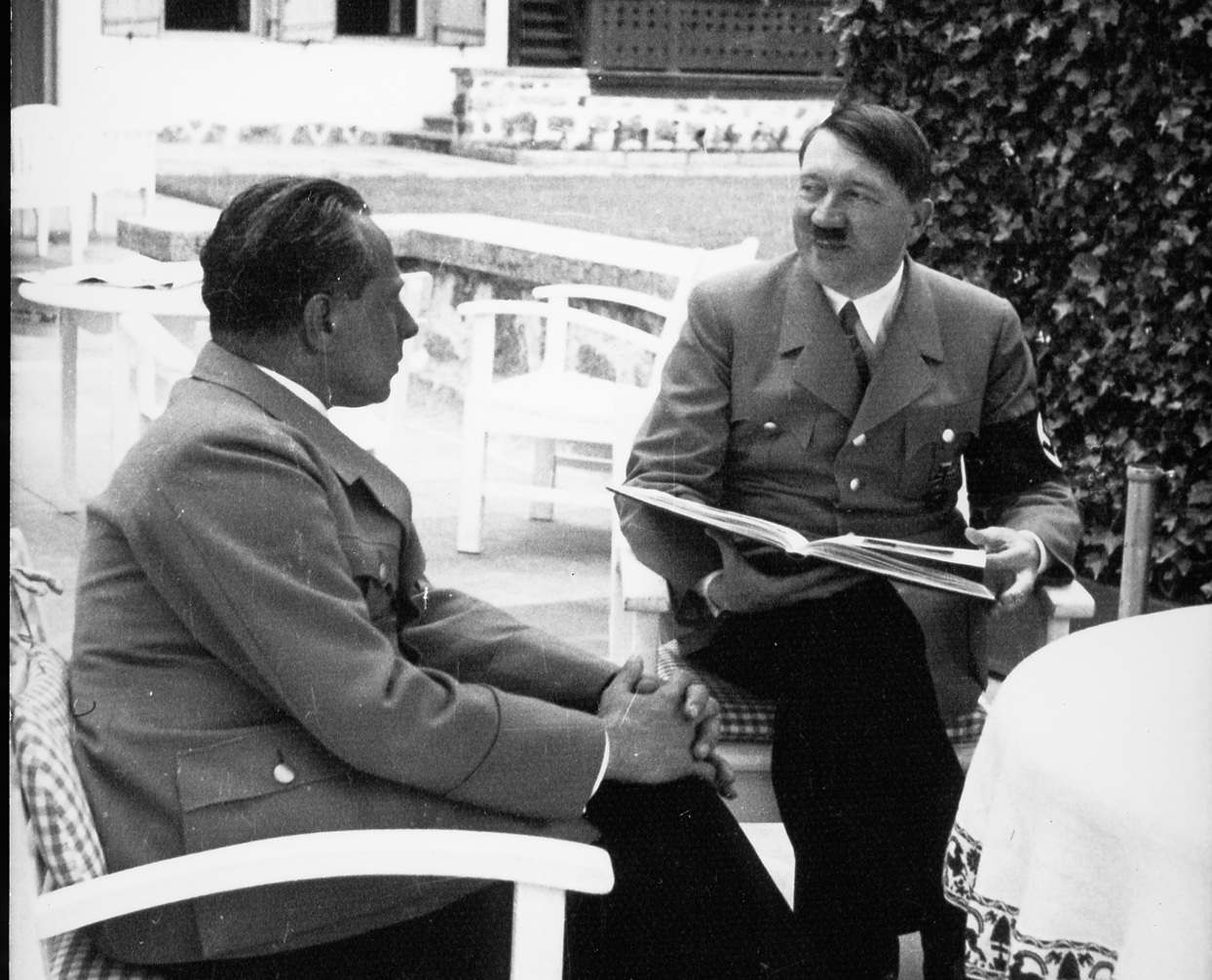
“What do you think my upcoming book, “Zin in Chaos” [A Taste for Chaos], needs to achieve even greater success in its crowdfunding campaign?” The answer was: “A text that makes it even clearer that National Socialism is a leftist movement and that Adolf Hitler was a leftist politician.” I invite you to view the crowdfunding page (including the video) and donate to the project
When we examine chaos and the search for meaning, we inevitably arrive at National Socialism—and specifically at Adolf Hitler (1889–1945) as a politician. After all, much of the current chaos in Europe stems from the fact that values such as cultural self-worth (at least when applied unilaterally to European peoples), discipline, strong leadership, and a sense of national unity have been declared absolute taboos and are actively rejected. Yet these very values are essential for any civilisation striving to carve out a future for itself in this harsh, chaotic world.
This process of erosion is linked to a secular metaphysics that took hold in the West during the decline of religious observance. Hitler has taken the place of Satan, and National Socialism plays the role of absolute evil.
Note two things here. First, it is a negative metaphysics: there are no positive ideals to strive for—what defines the stance is simply what is being opposed. Second, in practice, leftist politics shares many similarities with Hitler’s politics: it was not without reason that Hitler’s followers called themselves National Socialist.
This selective amnesia follows the maxim of the leftist agitator Saul Alinsky: “Accuse others of what you do.” One should instead hold fast to the wise words of Winston Churchill: “The fascists of the future will call themselves anti-fascists.”
Nick Fuentes as an Iconoclast
In December 2025, a debate between Piers Morgan and Nick Fuentes was watched by millions.[1] The underlying theme driving the debate was that the narrative of the Second World War (as told by the victors)—including the Holocaust—serves as a founding myth for Western civilisation.
The negative consequences of this founding myth have become so apparent that Fuentes—who literally described himself as an "iconoclast" during that debate—launches a frontal attack on this founding myth and the worldview associated with it.
A founding myth fulfils three functions. The myth explains the origin and structure of both the world and society. It defines ultimate good and evil; from this polarity are derived the values invoked to justify the possession and exercise of power. Thirdly, the myth establishes what is considered sacred and holy within society.
In the West, the narrative of the Second World War fulfils all these functions. Borders on the map, social institutions, our understanding of the era we live in—all of it is rooted in the Second World War.
Thus, the "ultimate evil" is the Nazis, and the ultimate good is "fighting Nazis." The consequence—precisely because this constitutes a negative theology—is that Nazis must be found, even when they are not there. Even in the absence of racist oppression, it must be uncovered because this follows from the way this morality justifies its own existence.
Collective self-loathing
The values distilled from this narrative are known today as anti-racism, equality, diversity, anti-nationalism, and so forth. The consistent result is that all ethnic groups are permitted to feel pride and self-worth—and even receive subsidies for doing so collectively—yet the moment white people with conservative leanings cultivate social cohesion, this is attacked and dismantled by societal institutions.
Ultimately, what emerges as sacred—what must not be mocked or relativised in the West—is the Holocaust.
Our problem is that the effects of all three functions are regressive.
This mythical moment was not a fresh start characterised by new life and flourishing growth—as seen in Greek and Roman myths, where fertility goddesses, rushing waters teeming with alluring nymphs, acanthus leaves, and the cornucopia feature prominently; rather, the Second World War and the Holocaust represent moments of mass murder, large-scale destruction, and total self-flagellation.
Thus, the highest good does not occupy the central place within this mythos; instead, that place is held by the very thing against which we define ourselves. The central role in this mythos is not played by the hero—who defies obstacles and triumphs over himself—but by the villain: Adolf Hitler, who seduces his people and drags them into a catastrophic downfall.
What is deemed sacred is not the mysterious or the sublime, but the ultimate perversion: the Holocaust, in which Western industrial knowledge—the mastery of the material world born of human ingenuity—turns against humanity itself by exterminating Jews and political opponents on an industrial scale.
Inverted Messiah
From the perspective of this negative theology, Hitler became a Messiah in the inverted sense: the ‘Occidentophobia’ that characterises our current era is a lingering effect of his extreme nationalism. After all, always doing the exact opposite is also a form of conformity.
These pieces of the puzzle fall into place all the more clearly when we look at Adolf Eichmann (1906–1962), a ‘desk murderer’ from the Second World War. When Eichmann was captured in 1960, a trial ensued that the Dutch writer Harry Mulisch followed closely.
According to Mulisch, Eichmann was utterly alienated from life, and his prosecution was meant to protect us from our own alienation; in a sense, his prosecution would heal us and bring salvation. Like medieval pilgrims, the jurists journeyed to Jerusalem—as if a fountain of eternal youth had sprung up there—yearning for tangible contact with the founding myth.
The Provo activist Duco van Weerlee once remarked that if Prince Claus had not existed, the progressive Netherlands would have had to invent him.[2] The same applies to Eichmann, as is evident from Mulisch’s writings, for Eichmann became the demon who would henceforth cast suspicion on any claim to authority. Not merely illegitimate authority, but any authority:
Eichmann, the desk murderer
“Eichmann is no exception: he embodies the utterly ordinary human being—the ‘mass animal’ or ‘creature of ordinariness’—and the mechanical recipient of orders. He walks the earth in the millions. Eichmann was, in fact, the quintessential ‘little man’.”[3]
In doing so, Mulisch superimposed the image of the perfect war criminal onto that of the dutiful citizen. This aligned perfectly with Frankfurt School authors such as Adorno and Fromm, who offered scathing analyses of obedience to ‘the order’.[4]
“Coming from the bourgeoisie, I had seen nothing around me but moderation, liberalism, mere survival, prudence, melancholy, hypochondria, collaboration—a stifling stagnation,” Mulisch observed regarding middle-class values.
He did note, however, that a Nazi like Goebbels had not exactly been ‘prudent’ or ‘liberal’; yet to this he responded: “that Goebbels’s ceaseless talk of ‘radicality’ was nothing more than the radicality of the smell of Brussels sprouts—which sought to be radically and totally the smell of Brussels sprouts.”[5]
Law-abiding family man turns out to be the true fascist!
With this reinterpretation, the fascist was no longer a dynamic personality seeking heroism and thus swept up by Mussolini’s passionate rhetoric. The true fascist turned out to be the respectable family man of the 1950s!
Half a century later, the terms ‘Left’ and ‘Right’ are still referenced in socio-political debate; one belongs to the ‘Left’ or to the ‘Right’. This concept dates back to the French Revolution, when a spatial division emerged within the French Estates-General. Proponents of preserving the old power structures sat on the right, while opponents sat on the left. Before we can place Hitler on this axis, we must define both poles.
The Left champions the idea of a malleable society and embraces utopianism: all people must become brothers. The Left operates on the utopian vision of a unified world and the belief that institutions are needed to facilitate this unification. This leads to transnationalism and the exercise of technocratic power, underpinned by apocalyptic fears (climate change, coronavirus, Russia).
Defining Left and Right
The Right, by contrast, cherishes a healthy sense of self-worth and is averse to state-driven collectivism that restricts individual freedom of movement. For the Left, intentions—or ‘feeling good’—matter more than effective functioning, whereas the Right looks at practical outcomes in reality: the yield and the results. The Right is satisfied if something functions with sufficient efficiency.
The Left favours societal reform fundamentally aimed at the collectivisation of capital goods and property. The far-left seeks to replace capitalism with a socialist or communist form of government focused on equality and based on ‘inclusion’. This equality and inclusion are intended to translate not so much into equal opportunities as into equal outcomes.
The twentieth century was the era of the Left's rise, initially driven by Karl Marx. His followers included Lenin, Stalin, and Mao, as well as Hitler; they aimed to subordinate the individual to the collective completely.
Communists called this the “classless society,” while in Nazi terms it was known as the “people’s community” (Volksgemeinschaft). Individual self-worth is destroyed, and anyone who might resist must be deported or killed. The end justifies the means in the pursuit of a society that can be socially engineered.
Hitler is one of the top left-wing mass murderers
Hitler fits into the leftist mould because he was a collectivist who thought in terms of masses of people, showing disdain for the individual. We see this reflected in leftist thinking today; consider, for instance, the statement by American Democrat Ayanna Pressley:
“We don’t need any more black faces that don’t want to be a black voice.”[6] This statement reduces a person's individuality to a mere expression of racial characteristics and group consciousness. It is the height of racism and collectivism.
Socialism counters the unbridled nature of capitalism with order—the organisation of the entire people and society, implemented down to the last detail. For this reason, Hitler—along with other Nazis like Otto Strasser—delivered speeches attacking the capitalist system.[7] Goebbels stated that National Socialism had to be revolutionary to “defeat the slavery of international capital.”
Once the Nazis controlled the state, business interests became aligned with the state's interests and objectives. The state issued commands, and entrepreneurs—insofar as they still deserved that title—obeyed. Both Nazis and Communists advocated for five-year plans: tightly controlled economic programs designed to shape their totalitarian states.
Under the guise of the “people’s community” (Volksgemeinschaft), private profits were nationalised; property was no longer an inalienable right, as it was in classical liberalism. In this way, Hitler destroyed the free-market mechanism.
The Left adopts Nazi institutions.
During the occupation, the German authorities implemented this corporatist model in the Netherlands as well. What is striking is that, following the liberation, these institutions were not merely preserved by left-wing administrators and activists; they were subsequently taken over and used to embed their own ideology more deeply within society.
In his book The Dictators (2004), British World War II expert Richard Overy compares Stalin and Hitler. Overy argues that Hitler viewed capitalism as a creation of the Jews—as illustrated by the well-known cartoon depicting a Jewish man as a capitalist in a three-piece suit with a watch chain.
This is precisely what Karl Marx himself argued in On the Jewish Question (1843): “Christianity is the ethereal, spiritual aspect of Judaism, which is no longer relevant in this capitalist era. What remains of Judaism is huckstering, speculation, and usury—capitalism itself.”
This statement explains why the Nazis linked nationalism with socialism: the German people could only be saved if, acting as a single community, they broke free from the shackles of international capital flows.
Cultural Marxism & Oikophobia
Communism and National Socialism both advocate for a society that can be engineered—centrally directed and driven by a utopian vision—and are therefore leftist ideologies. This raises the valid question of why nationalism is invariably labelled as right-wing.
The reason likely lies in its connection to pride and self-worth—sentiments that white people are no longer permitted to experience under the influence of Cultural Marxist oikophobia.
But what is actually strange about prioritising the interests of one’s own people? That "own people" refers to the taxpayers themselves; without them, the practice of politics would be impossible. Anyone reading letters from the era of Thorbecke—who revised the Dutch Constitution in 1848—will see that nationalism was closely linked to the emancipation of the people.
It was, in fact, the local barons who sought to keep the country’s administration feudal and fragmented. Without nationalism, there would have been no national platform to which they would have been accountable; instead, they could arrange everything through direct, private channels to the King.
Grand Mufti: Part of the Nazi Establishment
(extreme) nationalism is not the only defining characteristic of Hitler. His vegetarianism and animal rights activism are closely linked to leftist ideologies. Islam, too, aligns well with his worldview—particularly its collectivism, the Ummah. We must not forget his collusion with the Grand Mufti, who was a celebrated guest in Berlin during the war.
This Mufti called Eichmann "the Arabs' best friend."[8] Even the deportations of minorities fit within leftist collectivist ideology: they served the goal of creating an engineered society. This desire for a society that could be engineered also manifested itself in 1935, when the Nazis proclaimed the Reichsnaturschutzgebiet—the most far-reaching forest protection program in the world. Its purpose was to “protect the landscape from Jewish-capitalist pollution” in the name of “ecological diversity and sustainability”—familiar leftist hobbyhorses.
After the Second World War, these hobbyhorses were kept alive, albeit in new forms. Forest walking trails were designed to be dull and geometric, aiming to desacralize the woods as thoroughly as possible. The last thing anyone wanted was for a hiker to catch a glimpse of Odin behind the tree bark—for from that single glimpse, a mythical, nationalist sense of European self-worth might easily reignite…
Death tolls from leftist mass murders
If we tally all the victims of the respective regimes, estimates[9] yield the following figures:
– Hitler’s National Socialism, with its concentration camps, accounts for 17 million murders.
– Stalin’s Communist socialism, with its Gulags, accounts for 23 million murders.
– Mao’s socialism, with its re-education camps, is responsible for 78 million murders.
Exposing these leftist aspects of Hitler’s politics is painful (for the Left), yet it is vitally important to keep them in mind. However, they must not distract from the main point: the negative theology—that toxic "down with us" metaphysics. To that end—in conclusion—let us return once more to the iconoclastic debate between Piers Morgan and Nick Fuentes.
Fuentes on "Hitler is Cool" again.
What Fuentes presented there, with his "Hitler is cool" stance, served to break the Final Seal. And that Final Seal is the keystone holding the entire moral framework of the modern West together. "Hitler is ultimate evil" constitutes the Final Seal because, for the establishment, it is literally more important than women's suffrage, the climate narrative, or Islam as a "religion of peace."
For once this seal is broken, it becomes conceivable again that white/European ethnic groups deserve self-respect and may take pride in their achievements—and that they have interests specific to them as a group. Naturally, this concept defies globalism, technocracy, and multiculturalism.
All of this lies concealed behind the idea that "Hitler is absolute evil." If this seal is broken, the West will undergo a Copernican shift. It will be what Auguste Comte and Michel Houellebecq call a “metaphysical revolution”—comparable, in a moral and spiritual sense, to the crucifixion of Christ—a complete reorientation of values.
If you find this article incredibly valuable, head over to the author's crowdfunding page and help ensure it makes it into the book.
Sources:
[1] https://www.youtube.com/watch?v=X_KXvjOJ7YA (28/6/2026).
[2] Duco van Weerlee, Wat de provo’s willen, (Amsterdam 1966) 35.
[3] Harry Mulisch, De zaak 40/61, 132-4, 183.
[4] Arthur Herman, The Idea of Decline in Western History, (Londen 1997) 295-328.
[5] Harry Mulisch, De toekomst van gisteren, (Amsterdam 1972) 39.
[6] https://thehill.com/homenews/house/453007-pressley-democrats-need-any-more-black-voices-that-dont-want-to-be-a-black/ (29/6/2026).
[7] As in the speech of 1 May that John Toland attributes to Hitler in his 1976 biography. See also the speech ‘Warum wir Antisemiten sind’, delivered by Hitler in 1920 and published in 1933.
[8] https://www.camera.org/article/camera-op-ed-when-hitlers-mufti-gave-a-press-conference/ (29/6/2026).
[9] https://denieuwezuil.nl/hitler-een-socialist-ja/ (29/6/2026).





So, Sid, this is a lie and you know it. The NSDAP was never a leftist political party. You're a worthless son of a whore.
[…] rights for the citizenry, sat on the left side of the chamber.Read part 1 of this two-part series hereThis political landscape, characterised by a clash between conservative monarchies and republican […]