Dutch mainstream media outlets appear to have been instructed to report exclusively negative news about Israel. Even more concerning is that history is apparently taught only barely at journalism schools. This is no innocent oversight. Those who do not know history cannot understand the present. And those who do not understand the present easily become mouthpieces for the whims of the moment. That is precisely what we see happening every day.
By Oscar Hammerstein
Developments in Lebanon offer a striking example of this. Hardly anyone explains how the current situation came about anymore. It is as if history only began the moment Israel responded; as if Hezbollah appeared out of thin air; as if Syria and Iran never played a role.
Without historical context, journalism turns into activism. With an understanding of history, one can easily explain why Iran demands Israel’s withdrawal from southern Lebanon as a condition for peace with the United States.
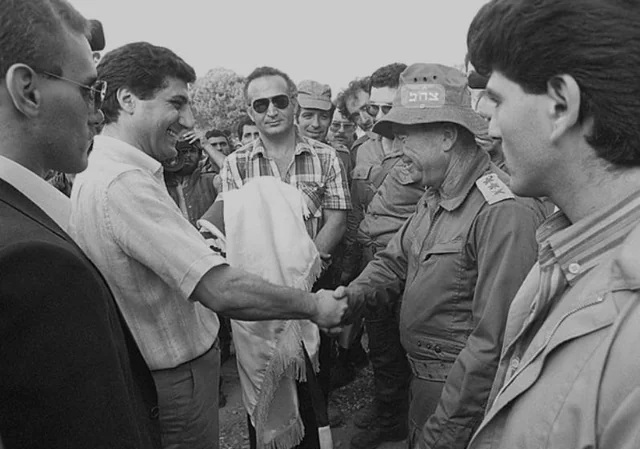
Yesterday, Sunday, June 28, marked exactly forty-four years since Israeli troops pushed deep into Lebanon. At that same moment, US special envoy Philip Habib arrived in Tel Aviv, determined to give Defence Minister Ariel Sharon a stern talking-to.
Ariel Sharon (1928–2014) fought as a young officer in the 1948 Arab-Israeli War and rose to become one of Israel’s most successful generals. He played a pivotal role in the Six-Day War and the Yom Kippur War, during which he encircled the Egyptian army by executing a daring crossing of the Suez Canal.
As Minister of Defence, he led the 1982 Israeli invasion of Lebanon to drive the PLO out of southern Lebanon. Sharon later returned to serve as Prime Minister of Israel (2001–2006).
Habib (1920–1992) was one of the most influential American diplomats of the Cold War era and was regarded as the United States' premier crisis negotiator in the Middle East. During the 1982 Lebanon War, President Reagan tasked him with three nearly impossible missions: brokering a ceasefire between Israel and the PLO, organising the evacuation of thousands of PLO terrorists from Beirut, and preventing the conflict from escalating into a confrontation involving Israel, Syria, and—ultimately—even the Soviet Union.
Habib—who made little effort to hide his disdain for Sharon—believed he had the situation fully under control. He insisted that Israel withdraw and stop pressuring the vulnerable Lebanese government to align with Israeli interests. Sharon listened in silence, leaning back and allowing the American diplomat to finish speaking.
When Habib had finished, Sharon played his own trump card. He placed a secret document he had quietly drafted with a confidant of the Lebanese leadership on the table. It outlined the framework for a peace settlement: the normalisation of relations, security arrangements, and a phased Israeli withdrawal, with Israel retaining a few forward positions on Lebanese territory.
Habib thereby discovered that he was effectively sidelined. Sharon had completely bypassed the American mediators. Through a private envoy, he had negotiated a detailed peace agreement directly with Lebanese President Amin Gemayel. Habib’s diplomatic mission thus proved essentially futile. Yet history never repeats itself literally; it merely rhymes. And that is precisely why last Friday's development is so remarkable.
For the first time since the short-lived peace treaty of 1983, Israel and Lebanon have announced a new framework agreement. Both countries commit to ending their formal state of war and working towards normal relations through follow-up negotiations.
The core of the agreement is as simple as it is revolutionary. Lebanon pledges to completely and verifiably disarm all non-state armed organisations—with Hezbollah explicitly named in this context. At the same time, the entirety of Lebanese territory must return to the authority of the Lebanese armed forces.
In return, the Israeli army will withdraw in phases. Not all at once. Not blindly. Instead, the withdrawal will proceed zone by zone, each time following independent verification that disarmament has actually taken place. Two pilot areas have already been agreed upon. Further details will be set out in a security annex yet to be drafted.
Moreover, Lebanon explicitly recognises Israel’s right to exist and confirms that only the Lebanese state has the authority to use force within its territory. For its part, Israel declares that it makes no territorial claims on Lebanon. That may sound technical, but in reality, it represents a fundamental power shift.
In short, Lebanon is effectively ‘renting out’ a portion of its own territory to Israel temporarily, allowing Israel to evict the problematic tenant—Hezbollah. Only after the area has been “cleared” will Lebanon get the keys back. The ultimate reward is the normalisation of relations.
On paper, this involves a phased Israeli withdrawal. In reality, Lebanon acknowledges that Israel will remain in southern Lebanon until Hezbollah is truly gone. That presence has once again exacted a heavy toll; this morning, 21-year-old Captain David Hazut was killed in a firefight with a Hezbollah fighter in southern Lebanon.
For the past four months, Iran has incessantly demanded that Israel withdraw from Lebanese territory. The Lebanese government’s response is now, in effect: “You have to get out first!”
Even if full normalisation ultimately fails to materialise, this agreement already represents a strategic victory for Israel. Not because Hezbollah has been defeated today. Not because peace will break out tomorrow. But because the agreement ends a geopolitical model that has held Lebanon captive for decades.
Until now, the system worked as follows: whenever Israel wanted to maintain a presence in southern Lebanon, it had to negotiate the matter with Washington. Hezbollah, by contrast, was accountable solely to Tehran.
The Lebanese government played hardly any independent role; it constantly wavered between two extremes—acting as an extension of Hezbollah on the one hand, and as the powerless façade of a failed state on the other. That is precisely the pattern this agreement seeks to break.
For the first time, the United States has decisively drawn the official Lebanese government itself into the anti-Iran camp. And unlike the initial 1983 Israeli-Lebanese peace treaty, this agreement is specifically designed to make Washington a lasting and indispensable partner.
In doing so, Lebanon is not merely choosing a future without Hezbollah; it is opting for a different kind of Lebanon—one that is rebuilt, economically supported, and politically sustained with American backing. It could hardly be summarised more simply.
Lebanon needs Donald Trump to stand firm against Hezbollah, and it needs Israel to carry out the necessary military action. For Prime Minister Netanyahu, this development comes at a highly opportune moment.
Even if Hezbollah is not eliminated before the elections—a distinct possibility—the political dividends could be substantial if the Israeli public comes to view the situation in southern Lebanon not as an endless war of attrition, but as a process of gradual military and diplomatic progress.
The international picture is shifting as well. While this agreement will not suddenly endear Netanyahu to the international media, it does validate a strategy that faced near-universal criticism for years: the idea that a military operation need not always wait until every political question regarding "the day after" has been fully resolved. That was one of the primary criticisms levelled against Israel regarding both Gaza and Lebanon.
What is the plan for what follows? Who will govern? Who will take power? Reality once again proves more intractable than theory. Sometimes, a political solution emerges only after the military reality has changed.
As was evident in Gaza, destroying a terrorist organisation's military capabilities can create new political possibilities that simply did not exist before. That is no guarantee of success, but it is a strategy. And strategy is judged only in retrospect—not during its execution. Yet, only an optimist would believe that this solves every problem.
On the contrary, the greatest weakness of this agreement is also its greatest strength. What Lebanon promises today, it can retract tomorrow. History proves this. That is precisely why this second agreement is necessary; after all, the first one did not hold.
In 1983, peace also seemed within reach. That hope was shattered almost immediately by the assassination of the intended architect of peace, President-elect Bashir Gemayel. On September 14, 1982—just nine days before his official inauguration—he was killed in a massive bombing at the headquarters of the Kataeb Party (better known as the Phalangists) in Beirut.
The attack was carried out by Habib Shartouni, a member of the Syrian Social Nationalist Party, with the assistance of Nabil Alam. The perpetrators acted on orders from the Syrian regime of Hafez al-Assad—an ally of the ayatollahs in Tehran. This is hardly surprising; Assad and Tehran fiercely opposed Bashir Gemayel’s pro-Israel stance and his pursuit of a lasting peace treaty with Israel.
After the assassination, his older brother, Amin Gemayel, became president. He did indeed sign a peace agreement with Israel in 1983. However, Syria exerted such intense political and military pressure that the agreement was never truly implemented. The treaty was gradually eroded, with domestic opponents joining the opposition.
Within a year, Lebanon withdrew from the agreement entirely. The peace treaty never actually came into effect. That past serves as the greatest warning today for anyone who believes that a signature is enough to guarantee peace. Paper is patient; the Middle East rarely is.
No one should harbour the illusion that Hezbollah will passively accept this development. Far more is at stake for Hezbollah than merely a military position in southern Lebanon; the organisation risks losing its monopoly on power, intimidation, and foreign influence.
This would also severely weaken Iran’s grip on Lebanon. Consequently, Hezbollah will do everything in its power to ensure this agreement meets the same fate as the 1983 peace treaty. The organisation has several weapons at its disposal to achieve this.
The first is intimidation. Many believe that President Joseph Aoun and other prominent Lebanese proponents of the agreement face a genuine risk of being targeted. Hezbollah MPs have already declared that they will oppose any attempt at disarmament and that the Lebanese army will be unable to force them to comply.
The second weapon is mobilising the streets. Hezbollah supporters have already taken to the streets of Beirut in large numbers to demonstrate against the agreement. In doing so, they are making good on their earlier threat to mobilise the Lebanese "street" against any attempt actually to implement the accord.
The third tactic is delegitimisation. Hezbollah leaders are attempting to portray the agreement as illegitimate and are deliberately sowing doubt about its contents. For instance, parliamentary bloc leader Mohammad Raad described the deal as a "cover" for a permanent Israeli military presence, even though the agreement explicitly states that Israel has no territorial ambitions in Lebanon.
The message behind this campaign is clear to everyone: challenging Hezbollah risks a return to the Lebanese Civil War. Moreover, Hezbollah continues to be backed by Iran—albeit an Iran weakened by war. Tehran has never respected Lebanon’s sovereign decisions, and there is little reason to assume that this will suddenly change now.
Iran is even using the agreement as an argument to delay the nuclear negotiations further.
According to Tehran, the deal conflicts with the provisions regarding Lebanon in an earlier memorandum of understanding. This shifts the focus back to Washington—and ultimately to Donald Trump.
The question is not merely whether Israel will hold out militarily. The question, above all, is whether the United States will hold out politically. History teaches us that agreements in the Middle East rarely collapse at the negotiating table; they fall apart the moment international attention wanes.
As recent history has once again demonstrated, the history of this region is rewritten almost every week—and just as often, rewritten again. It is therefore entirely possible that this agreement, too, will ultimately suffer the same fate as so many previous treaties: abandoned, left unimplemented, and eventually reduced to a mere footnote to the next war.
But suppose it does endure. Suppose Hezbollah is actually disarmed. Suppose Lebanon regains its sovereignty. Then June 26th might well go down in history as the day a broken nation began its long journey back to what it once was: the Paris of the Middle East. It is a possibility.
Yet even that possibility represents more hope than Lebanon has seen in decades. Perhaps that is the most important lesson history offers: not that peace emerges spontaneously, but that it stands a chance only when states are willing to reclaim their sovereignty from militias, terrorist organisations, and foreign powers.
And perhaps there is a second lesson. Anyone who reports exclusively on the Israeli military presence in southern Lebanon while remaining silent on the disarmament of Hezbollah, the role of Iran, the history of Syria, the assassination of Bashir Gemayel, and the responsibility of the Lebanese state is not practising journalism; they are engaging in propaganda.
To truly understand what is unfolding in Lebanon today, one must be willing to look further back than yesterday’s headlines. The truth rarely fits into a ninety-second news bulletin. That leaves only one thing to say: Well done, Marco Rubio!