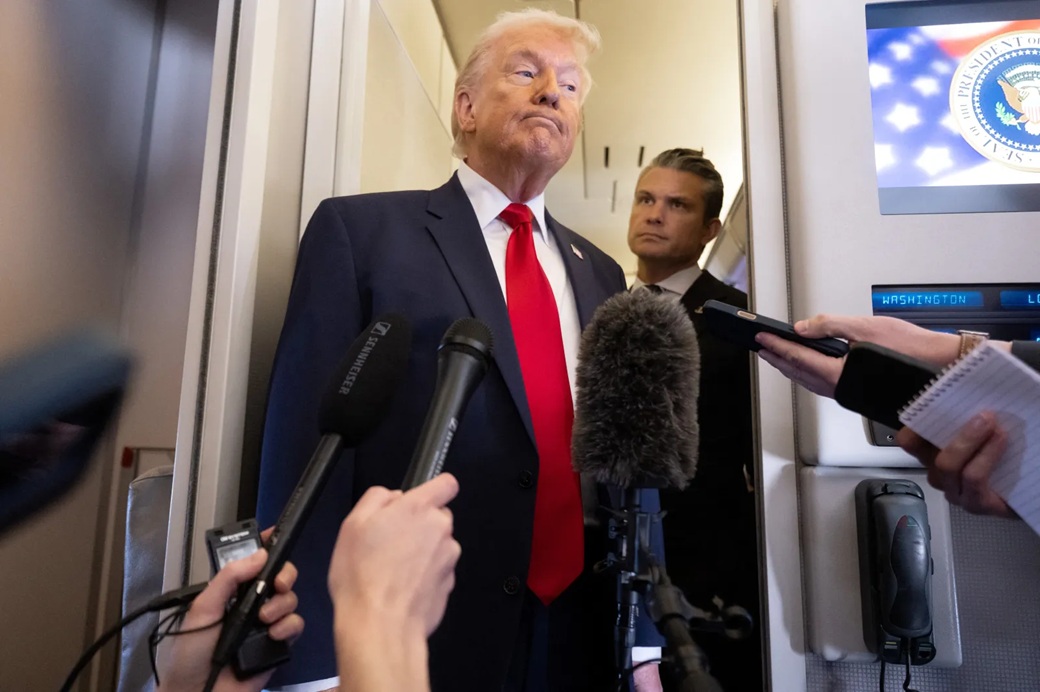
The increasingly frequent periodic statements by current U.S. President Donald Trump about “guardian” control over the Strait of Hormuz and the possibility of levying duties on passing vessels, as well as the threat of using force against Iranian energy infrastructure, demonstrate that Washington is considering at least two main tracks for ending the conflict — a diplomatic one and a military one.
By Alihuseyn Gulu-Zada
All of this indicates the existence of at least two possible outcomes for the conflict’s conclusion. It is worth noting that the US president’s own words make it clear that behind-the-scenes negotiations between the parties (through intermediaries) are nevertheless ongoing.
In general, the root of the entire Iranian crisis lies in the fact that neither side has been able to demonstrate a decisive advantage on the battlefield. As for the United States and Trump personally, the head of the White House has essentially failed to fully resolve either the issue of the safe functioning of the Strait of Hormuz (which was open before the crisis began) or the Iranian nuclear question.
The American side’s manner also lends the situation a certain predictability. On the one hand, Trump publicly issues ultimatums — demanding the full and immediate opening of the Strait of Hormuz under threat of “zeroing out” Iran’s energy system, destroying bridges, and oil infrastructure.
On the other hand, he allows for the possibility of a “significant agreement” in the near term, linking the lifting of some sanctions and the unfreezing of a limited volume of frozen Iranian assets to concessions on the nuclear program and the regime governing the Strait of Hormuz.
This dual positioning creates an incentive for an already difficult negotiating partner, Iran, to simultaneously test the military threshold of US patience and exploit diplomatic windows of opportunity.
The diplomatic track
Hormuz as the “core” of a potential deal. As noted above, the question of the functioning of the Strait of Hormuz currently occupies priority status in any advancement of the diplomatic track.
Earlier drafts of a memorandum that have already been discussed envisaged that Iran would undertake an obligation to open the strait to all commercial vessels immediately. At the same time, the United States would lift the maritime blockade and ease oil sanctions for a certain period.
Iranian sources and officials continue to insist that management of the strait (routes, transit times, issuance of permits) must remain the exclusive prerogative of Tehran. Notably, in one of his recent statements, Iranian Foreign Minister Abbas Araghchi indirectly compared the situation in Hormuz to the Turkish straits, asserting Tehran’s right to charge fees for services ensuring the passage of vessels.
The nuclear case — rhetoric and uncertainty. In retrospect, it was precisely the Iranian nuclear dossier that became the key factor in the current crisis. After the start of the large-scale US-Israeli coalition operation against Iran, under the pressure of a wartime situation, part of Iranian political and expert discourse shifted from the formula “we do not seek a bomb” to “the right to a hard response.”
As for the question of Iran’s frozen assets, open sources had previously mentioned a sum on the order of $24–25 billion in Iranian assets that the United States could unfreeze in several stages in exchange for an end to the war and restrictions on Tehran’s nuclear program.
At the same time, Trump’s statements of 27 July 2026 about using frozen Iranian funds to compensate for damage to commercial vessels in Hormuz and adjacent waters in response to periodic strikes against them by the IRGC effectively change the logic of this issue as well.
This potential step by the American side would, in prospect, further escalate the conflict and the potential diplomatic track, because just a few hours after Trump’s message, the IRGC called such an initiative involving the funds a “dangerous precedent.”
The military track. The limited effectiveness of force
The 13-day phase of active US strikes on the waters of the Strait of Hormuz (against the IRGC’s military-logistical infrastructure) demonstrated Iran’s ability to withstand pressure and refuse to sit down at the negotiating table “under coercion.”
Even after this, Tehran continues de facto to block the Strait of Hormuz to vessels of countries participating in the war against it and demonstratively rejects the deadlines and conditions of US ultimatums.
Additionally, this “coercion” strategy has produced conflicting opinions regarding the personal prospects of CENTCOM command.
Just days ago, CENTCOM commander Admiral Brad Cooper was among those who recommended to the Pentagon and the White House that the campaign of strikes against Iran be concluded due to its ineffectiveness, as well as concern over a possible shortage of air- and missile-defence interceptors (Patriot, THAAD, NASAMS) and long-range missiles in the event of Iranian retaliatory strikes during a potentially protracted escalation.
It should be noted that as military objectives have clearly been exhausted, Washington has also begun striking Iran’s critical logistical infrastructure — ports, bridges, and energy facilities. Trump, who had previously repeatedly publicly threatened to “wipe Iran off the face of the earth,” has also repeatedly publicly threatened to “zero out” Iranian energy facilities, “starting with the largest power plant,” and to destroy oil islands such as Kharg if Tehran refuses to open the Strait of Hormuz.
In response, the IRGC declared its readiness to strike energy supply systems and desalination plants linked to the United States and its allies in the region.
Of course, beyond this, the media continue to periodically circulate rumours about a possible US ground operation against Iran. And here the question arises: did the 13-day US bombings of the Persian Gulf waters pursue solely the goal of reducing the IRGC’s ability to strike commercial vessels in the Strait of Hormuz, or were the American precision strikes also intended (in the event of a complete collapse of diplomacy) to significantly facilitate a hypothetical landing of American troops on the Iranian coast?
Overall, the risk of a ground operation against Iran truly holds nothing good for the United States and threatens Trump with the loss of the presidential seat in the next election, together with a potential Republican defeat in the upcoming November Senate elections.
The most probable outcomes
It is becoming obvious that making concrete forecasts (especially short-term ones) regarding the development of the situation between the United States and Iran remains a futile exercise, at least because of the presence of two “destabilising factors” in the persons of Donald Trump (1) and the IRGC (2).
But it is still possible to outline an outcome with some degree of probability. And here the following situation emerges in the event of a failure of diplomacy:
Under the most realistic military outcome, the actual functioning of the Strait of Hormuz will take place with periodic escalation, in which both the United States and Iran will claim control over this waterway. That is, an endless “hybrid conflict” will continue in Hormuz, affecting energy prices.
And overall, it is most likely that the Strait of Hormuz will indeed no longer function as before and will be divided into an Iranian (northern) and an Omani (southern) sector. The technical details will become the subject of future negotiations.
On the nuclear question, if diplomacy fails, the most probable course will be a powerful U.S. bombardment of Mount Kolang (under which, according to CIA and Mossad reports, Iran is sheltering stocks of enriched uranium) and other nuclear facilities.
But such an operation would last a maximum of 2–3 days, after which Trump could declare the “destruction of Iran’s nuclear potential.”
Alihuseyn Gulu-Zada is an independent analyst and researcher specialising in geopolitical processes, risk dynamics and security, as well as the history of the South Caucasus and Iran. His research interests include the peace process between Armenia and Azerbaijan, domestic and foreign policy trends in Iran with implications for the Middle East, and Russia's and Turkey's external vectors in the South Caucasus. His previous contribution to The Liberum can be found here.