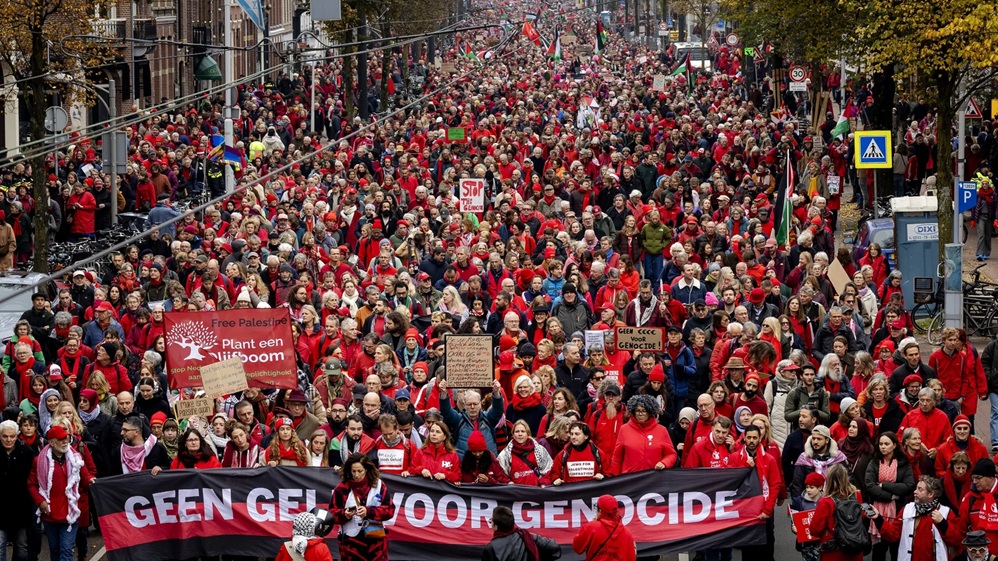
It was a sea of crimson, though from a distance, it looked more like a vast field of silver. Last weekend, Amsterdam bore witness to the "Red Line" demonstration, a massive, impeccably organised manifestation against Israel's policies and Western complicity. Welcome to Jurassic Park, where the dinosaurs of mid-century European social democracy still roam, louder and more determined than ever.
By Ken van Ierlant
Organisers proudly claimed nearly a quarter-million attendees. Yet, for all the urgent, youthful energy usually associated with contemporary street-level geopolitics, the crowd's overwhelming aesthetic felt less like a vanguard of the future and more like a beautifully preserved ecosystem from a bygone political era.
To the casual observer, a mass protest is a volatile cocktail of Gen-Z TikTok creators, climate anxieties, and fluid, decentralised digital networks. But in Amsterdam, the operational muscle did not belong to the internet.
It belonged to the grand, institutional monuments of traditional European progressivism: Amnesty International, Oxfam Novib, and PAX. These organisations' donor databases double as a census of the continent's comfortable, affluent, and fiercely idealistic Baby Boomers.
And they marched. Oh, how they marched.
They arrived by the trainload, cushioned by first-class rail passes and retirement packages the current generation will only ever read about in history books. An undeniable, almost touching nostalgia hung over the gathering. For Europe's ageing left, the "Red Line" march offered a temporary, exhilarating escape from the modern political wilderness.
After decades of watching their beloved welfare states shrink and their traditional political parties fragment into irrelevance, the crisis provided something they hadn't felt in years: a clear moral binary.
Watching these septuagenarians brandish their hand-painted signs was an exercise in evolutionary muscle memory. This is the generation that came of age blocking train tracks to protest American cruise missiles in the 1980s and boycotting South African oranges in the 1970s.
When they look at the West Bank, they do not see the dizzying, intractable complexities of 21st-century Middle Eastern proxy warfare. They see the moral clarity of Pretoria, circa 1985. They see an underdog to defend, a state authority to condemn, and a chance to feel, if only for an afternoon, that history still marches linearly toward justice.
The presence of political royalty lent it ultimate legitimacy. When Job Cohen, the 79-year-old former leader of the Labour Party, stepped onto the cobblestones alongside nearly 300 retired diplomats and former ministers, it wasn't just a protest; it was a reunion of the Old Establishment.
They stood as living monuments to a time when European diplomacy actually believed its own rhetoric about the international legal order, back when the Hague's courts were viewed as the moral compass of the world rather than an increasingly ignored judicial theatre.
The great psychological absolution
Yet, beneath the lofty rhetoric of human rights lay a far darker, more cynical undercurrent of timing and psychology.
The demonstration was meticulously scheduled exactly one day before the annual commemoration of Kristallnacht. To critics of the movement, this timing was anything but accidental; it was a vile, calculated inversion of historical roles. By filling the streets with cries of "genocide" on the eve of the anniversary of the Nazi pogroms, the protest effectively flipped the script, reframing the historic victim as the modern perpetrator.
For the ageing European left, this inversion serves a profound psychological purpose. For decades, Western progressives have carried the crushing weight of a collective "Holocaust syndrome", an enduring guilt over Europe's failure to protect its Jewish population during World War II.
By superimposing Nazi-level atrocities onto the actions of the modern Israeli state, this generation experiences a twisted form of moral absolution. In their eyes, if the descendants of the victims are now committing the same sins as their former oppressors, Europe's historical guilt is magically washed away.
Hamas, through its brutal provocation, inadvertently provided the catalyst that liberated the Western conscience, allowing the silver-haired masses to project their deep-seated neuroses onto the Middle East.
To solidify this collective absolution, the vanguard of the march featured a highly specific, performative asset: the elderly Joodse demonstranten of Een Ander Joods Geluid (EAJG). Walking prominently at the front, these silver-haired figures served as the movement's moral shield.
To critics, their prominent placement felt like a desperate, final straw to clutch at, a frantic bid to be visibly designated and celebrated by the progressive crowd as "the good Jews." By publicly denouncing the Jewish state, they provided the non-Jewish majority behind them with the perfect alibi, validating a rhetoric that would otherwise carry a much uglier historical sting.
The theatre of realpolitik
The true pinnacle of this contemporary political theatre, however, arrived precisely twenty-four hours later, just a few canals away.
On Monday evening, under the heavy, flickering chandeliers of the historic Portuguese Synagogue, Prime Minister Rob Jetten stood before a heavily secured crowd to mark the anniversary of Kristallnacht.
The contrast was dizzying. Jetten, who had famously marched at the front of earlier pro-Palestinian demonstrations in his faded red shirt, delivered a beautifully solemn, almost mournful address on the terrors of rising domestic antisemitism and the "smouldering fires of hatred."
In a masterclass of performative solidarity, the Prime Minister even revealed that he had recently nailed a Delft blue mezuzah to his own front door, an act meant to show his commitment to visible Jewish life in the Netherlands.
It was a striking piece of political gymnastics: hours after his political partners and the general public spent Sunday accusing his government of historical complicity on the Museumplein, the Prime Minister was physically weaponising a sacred Jewish scroll on his doorpost to signal absolute domestic protection.
For the silver-haired progressives who had spent their Sunday drawing red lines in the rain, Jetten's synagogue appearance was a bitter pill of modern realpolitik. To his critics, the spectacle of a Prime Minister who courted the activist left on the weekend, only to wax poetic about the preservation of Jewish safety on Monday while deploying religious artefacts as political shields, was the ultimate display of moral flexibility.
As the sun set over the Rijksmuseum, the sea of red slowly dispersed. The banners were folded neatly away, the thermos flasks were packed, and Europe's most dedicated protest generation headed back to the quiet comfort of their suburban homes.
They had drawn their red line. They had spoken truth to power. But as the silver-haired masses boarded their trains home, one could not help but wonder whether the political ideals they were trying to save were already extinct, and whether Museumplein was less a launching pad for change and more a beautifully curated exhibit of what European idealism used to be.