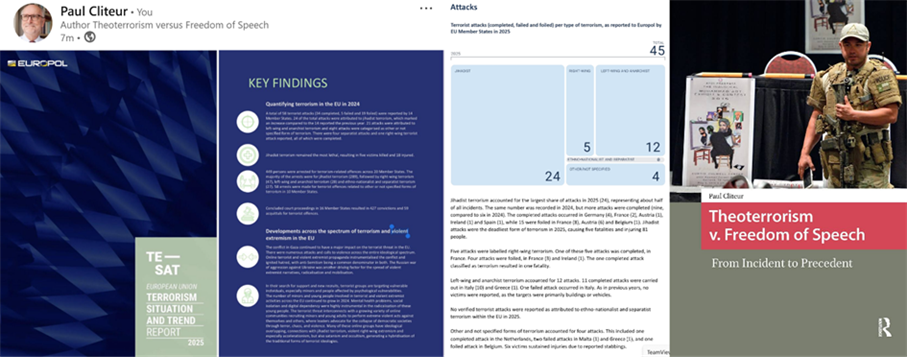
Europol’s 2025 figures show that jihadist attacks outnumbered far-left and far-right attacks in the EU. The article argues that European states nevertheless focus disproportionately on the far-right threat, partly because jihadism is a relatively recent problem.
By Paul Cliteur
Every year, Europol, the umbrella organisation for police services within the European Union, publishes a statistical overview of terrorist attacks carried out in EU member states. Terrorism is a purposeful activity: a terrorist has a particular intention or motive in carrying out an attack.
Europol also records that motive, as established during police questioning or in the trial resulting in the terrorist’s conviction. Europol distinguishes between:
This is a very useful overview because it makes it possible to determine immediately which ideologies pose a major—and indeed the greatest—threat to national security. Is it jihadism? Is it a far-right ideology? Or is it a far-left or anarchist ideology?
The advantage of this overview of the motives for terrorist attacks is that it tells states which ideologies they should focus on when seeking to prevent future attacks. After all, a state must not only punish an attacker; it must also try to discourage support for the ideology that motivated the attacker. A state must therefore seek to discourage jihadism, the far left and the far right.
But in what proportions should the state try to discourage support for these ideologies? Naturally, every terrorist attack must be prevented. In that sense, jihadism, the far left and the far right must all be countered. But because the state also has limited resources, it must consider which ideology motivates the greatest number of attacks. It is reasonable to devote the greatest share of resources to combating the ideology responsible for the greatest number of attacks.
What Are the Figures for the 2025 Attacks?
The figures are:
These figures, which, incidentally, show a consistent pattern over several years, would lead one to expect European states to devote substantial resources to combating jihadism. Less attention should be devoted to combating far-left ideology (or anarchism), and still less attention to combating the far right. Is that what happens?
Remarkably, precisely the opposite occurs. States are deeply preoccupied with combating the far right, which therefore represents the smallest threat. They devote a moderate amount of attention to combating the far left (or anarchism). And they show scarcely any interest in combating jihadism, which therefore represents the greatest threat.
The question is why. I shall offer, speculatively, a few thoughts that may help explain this irrational behaviour by states. One possible explanation is that jihadism is a relatively new problem. It emerged in the 1970s and 1980s and relates to the growing influence of the Muslim Brotherhood in European countries. T
The 24 jihadist attacks are therefore an ‘imported’ problem. Yet the issue has barely registered with these states—or, for that matter, with their populations.
This applies less to the 12 far-left attacks. After all, anarchists were already planning attacks in the nineteenth century. One example is the assassination of the French president Sadi Carnot in Lyon in 1894. Carnot was stabbed to death during a public visit by the Italian anarchist Sante Geronimo Caserio.
Another example is the bombing of the Liceu theatre in Barcelona in 1893. The anarchist Santiago Salvador threw two bombs into the auditorium of the Gran Teatre del Liceu opera house. One exploded, killing twenty people.
A further example is the bombing of the royal wedding in Madrid in 1906. The anarchist Mateo Morral threw a bomb at the wedding procession of King Alfonso XIII and Victoria Eugenia. The royal couple survived, but approximately 25 bystanders were killed.
Let us now consider the far-right attacks. The five far-right attacks are a problem, just like every attack. But the far-right problem is only one-fifth the size of the jihadist problem. Moreover, the threat from the far right is steadily diminishing. From 1933 to 1945, the far right was a major force, with fascism and Nazism as its principal ideologies. Since then, that threat has continued to decline.
Yet the preoccupation with the far right is enormous. And, wholly irrationally, that preoccupation is only increasing—both among public authorities and among the public at large. When German police recently established once again that the attack at Berlin Pride had been motivated by Islamism (or jihadism), far-left activists even said that they were disappointed that it had not been a far-right attack. They regretted this.
That is of course absurd, but it clearly illustrates the prevailing mood.
We also see television talk shows making strenuous efforts to sweep the perpetrator’s motive, Islamism or jihadism, under the carpet. Leaders of mainstream political parties, such as Jetten and Merz, hold forth about ‘hatred’ and ‘intolerance’ as attacks on ‘our values’, while carefully avoiding any mention of jihadism as the problem and the cause.
References
Cliteur, Paul, Theoterrorism v. Freedom of Speech: From Incident to Precedent, Routledge, 2019: https://ap.lc/pfvkc
Constandse, Anton, Anarchisme van de daad, Pamflet, Amsterdam, 1980.
Cyrus, Aynaz Anni, The Architecture of Jihad: Inside the Ideology, Law, and Global Strategy Driving Islam’s Multi-Front Expansion, Live Up to Freedom, USA, 2026.
Europol, European Union Terrorism Situation and Trend Report 2026 (EU TE-SAT): https://www.europol.europa.eu/publication-events/main-reports/european-union-terrorism-situation-and-trend-report-2026-eu-te-sat
Frères musulmans et islamisme politique en France, République française, Ministère de l’Intérieur, 25 May 2025: https://www.interieur.gouv.fr/actualites/dossiers-de-presse/publication-du-rapport-freres-musulmans-et-islamisme-politique-en-france
Wittkop, Justus F., Unter der schwarzen Fahne: Aktionen und Gestalten des Anarchismus, S. Fischer, Frankfurt am Main, 1979.