Lebanon and France are leading a diplomatic push to extend the United Nations Interim Force in Lebanon (UNIFIL) beyond its mandate expiry on December 31, 2026. After roughly 49 years, a fair question is: besides the multi-billion-dollar costs, lengthy reports and bold condemnations of violence, what has the UNIFIL mission brought Lebanon? With the recent rapprochement between Jerusalem and Beirut, is renewing the 'interim' mission really in Lebanon's interest?
By Arthur Blok & Nadia Ahmad
Created in 1978 as a temporary measure to confirm Israel's withdrawal from southern Lebanon, restore peace and security, and help the Lebanese government re-establish its authority in the area, UNIFIL grew to roughly 10,000 personnel at its peak. It is currently being downscaled as its mandate approaches its end.
Over the years, more than 80 countries have participated with military or police personnel. In 2006, 15 countries also contributed naval units to the specialised UNIFIL Maritime Task Force after Hezbollah recklessly drew Lebanon into a 34-day war in July of that year.
Additional objectives included monitoring the cessation of hostilities, accompanying and supporting the Lebanese Armed Forces (LAF) as they deployed throughout the south, and helping secure humanitarian access for civilians alongside the safe return of displaced persons.
In many donor countries, including the United States, a common argument is that funding the mission is an inefficient use of taxpayers' money because it has failed for almost half a century to achieve what it was intended to do: foster genuine state sovereignty and border stability.
A fair point indeed.
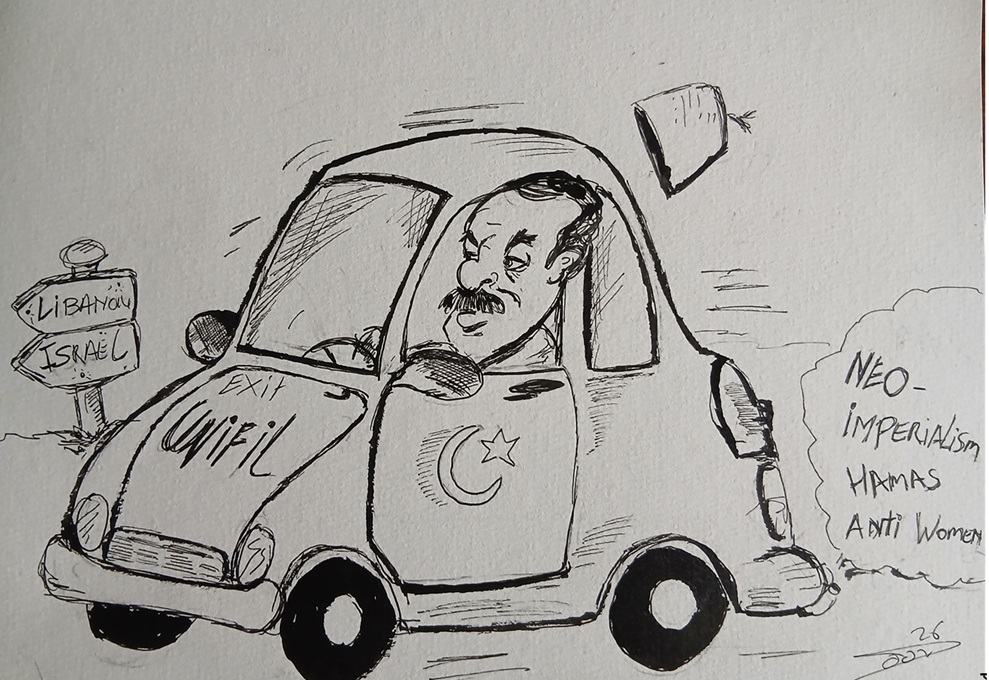
With the mission's end in sight, Turkey has made no secret of its eagerness to expand its influence in Lebanon and potentially put boots on the ground to fill the vacuum after UNIFIL's departure. Such a development would be a thorn in the side of Israel and the Gulf states, especially as Saudi Arabia is likely to join the Abraham Accords and the Lebanese government has engaged in unprecedented peace talks with Israel.
On June 26, Lebanon and Israel signed a framework for peace in Washington, an agreement that did not receive the attention it deserved in Western mainstream media. The agreement aimed at finding lasting peace between the two countries, with Israel stating that its army would remain in southern Lebanon until Hezbollah is disarmed. The under-equipped LAF also plays a pivotal role in that process, and that is the rub.
The historic 14-point US-brokered trilateral framework agreement aims to end the ongoing conflict, establish comprehensive peace and restore Lebanon's sovereignty. One key point is the verified disarmament of non-state armed groups and the dismantling of their associated infrastructure. In practice, this means Hezbollah.
It comes as no surprise that Iranian-backed militias opposed the negotiations from day one and did everything in their power to sabotage them. The most recent flare-up of violence began on October 8, 2023, when Hezbollah and its Iranian masters launched cross-border rockets and artillery at Israeli positions in solidarity with their Palestinian allies following the horrific October 7 attacks in Israel.
Once again, Hezbollah gambled with Lebanon's safety without the consent of the country's institutions or people, marking the beginning of a prolonged front of hostilities. Fighting in the south and Bekaa Valley continued, while an Israeli military presence in parts of southern Lebanon persisted as a direct consequence.
The agreement signed in June was hailed as an important first step towards breaking the status quo of indefinite war and was praised by Lebanese President Joseph Aoun. Hezbollah, however, used it as a pretext to threaten the government, claiming that implementing the agreement risked triggering civil war.
Hezbollah's threats against the government continue as the organisation remains engaged in an intense round of fighting that cannot be won. The current battle could also be described as Hezbollah's last stand, where, of course, Lebanon is paying the price.
The Israeli army carried out extensive air strikes on Hezbollah strongholds and deployed troops in the south, killing more than 4,000 people in Lebanon and dozens in Israel. Thousands were wounded, numerous villages were destroyed, and hundreds of thousands were displaced. Israel established a security buffer zone of approximately 570 to 600 square kilometres, extending up to ten kilometres into southern Lebanon.
One of the key points of the agreement, the verified disarmament of non-state armed groups and the dismantling of their associated infrastructure, hangs like a sword of Damocles above Hezbollah, which remains steadfast in its opposition to the negotiations.
The agreed framework also provides for the LAF to progressively take control of two pilot zones, with the intention of expanding them until state forces control all relevant sectors, eventually allowing civilians to return.
However, the Israeli withdrawal is expected to be limited, as Benjamin Netanyahu has repeatedly stated that his army would remain in southern Lebanon until Hezbollah is disarmed.
Under the framework agreement, the United States will more broadly support the Lebanese government in the country's reconstruction, economic recovery and prospects for prosperity. For its part, Beirut commits to ensuring that funds do not end up in the hands of armed groups or affiliated entities.
The first two southern pilot zones created under the framework agreement are Zawtar al-Gharbiyeh and Froun. Two major problems have already surfaced: Hezbollah disarmament efforts undertaken by the LAF are failing to meet the requirements set by the agreement, while the reconstruction model taking shape in the south could help Hezbollah regain popular support.
Israel's 2000 withdrawal
The direct talks launched in mid-April are the first in decades between the two countries, which are technically still at war. The talks were expected to resume in Tampa, Florida, ahead of the upcoming Israeli elections.
This is not the first attempt to disarm the country's last active post-civil-war militia. After Israel withdrew from southern Lebanon in May 2000, it seemed an almost impossible mission for successive Lebanese administrations to regain full state control.
Instead of transitioning into a purely political movement after Israel's full withdrawal, Hezbollah expanded further. The organisation rapidly transformed from a resistance force focused on occupation into a regional military actor deeply integrated into Iran's broader strategic architecture.
The Iranian-backed militia immediately declared victory over Israel after its May 2000 retreat. Within days, however, it began constructing new justifications for keeping its weapons, inflating border disputes and unresolved territorial questions into existential national causes.
For many Lebanese, this marked the moment when Hezbollah's role fundamentally changed. The central issue was no longer resistance to occupation, but whether Lebanon itself retained the sovereign right to decide questions of war and peace through its own state institutions.
That tension exploded dramatically in 2006. Following Hezbollah's cross-border operation into Israel, which resulted in the kidnapping of Israeli soldiers and the killing of others, the region descended into a devastating summer war. The destruction inflicted upon Lebanon was enormous. Entire neighbourhoods were reduced to rubble, infrastructure collapsed, and thousands of civilians were killed, wounded or displaced.
The conflict ended with the adoption of United Nations Security Council Resolution 1701, which called for the cessation of hostilities and the establishment of a demilitarised zone south of the Litani River under the authority of the Lebanese Armed Forces and UNIFIL. Yet the resolution never fully achieved its strategic objective.
Hezbollah rebuilt rapidly and emerged politically stronger inside Lebanon than before the war. The 2006 conflict intensified a painful national question: could Lebanon survive indefinitely while a non-state military actor retained the independent authority to trigger regional wars?
The UNIFIL failure
After 49 years, the UNIFIL mission is clearly a complete failure. It did not stop Hezbollah from building a massive military presence in southern Lebanon despite the extensive international deployment and the strengthened mandate introduced after the 2006 debacle.
Following the 2006 war, Resolution 1701 tasked UNIFIL with helping ensure that southern Lebanon remained free of unauthorised armed personnel and weapons. Almost simultaneously, Hezbollah increased its rocket inventory from roughly 15,000 in 2006 to more than 150,000 by 2023.
Not to mention the hidden infrastructure built right under UNIFIL's eyes. The mission failed to prevent the expansion of underground logistics, attack tunnels and weapons caches, some located close to UN observation posts.
The mandate allows UNIFIL to assist the LAF, leaving the peacekeepers with limited authority against armed non-state actors. They have often appeared as passive observers, reluctant to confront Hezbollah directly and constrained by the need to protect their own personnel. The result has been a mission unable to deliver the security transformation Lebanon desperately needed.
Renewing such a mission without changing its mandate, capabilities, and objectives would be another symbolic act of international incompetence. It is time for Lebanon and its President to respect the security of their own people, finally take responsibility in the south and put the country's commitments into practice.
What comes after UNIFIL?
The debate over UNIFIL's future has now moved beyond diplomatic speculation. Under Security Council Resolution 2790, adopted in August 2025, the mission is scheduled to end its operations on December 31, 2026, before beginning an orderly withdrawal over the following year. Yet the political and security conditions on the ground have changed considerably since that decision was taken.
Lebanon is now asking the international community to reconsider. On August 26, Beirut formally argued that a limited extension of UNIFIL would be the most practical and cost-efficient option. The position has since gained considerable support in Parliament.
On October 6, 86 MPs submitted a legal study to President Joseph Aoun and Parliament Speaker Nabih Berri, calling for an extension or an alternative international arrangement. Their argument is straightforward: withdrawing peacekeepers before Israeli forces have left Lebanese territory and the Lebanese Army has established control could create an even more dangerous situation in the south.
France has backed Lebanon's request. During his visit to Beirut on October 17, French Foreign Minister Jean-Noël Barrot discussed arrangements for an international presence after UNIFIL's departure.
President Aoun reiterated that extending the existing mission remained Lebanon's preferred option, but said Beirut would welcome another arrangement if an extension proved impossible. He specifically warned against leaving the Lebanese Army in direct contact with the Israeli military without an international presence to help prevent escalation.
However, political support does not automatically translate into a new Security Council mandate. The United States has been a leading advocate of ending UNIFIL, arguing that a mission which has operated for decades without preventing Hezbollah's military expansion should not continue indefinitely. Washington's difficulty is that withdrawing the force does not resolve the problems that made its presence necessary in the first place.
The United Nations has already considered alternatives. Secretary-General António Guterres presented three possible arrangements for a future international presence, ranging from approximately 1,980 to 5,525 uniformed personnel.
These proposals would retain some form of monitoring along the Blue Line, support the Lebanese Army and help prevent incidents from escalating into another conflict. They are not simply proposals to maintain the existing force under another name.
There is also a distinction worth making. UNIFIL was never given an independent mandate to disarm Hezbollah by force. Under Resolution 1701, its role was to monitor, report and assist the Lebanese Army in establishing state authority south of the Litani River.
This limitation does not absolve the mission of criticism, particularly over its inability to prevent Hezbollah's military infrastructure from expanding. But it raises a harder question: was the failure entirely UNIFIL's, or was the international community unwilling to give the Lebanese state the political and practical support it needed to enforce its own authority?
That question matters because the Lebanese Army is now expected to take on responsibilities that neither it nor the government has been able to fulfil fully for decades. Its equipment, funding and operational capacity remain limited.
It must also operate in a country where Hezbollah retains considerable political influence and where any attempt to force a confrontation carries the risk of renewed internal conflict. Expecting the army to replace an international force overnight is therefore unrealistic.
On November 5, UNIFIL reiterated that it intends to begin its withdrawal when its mandate expires, while confirming that the Security Council is still considering arrangements for the period afterwards. There is no settled replacement yet.
Lebanon should therefore be careful what it asks for. An extension without clear objectives, stronger monitoring and a timetable for transferring responsibility to the Lebanese state would simply preserve the same arrangement that has failed to deliver lasting stability.
An abrupt withdrawal without a credible alternative could leave southern communities exposed and increase the risk of another confrontation between Israel and Hezbollah.
The answer cannot be to keep international forces in Lebanon forever. Nor can it be to pretend that their departure will somehow resolve the country's security problems. Lebanon needs a functioning state, an army capable of protecting its borders and a government with the authority to decide questions of war and peace. International support should help achieve those objectives, not replace them.
Ultimately, the question is not whether Lebanon needs UNIFIL under its present name, or whether another international force should simply take its place. The question is whether Lebanon is finally prepared to become a sovereign state in practice, not merely in diplomatic declarations.
A new mission without a new political reality would repeat the old failure. An international withdrawal without a credible Lebanese security structure would risk creating another. Neither outcome serves Lebanon.
Its future depends on ending the parallel military authority that has repeatedly taken the decision of war out of the hands of the Lebanese state. Only then can the south become part of a country governed by one authority, one army and one sovereign decision on peace.