The missing rungs: Who will lead when AI replaces the entry level?

For a century, organisations have looked like pyramids. A CEO at the top, a few executives, layers of managers and senior specialists, and a broad base of entry-level staff doing the repetitive work that keeps the business running. That base was never just labour. It was the training ground where analysts became engineers, engineers became project managers, and project managers became leaders.

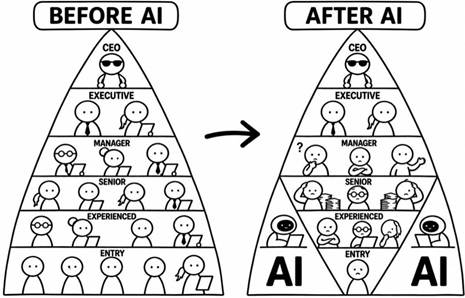
Artificial intelligence (AI) is changing that shape. The pyramid is becoming a diamond.

AI now drafts reports, reconciles data, prepares the first version of the proposal, and answers routine queries. The entry level is shrinking. Experienced staff are fewer and under pressure, and senior professionals are buried in paperwork that now reaches them first, with nobody below to filter it.

Managers stand in the middle, unsure whom to develop and how.
The productivity case is real. In a field experiment led by Harvard Business School with Boston Consulting Group, consultants using AI on suitable tasks completed 12.2% more tasks on average, and completed tasks 25.1% more quickly, with markedly better quality.

But the same study gave a warning that every leader should take to heart.

On a task chosen to be beyond the AI’s capability, consultants using AI were 19% less likely to produce correct answers.

The researchers call this the “jagged technological frontier”. AI is brilliant at some tasks and quietly wrong at others that look just as difficult. Telling which is which takes judgement, and judgement is exactly what the entry level used to build.

Three lessons stand out for leaders reshaping their organisations:
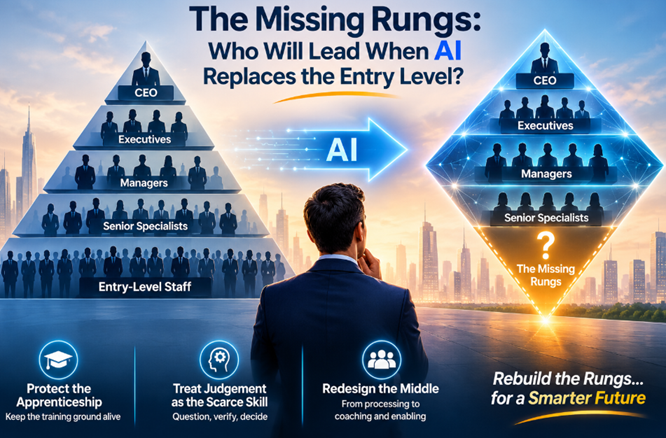
  • Protect the apprenticeship, not just the headcount. Junior roles were never only about cheap labour; they were how experience was passed on. When AI writes the first draft, juniors must still learn why it is right or wrong. Leaders should redesign entry-level roles around reviewing, challenging and improving AI output, under real supervision. Remove the training ground, and in ten years there will be no seniors to promote.
  • Treat judgement as the scarce skill. The Harvard research shows that the risk of AI is not that it does too little, but that it convinces us too easily. In engineering, energy and project delivery, a confident but wrong answer can cost millions or put lives at risk. Organisations must reward people who question the machine, check its work against field reality, and know when to override it. Critical thinking becomes a core competency, not a soft skill.
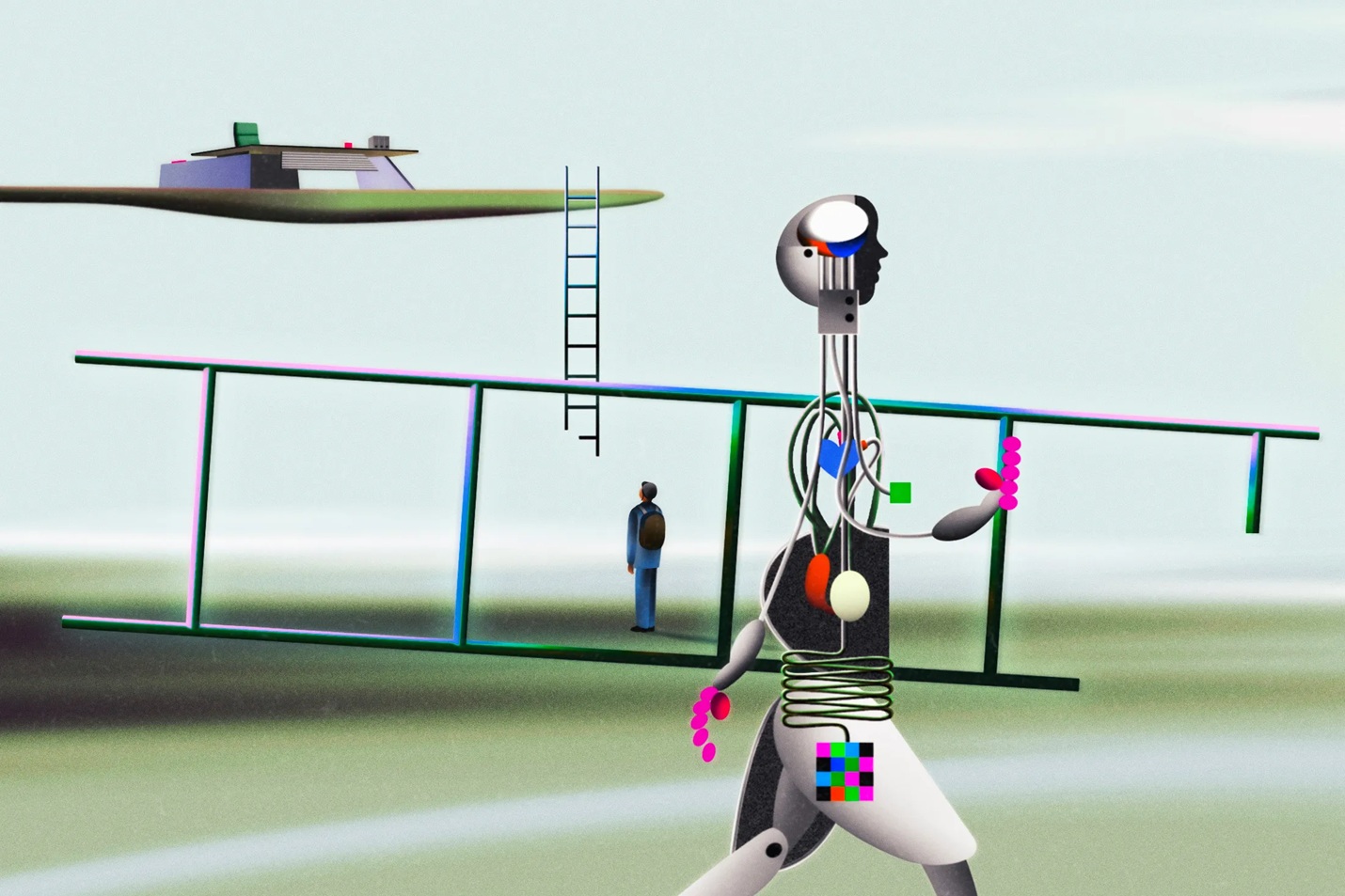
  • Redesign the middle before it breaks. The picture shows the strain clearly. Seniors drowning in documents and managers asking “what now?” The middle layer must move from processing work to coaching people and orchestrating human–AI teams. That means new metrics, new training, and leaders who can deliberately split work: tasks AI does well, tasks humans must own, and tasks where the two must work together.

AI will not decide the shape of our organisations; leaders will.

The diamond can be fragile, top-heavy and starved of new talent. Or it can be a smarter structure, where machines take on routine work and people are freed to learn faster, think deeper, and lead sooner.

The companies that win the next decade will not be those that use AI to remove the bottom of the ladder. They will be those that rebuild the rungs, so the next generation can still climb.

The question for every leader today is simple: when you look at your organisation in five years, who will be standing at the base, ready to rise?

 

Emile Fakhoury

Corporate Expert Writer, Business Professional in Energy/Water/Oil/Gas, Specialist in Coaching/Training, Association of Project Management UK Fellow Member. The professional who believes that adaptation to various social or corporate environments is the only way to survive and strive. Master the rules of the game in order to reach the top and change the rules.
See full bio >

Leave a Reply

Your email address will not be published. Required fields are marked *

More articles you might like

How history falsification became the Palestinians political weapon

Historical misinformation, weaponised against Israel, ranks among one of the most potent tools in the […]

Jurassic Park in Amsterdam: How Europe's ageing activists found a new extinction to protest

It was a sea of crimson, though from a distance, it looked more like a […]

The triumph of 'woke' folly over common sense

I have developed a profound aversion to everything that currently falls under the umbrella term […]
- by Rami Audi on 10/11/2026

Europe’s original sin: The Rothschilds, the Balfour Declaration and an unpaid debt

Rome destroyed Jerusalem in 70 CE. The Second Temple was burned, Jewish sovereignty was crushed, […]
by Emile Fakhoury on 09/11/2026

Bring the thinking brain online: The neuroscience behind project success

Every project leader has seen it happen. You have a capable team, a solid plan […]

Before and after

We have always needed to divide time into before and after, as though life were […]