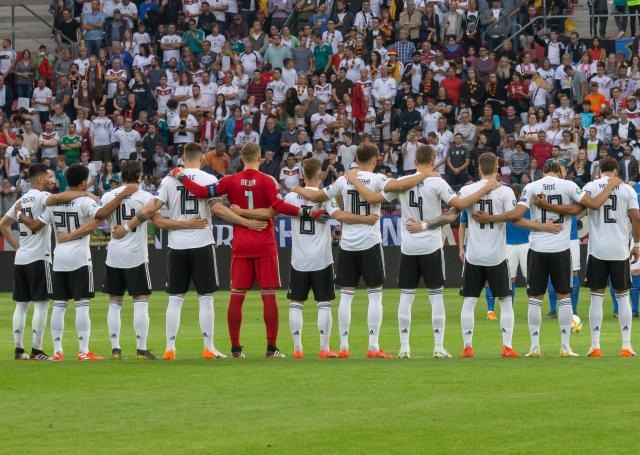
There was a time when facing Germany at a World Cup felt less like a football match and more like a long appointment with destiny. You could lead Germany in an hour. You could dominate possession, hit the post twice and hear commentators praising your football. Yet somewhere in the back of your mind remained the same uncomfortable thought that haunted generations of opponents. Germany is still here. And if Germany were still here, Germany could still win.
By Nadia Ahmad
For decades, that was the aura of the Mannschaft. It was not always the most entertaining team in the tournament. It was rarely the most romantic. But it was the team nobody wanted to see waiting on the other side of a knockout draw.
There was an old football joke repeated from Buenos Aires to Rome, from London to Tokyo. Football is a simple game. Twenty-two men chase a ball for ninety minutes, and in the end, Germany wins. The joke survived for years because too many people had lived through it.
Ask supporters of about 1990 and 2014 about Seville in 1982. The details changed, but the feeling remained the same. Germany simply refused to leave tournaments.
That was the Germany of gliding across the pitch as if he owned every blade of grass beneath his boots. It was Germany playing through pain because World Cups were not places for excuses. It was the Germany of, who looked less like a footballer and more like a man settling unfinished business every time he stepped onto a pitch. It was the Germany of roaring at defenders after misplaced passes as though the fate of civilisation depended on the next corner kick. It was the Germany of, who never possessed the glamour of a global superstar but somehow always seemed to score when Germany needed him most. Surrender was not part of the national football vocabulary.
No one who watched the 2014 final against Argentina will ever forget Schweinsteiger's face at the end of the match. Mud. Blood. Exhaustion. Victory. He looked less like a midfielder lifting the World Cup and more like a soldier returning from a campaign. That image captured something important about the old Mannschaft.
The old Mannschaft wanted to win. The old Mannschaft also wanted to suffer for victory. Fast forward to 2026.
Germany arrived at the tournament with talent, optimism and one of the brightest collections of attacking players in international football. Nobody questioned the technical ability of this generation. Under coach Julian Nagelsmann, Germany arrived expecting to compete for the trophy.
Then came the match against Paraguay. The match itself will eventually disappear into statistics and archives. Future generations will see the scoreline and move on. But those who watched it unfold will remember a strange feeling, not of anger or even shock, but sadness at a defeat that felt bigger than a football match.
Germany went to penalties, ultimately leaving the tournament before reaching even the Round of Sixteen. For many countries, that would lead to disappointment; for Germany, it was unnatural.
For a country that once treated the quarterfinals as a minimum requirement and the semifinals as an annual appointment, which made reaching the last four of major tournaments look routine, its early elimination was bitter.
The exit hurt supporters not only in Germany but across the world. The Mannschaft has supporters scattered across continents. German communities in North America woke up early to watch the game. Families in South America gathered around televisions carrying memories of previous tournaments. Supporters in Australia stayed awake deep into the night, hoping to witness another chapter in Germany's football story. Instead, they watched another early exit.
Many are no longer asking why Germany lost, but a more uncomfortable question: When did the world stop fearing Germany?
The answer cannot be a lack of talent. Nobody watching Musiala or Wirtz can seriously claim that German football has forgotten how to produce footballers. If anything, modern Germany may produce more technically gifted players than ever before. The problem lies somewhere else.
Football supporters are terrible sociologists but excellent judges of atmosphere. They know when a team feels different. While the old Germany inspired fear, the new one inspires uncertainty. Germany used to make its opponents nervous; now, it appears nervous itself.
Nobody remembers tactical diagrams twenty years later; they remember moments and feelings. Kahn screaming, Matthäus fighting, Klose scoring, Schweinsteiger bleeding. These moments became part of the mythology of German football.
Against Paraguay, there was no mythology. There was possession. There was structure. There was organisation. But there was no sense of inevitability. No feeling that Germany would somehow find a solution, because Germany always found one.
When the penalties began, millions of German supporters watched with an emotion that previous generations rarely experienced during shootouts – doubt.
There was a time when penalty shootouts involving Germany felt unfair to the opposition. The Germans collected penalties.
The pressure always seemed to affect the other team. This time, the pressure appeared to affect Germany itself. Perhaps that is what disturbed supporters most. Not the defeat, but the familiarity of defeat.
For years, Germany has accumulated disappointments that once seemed impossible for a football superpower. Group-stage exits. Early eliminations. Promising starts followed by sudden collapses.
Each tournament ends with investigations, debates and promises of renewal. Then another tournament arrives, and the same questions return. Some blame tactics. Others blame youth academies. Others blame administrators.
Supporters usually offer a simpler explanation. The old players looked as though they would die for the shirt. The new players sometimes look as though they are merely wearing it. The difference may sound exaggerated, but football supporters understand immediately what it means.
Nobody doubted what Germany meant to Beckenbauer. Nobody doubted what Germany meant to Rummenigge. Nobody doubted what Germany meant to Klose or Lahm or Schweinsteiger.
The current generation may feel the same emotions privately.
The problem is that supporters no longer feel them from the stands or through television screens. Football has always been theatre. The audience believes what it sees.
And right now, many supporters believe they are watching gifted individuals rather than an old-fashioned Mannschaft. A collection of talent can win matches. A Mannschaft wins tournaments.
The team that refused to lose had learned how to lose. Perhaps this generation will eventually prove its critics wrong. Perhaps Musiala and Wirtz will become the faces of a new golden age. German football history advises caution before writing obituaries. After all, this is a country that has reinvented itself repeatedly across football history.
The Germany of Beckenbauer looked different from the Germany of Matthäus. The Germany of Kahn looked different from the Germany of Schweinsteiger. Every era eventually creates its own identity.
Perhaps another identity is waiting to emerge. But history alone cannot carry a team forever. Every generation that wears the German jersey is eventually asked the same question.
Are you worthy of the inheritance you received? The generation of Beckenbauer answered yes. The generation of Matthäus answered yes. The generation of Klose, Lahm and Schweinsteiger answered yes.
After the defeat against Paraguay, supporters of the Mannschaft from Berlin to Buenos Aires, from Hamburg to Melbourne, are still waiting for the current generation to answer the same question, not through interviews or social media posts, or promises around the future.
But in the final twenty minutes of a difficult knockout match somewhere in the years ahead, when legs are tired, the pressure is unbearable, and the entire football world is watching. That was always the moment when the old Germany introduced itself, when opponents looked at the clock and realised they were in trouble.
Because Germany was still there, Germany could still win. The saddest part of the World Cup defeat against Paraguay was not that Germany lost. It was that for the first time in a very long time, nobody seemed entirely surprised. Perhaps that is why many supporters were not mourning a result; they were mourning the long goodbye of the old Mannschaft.