"A doctor belongs to his patient, not to the state."
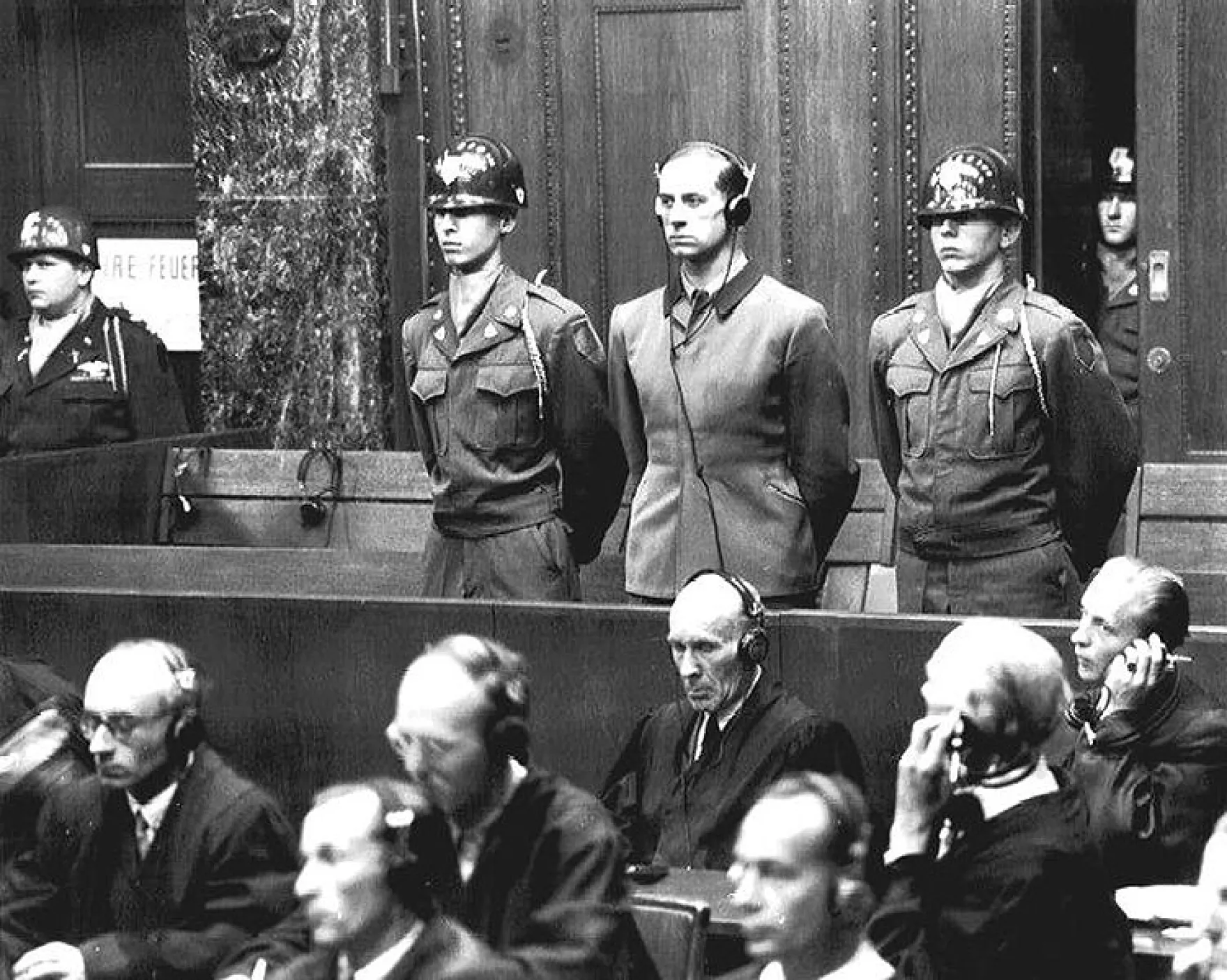
Since the Nuremberg Doctors' Trial, this idea has formed the moral foundation of modern medicine. Karl Brandt was Adolf Hitler's personal physician and one of the key figures responsible for the Nazi euthanasia program. Twenty-three doctors and health officials were charged with war crimes and crimes against humanity for their roles in medical experiments on concentration camp prisoners. Sixteen were found guilty; seven doctors were hanged, while the others received life sentences or long prison terms. The independence of the medical profession is on trial again, this time in Rotterdam.
By Oscar Hammerstein
Their crimes included sterilisation experiments and experiments involving hypothermia, malaria, toxins, and high-altitude pressure. In addition to the Nazi’s euthanasia program, in which tens of thousands of psychiatric patients and people with disabilities were murdered.
The Nuremberg Doctors' Trial taught the world that the greatest threat to medicine arises when doctors subordinate their profession to political or ideological goals. That is why the World Medical Association was founded in 1947: to protect the independence of the medical profession.
The tragic irony is that this very organisation, eighty years after those trials, must now take a stand on a campaign seeking to impose a political loyalty test on doctors and their professional association once again.
From October 7 to 10, 2026, the 117 national medical associations that are members of the World Medical Association (WMA) will gather there. An international coalition of activist medical organisations is seeking to use this meeting to secure the suspension of the Israeli Medical Association (IMA) from the WMA.
The campaign is led by the People's Health Movement, the Dutch activist group Artsen voor Gaza (Doctors for Gaza), and the Health Advisory Council of Jewish Voice for Peace. Their call gained significant weight in June when ‘The Lancet’, one of the world’s most prestigious medical journals, provided a platform for the suspension campaign. The Dutch role, in particular, warrants attention.
The issue at stake in Rotterdam, therefore, goes beyond Israel; it touches on the very foundation on which international medical ethics was built in the wake of Nuremberg. From that point on, medical ethics was to stand above any ideology.
That is precisely why the events threatening to unfold in Rotterdam this autumn are so disgraceful.
It is not Doctors for Gaza that is among the driving forces behind this international campaign. Remarkably, the organisation provides no insight into its own structure, making it just as masked as the individuals campaigning on its behalf.
Its website lacks the names of founders, board members, and official spokespersons. Nor has it been disclosed which Dutch doctors are leading the international campaign for the organisation or which Dutch healthcare professionals have supported the appeal to the World Medical Association.
For a movement seeking to persuade one of the oldest international medical organisations to expel a founding member, this complete lack of transparency is striking. Transparency should be expected not only of governments and universities but also of organisations that are themselves pursuing a far-reaching international boycott.
Even more remarkable is the content of the group's own mission statement. It presents itself as a humanitarian organisation of healthcare professionals, yet simultaneously explicitly declares its endorsement of the Boycott, Divestment and Sanctions (BDS) strategy: “Following the lead of Palestinian civil society organisations, we endorse, among other things, the strategy of Boycott, Divestment and Sanctions.
This entails, among other things, calling upon (academic) healthcare institutions to sever their ties with Israeli institutions.”
In doing so, the organisation does not limit itself to advocating for the protection of patients, hospitals, or medical professionals. It explicitly opts for a political strategy to sever institutional ties with Israeli universities, research institutes, and medical organisations.
Another initiator of the campaign against the Israeli Medical Association is the People's Health Movement (PHM), an international activist health movement rather than a professional association for doctors. One of the Dutch faces of the People's Health Movement is Juliette Mattijsen. She is a medical doctor working as a junior researcher at UMC Utrecht.
Mattijsen explicitly identifies as an activist, is a co-founder of People's Health Movement Netherlands (De Gezondheidszaak), and is involved in initiatives such as Doctors for Gaza and Utrecht Medics for Gaza. Her work focuses on health justice, the decolonisation of medicine, and climate justice.
That gives you an idea of where she stands, to say the least.
Israel has a population of fewer than ten million people, yet it has produced fourteen Nobel laureates since its founding. In terms of per capita figures, it ranks among the global elite, leaving scientific powerhouses such as the United States, Germany, and France far behind.
Israel holds an exceptionally strong position in medical research and biotechnology. It is one of the world’s most innovative medical hubs, having delivered groundbreaking developments in fields including oncology, immunotherapy, AI-driven diagnostics, and medical technologies such as the PillCam and ReWalk.
Against this backdrop, the call to exclude the Israeli Medical Association from the World Medical Association takes on broader significance. Such a boycott would not only affect Israeli doctors but also threaten to impoverish international scientific collaboration and ultimately harm the patients worldwide who benefit from these innovations.
The question facing Rotterdam is not whether one agrees with the Netanyahu government's policies. The real question is: can an independent professional association of physicians be held responsible for its government's policies? That question strikes at the heart of international medical cooperation.
The World Medical Association has already provided a clear answer to this. Responding to the campaign, it stated to ‘The Lancet’ that it is fundamentally opposed to the exclusion of national medical associations based on the actions of their governments.
According to the WMA, such a measure would undermine international dialogue among physicians and thereby weaken the organisation in its core mission: promoting medical ethics worldwide. Moreover, the Israeli Medical Association is one of the WMA’s founding members.
The Royal Dutch Medical Association (KNMG), the host of the Rotterdam congress, has also not supported the campaign for suspension. On the contrary, in recent years, the KNMG has consistently advocated for medical neutrality, the protection of healthcare professionals, and ongoing dialogue between physicians, especially during times of war. KNMG President Jurriaan Penders recently reiterated, quite rightly, that physicians treat people, not political positions.
While a Dutch activist group campaigns internationally for the exclusion of a fellow association, the official representative of over 65,000 Dutch doctors upholds the principle upon which international medical cooperation has been built since the Second World War: doctors continue to talk to one another, precisely when governments are at war.
It is a lesson medicine learned at great cost. A doctor treats a patient, not an ideology. He cares for friend and foe, soldier and civilian, rich and poor. His loyalty belongs neither to the state nor to a government, nor to a political movement. It belongs solely to the patient.
When international medical associations begin to judge national professional bodies based on their governments' policies, the character of those bodies changes fundamentally. They cease to be forums for medical ethics, scientific cooperation, and education. They become political tribunals.
That is precisely why the meeting in Rotterdam is far more significant than a debate about Israel alone.
After Auschwitz, the international medical community reached one unequivocal conclusion: doctors must never again be made subordinate to political ideologies or state power. It was with this conviction that the World Medical Association was founded, tasked with safeguarding medical ethics; precisely when governments sought to undermine them.
Over the past two centuries, the Jewish community repeatedly sought to become an integral part of non-Jewish society. Nineteenth-century emancipation finally paved the way for this. Jews could attend universities, practice professions, open shops, and participate in public life.
After centuries of exclusion, the Jewish citizen finally seemed poised to become a natural part of European society. Yet, that very emancipation also gave rise to new hostile stereotypes. In France, Germany, and elsewhere, the notion took hold that the emancipated Jew would ultimately wield excessive influence and even aspire to world domination.
These age-old antisemitic myths regained traction in the late nineteenth and early twentieth centuries, ultimately forming one of the ideological breeding grounds in which National Socialism could flourish. The destruction of a vast portion of European Jewry was the horrific consequence.
Yet for many Jews, the allure of an open and emancipated Europe proved stronger than the wisdom of drawing lasting lessons from that history. Even after the Holocaust, the vast majority of Dutch Jews chose to reintegrate into society.
Despite betrayal, collaboration, and the cold reception accorded to survivors, they continued to believe in a shared future. They participated in civic life, in universities, cultural institutions, and national commemorations.
After October 7, 2023, the fragility of that assumption became apparent. During the opening of the National Holocaust Museum in Amsterdam, protests drowned out the solemn ceremony, and Jews, including Shoah survivors, were harassed. Jewish students no longer feel safe at universities.
Once again, Jews were judged not as individuals, but as representatives of a collective held responsible for war, oppression, and violence. And perhaps most bitterly of all, the descendants of Holocaust victims are increasingly portrayed as the moral heirs of their former persecutors and murderers. In this way, an old pattern re-emerges: it is not the facts that change, but the roles assigned to perpetrator and victim.
Eighty years after the founding of the World Medical Association, a new challenge has emerged. It is not the state, but political activism that threatens to mobilise medicine once again for an ideological cause.
Therein lies the paradox of Rotterdam 2026: an organisation established to shield medicine from politics now finds itself facing a campaign seeking to exclude a national medical association, not because of its medical conduct, but because of its government's policies.
Taking such a step transforms a professional organisation into a political forum. And politicising medicine ultimately undermines not only international cooperation among physicians but also the very foundation of the medical profession: the trust that a doctor acts solely in the patient's interest, rather than in the service of a political cause.