The Centrum Informatie en Documentatie Israël (CIDI) has presented itself for decades as a watchdog against antisemitism in the Netherlands. An important task. Antisemitism exists, it is dangerous, and it deserves serious opposition.
Yet somewhere along the way, CIDI appears to have developed a small vocabulary problem.
Take two words: antisemitism and anti-Zionism. In most dictionaries, they mean different things. Antisemitism is hatred toward Jews as Jews, a racist ideology with a long and violent history in Europe.
Anti-Zionism, by contrast, concerns a political ideology: Zionism. That is the idea that the State of Israel, as a Jewish nation-state, possesses a particular political legitimacy. Like any political ideology, that idea can be supported, criticised, or rejected. |
That is called political debate.
At CIDI, however, a more efficient method seems to have been discovered. The two terms are merged. Anti-Zionism? Antisemitism. Criticism of Israel? Antisemitism. Asking questions about Zionism?
You guessed it.
It is quite an impressive piece of linguistic innovation. By stretching the meaning of words, political arguments conveniently disappear. A debate about the ideological foundation of Israel? No need. Attaching the right label does the job.
Unfortunately, this strategy comes with a small drawback: it steadily empties the concept of antisemitism of its meaning. If every form of criticism of Israel is called antisemitic, it becomes harder to recognise when actual hatred of Jews occurs.
And that is where the irony appears. An organisation that claims to fight antisemitism risks diluting the very concept it seeks to defend.
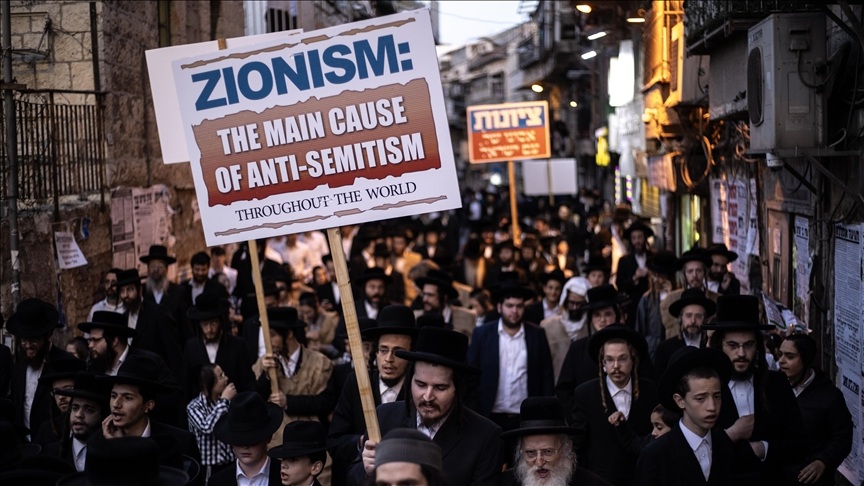
There is another side effect. By automatically equating anti-Zionism with antisemitism, the implicit message becomes that all Jews are Zionists and all Zionists are Jews.
Reality, as it turns out, is somewhat more complex. Jewish thinkers, religious traditions, and activists exist who have criticised Zionism for generations.
Of course, antisemitism can sometimes hide behind anti-Israel rhetoric. That does happen and should be called out clearly. But that does not mean that every criticism of Zionism or Israeli policy is suddenly a racist expression.
Perhaps it is time for a radical step: CIDI could begin by reopening the dictionary.
Fighting antisemitism is already complicated enough without redefining the terms along the way.