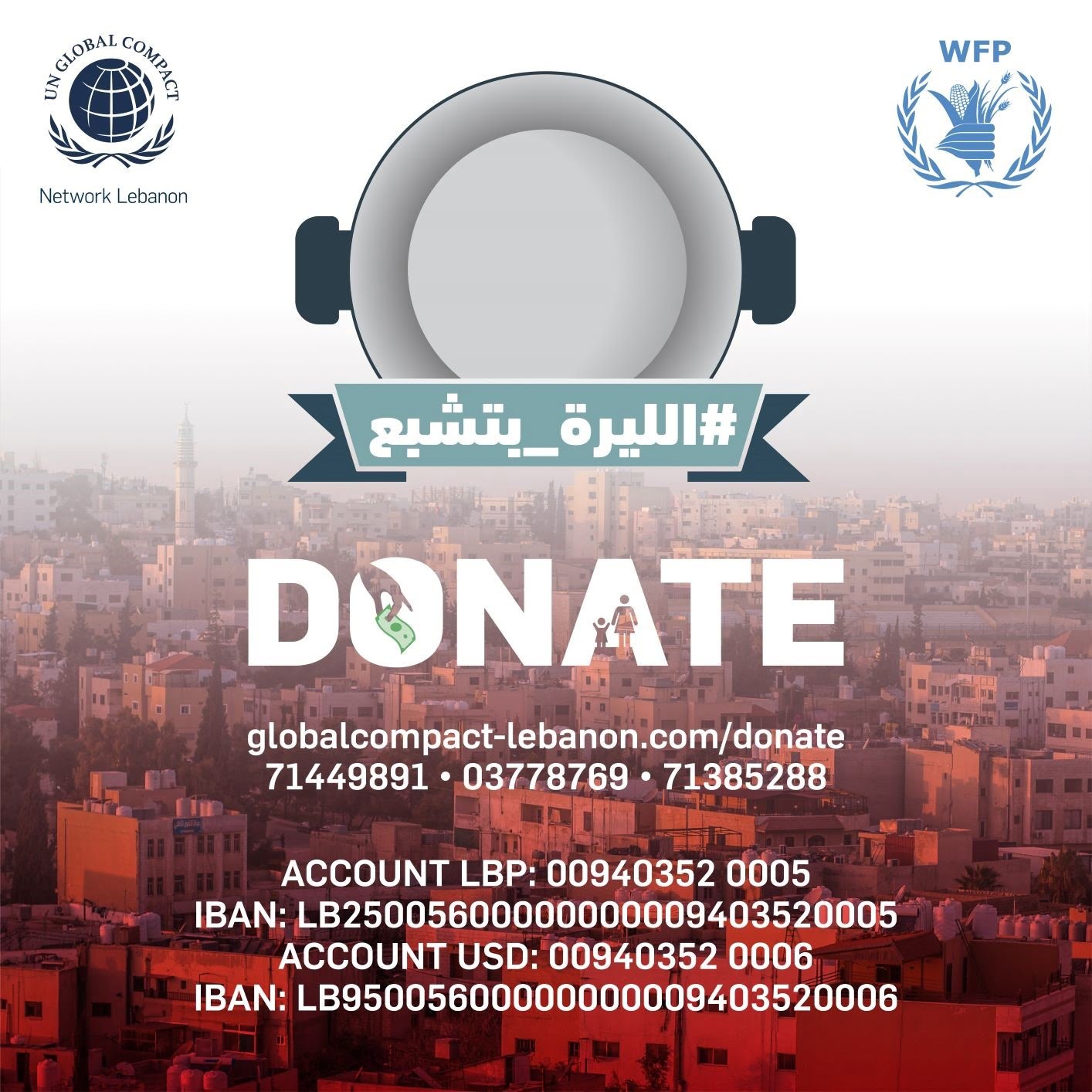
The Global Compact Network of Lebanon (GCNL) launched a new campaign, “الليرة بتشبع” in collaboration with the World Food Programme (WFP) on Wednesday to support a two-month crowd-funding campaign. The private-sector campaign in Lebanon supports the National Poverty Targeting Program (NPTP).
The NPTP is an ongoing social assistance program developed by the Office of the President of the Council of Ministers to support the most vulnerable Lebanese families living under the extreme poverty line. Led by the technical partners, the World Bank and WFP, the NPTP is designed to provide the poorest 44,000 families in Lebanon with holistic support across three core areas: health, education, and food assistance.
In 2018, Lebanon's poverty rate was estimated at 30%. Today, with the exacerbating economic crisis and the social repercussions of the coronavirus pandemic, the poverty rate in Lebanon has escalated to an alarming 45%—almost half of the population lives below $4/day. In collaboration with WFP, GCNL recognised the urgent need to reinforce and support the National Poverty Targeting Program, particularly the food assistance component, as an emergency measure to counter the rise in poverty.
Since last year, the NPTP's outreach has been to 15,000 families (out of 44,000), all of whom received assistance. Given the deteriorating socio-economic situation in Lebanon, thousands of families dropped beneath the poverty line with no available means for social support. In this regard, the “الليرة بتشبع” crowd-funding campaign was designed to support the food assistance component of the NPTP and to scale up the distribution of electronic food voucher cards to benefit more struggling families, in addition to the 15,000 already covered. Over the next two months, donations will be open to both local citizens and the Lebanese diaspora. As a result, the collected funds will be transferred directly to the WFP’s fund.
The الليرة بتشبع crowd-funding campaign is led by GCNL (representing the private sector in Lebanon) in collaboration with the WFP. GCNL is a UN-affiliated network comprising more than 140 of Lebanon's largest and most credible businesses, led by their progressive CEOs, which support various social and environmental projects. The private sector in Lebanon was keen to assume a distinctive role in endorsing this campaign. Therefore, support from the private sector is essential as we launch the الليرة بتشبع campaign.
In parallel with the crowdfunding website, a TV commercial and a social media campaign involving 100 social media influencers were designed as a package to maximise engagement and contributions. Promoting the message will be the nation’s most admired influencers and public figures who will not only donate but also ask their viewers to contribute as little as 5,000
LBP.
To Donate:
Please visit: globalcompact-lebanon.com/donate
For Inquiries:
Call +961 71 449891 • +961 3 778769 • +961 71 385288