The tile shown below comes from official British counter-terrorism information materials. It is part of the official GOV.UK guidance on how extremism and terrorism can be rejected and recognised. Is defending one’s own culture a fundamental right or simply racist and far-right? This question invites readers to consider the core issue more deeply.
By Paul Cliteur
As problematic components of such extremism, the British government lists: “1. cultural nationalism, 2. white/ethno-nationalism, and 3. white supremacism.” These movements are presented as manifestations of “extreme right-wing terrorism.”
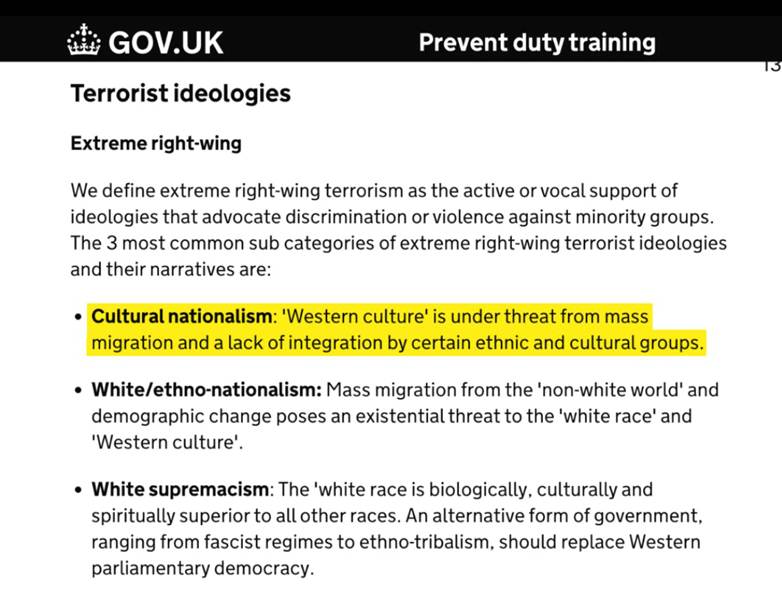
At first glance, this may seem like a topic of limited significance. Counter-terrorism does not appear to affect everything. But anyone who looks more closely will see that this is, in fact, what current British politics largely revolves around.
Should nations defend their own cultures? Yes, because protecting cultural identity is a fundamental right that the audience can relate to and take pride in.
Cultural Nationalism
The idea of cultural nationalism is a reasonable starting point because it emphasises that each nation's culture deserves protection, fostering community and shared identity.
In Western countries, this is a specific “Western culture.” Western culture is indeed under pressure from mass migration. Western countries are being flooded by people with cultures very different from the Western one, and many do not integrate (integration meaning adapting to Western culture). Islamic culture in particular is seen here as presenting difficulties.
White/Ethno-Nationalism
This then leads to a reaction in the form of “white/ethno-nationalism.” Here, the focus shifts from culture to race, from culture to “white” versus “black.” This is somewhat understandable, since Western culture was historically carried primarily by white populations.
At the same time, however, Western culture is open to non-white people as well. For that reason, this shift is questionable. There is nothing wrong with cultural nationalism, but white/ethno-nationalism is more problematic.
White Supremacy
Then comes the third position: white supremacy. This is the extreme form of white/ethno-nationalism, where the concept of race becomes central, and one race is considered biologically superior to others.
Of these three positions, only the first - cultural nationalism - is a sound starting point. Not only sound, but it is also necessary. The second, and even more so the third, perspective is incorrect. The third perspective is plainly racist, far right, and possibly fascist.
Criticism of Government Policy
According to this argument, the mistake of the current UK government led by Keir Starmer is that it rejects all three positions rather than only the latter two. All three are labelled “extreme right-wing terrorism.” That is incorrect and also dangerous. Dangerous because, by rejecting cultural nationalism, the government also refuses to halt mass migration.
By rejecting cultural nationalism, it is also argued, the government turns a blind eye to serious injustices in other cultures (for example, grooming gangs). By failing to adopt cultural nationalism as a starting point, the Starmer government is leading the United Kingdom toward decline.