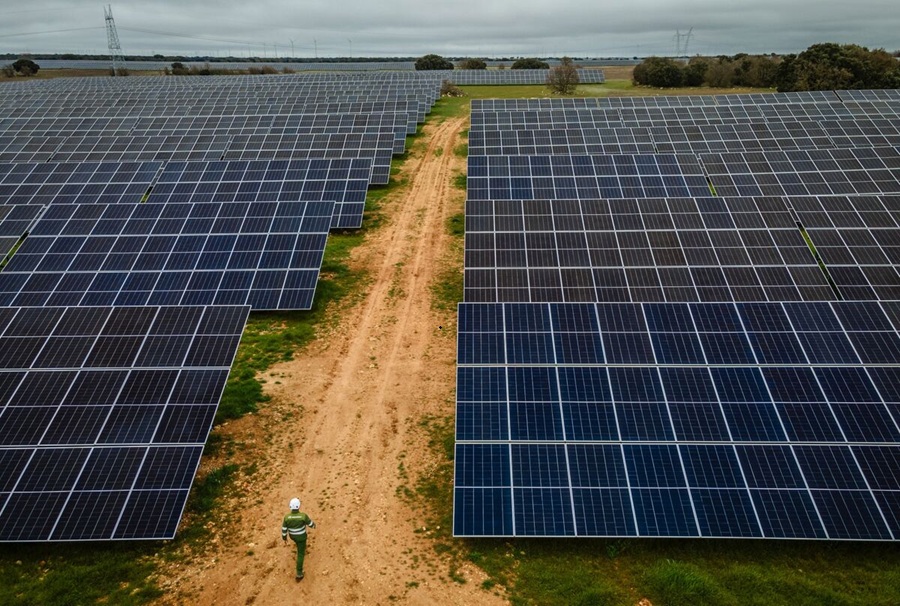
Europe is sweating. Not because of another political crisis in Brussels. Not because of another war on its borders. But because the oldest force in human history has decided to remind the continent that nature always has the final word.
By Nadia Ahmad
Across Southern Europe, thermometers climb toward record levels. Streets empty in the afternoon, train services slow down, rivers shrink, electricity consumption reaches new peaks as millions seek refuge behind air conditioners, and governments issue warning after warning.
For most Europeans, this is another difficult summer.
But history often hides its greatest revolutions inside ordinary headlines.
What if this heat wave is not simply another climate story? What if it is announcing the beginning of a geopolitical revolution as significant as the discovery of oil itself?
That may sound exaggerated. Then again, every great transformation in history sounded exaggerated before it became obvious.
When steam engines first appeared, few imagined they would build the British Empire. When oil replaced coal in the twentieth century, few understood that deserts would become the centre of global politics. Today, another energy revolution is unfolding quietly before our eyes.
Its fuel is not hidden beneath deserts.
It shines above our heads every morning.
For more than two centuries, humanity searched for power beneath the Earth.
Coal fueled the factories of the Industrial Revolution—oil powered cars, aircraft, industries and armies. Entire economies were built around drilling deeper, extracting faster and transporting farther.
Modern geopolitics was born underground.
The twentieth century became an age of pipelines, oil tankers, strategic straits and energy cartels. Nations fought wars over oil fields. Governments rose and fell because of energy prices. A pipeline could reshape alliances more effectively than a diplomatic summit.
Energy was never simply about electricity. It was about influence.
Countries blessed with oil enjoyed strategic importance that often exceeded their size. Those without natural resources became dependent on those who possessed them.
The Earth created monopolies. A handful of nations controlled resources everyone else desperately needed.
That monopoly shaped international politics for more than a century. But every monopoly eventually meets its challenger.
And this time, the challenger arrives every morning with the sunrise.
Unlike oil, the sun recognises no borders.
It does not require pipelines to cross continents. A navy cannot blockade it. No organisation can reduce its production. No embargo can stop tomorrow's dawn.
For the first time since the Industrial Revolution, humanity is beginning to build an energy system around something that belongs, at least in principle, to everyone.
That is why the Solar Coup is not simply about renewable energy. It is about the possible democratisation of power itself. Imagine two neighbouring countries. One sits on enormous oil reserves. The other possesses almost none. For decades, their economic futures were determined largely by geology. Now imagine both countries under the same sun.
Suddenly, geography begins to lose part of its old tyranny. A rooftop becomes a miniature power station. A village can generate part of its own electricity.
A country that imports most of its fossil fuels discovers that one of its greatest energy resources has been shining over its territory all along. This does not mean oil disappears tomorrow. History never changes that quickly.
Coal did not vanish when oil appeared. Horses did not disappear the day the automobile was invented. New energy sources usually grow beside old ones before eventually transforming them.
But the direction of history is becoming difficult to ignore. The age of underground power is slowly giving way to the age of sunlight. The irony could not be greater.
Europe is enduring one of its hottest summers in modern history. Yet the very force making life more uncomfortable may also offer the continent one of the greatest strategic opportunities since the Industrial Revolution.
The question is no longer whether the sun is becoming more important. The question is who understood this first. The answer is not Europe. Nor was it the United States. It was China.
China recognised the coming revolution long before most of the world.
While much of Europe argued about climate targets and many Western governments treated renewable energy primarily as an environmental issue, Beijing saw something much bigger.
It saw geopolitics.
History has always rewarded those who understood the next energy revolution before everyone else. Britain mastered coal and built the first industrial empire. The United States mastered oil and dominated much of the twentieth century. China concluded that the next great race would not be fought over oil wells, but over the technology capable of transforming sunlight into electricity.
Quietly, almost unnoticed by the wider public, China built factories, invested in research, secured supply chains and became the world's largest manufacturer of solar panels and many of the components that make the renewable energy economy possible.
It understood a lesson that history teaches again and again. The winners of a new age are rarely those who defend the previous one.
Yet the Solar Coup also carries an important warning. The sun may belong to everyone. The technology does not.
Solar panels require advanced manufacturing. Batteries depend on strategic minerals. Energy storage demands innovation, capital and industrial capacity.
Oil monopolies dominated the old world. Technological monopolies could easily dominate the new world.
That is why Europe's current heat wave should be seen not only as a climate emergency.
It is also a strategic wake-up call. Europe has spent decades discussing the green transition. The real question is whether it will also lead it.
Will Europe manufacture the technologies of the future? Or will it simply import them?
History suggests that nations rarely remain great by depending on others for the industries that define a new era. The debate is therefore much larger than electricity bills or carbon emissions.
It is about sovereignty. For generations, governments measured energy security by asking a simple question: Who owns the oil?
The twenty-first century may ask a different one: Who masters the sunlight?
This is where the Solar Coup becomes something far more profound than an energy story. It becomes the story of power itself.
For nearly two hundred years, humanity looked downward in search of progress—every discovery required digging deeper into the Earth.
Now civilisation is beginning to raise its eyes again. Not because of mythology. Because of necessity. The irony is beautiful.
Ancient civilisations looked to the heavens because they believed the sun gave life. Modern civilisation is looking back because it may help preserve the way we live.
The same sun that once inspired temples is now inspiring laboratories. The same light that ancient civilisations celebrated is now being converted into electricity by millions of solar panels spread across rooftops, deserts and valleys.
Perhaps history enjoys these kinds of ironies. After all, the greatest revolutions often resemble circles more than straight lines.
Humanity thought its future lay beneath its feet. It may have been shining above its head all along. And perhaps that is the deepest meaning of Europe's scorching summers.
They are not only warning us about a warming planet. They are reminding us that a new civilisation is already knocking at the door.
Two thousand years ago, the Christian world was transformed by the coming of the Son of God.
Today, history may be witnessing, in an entirely different and symbolic sense, the second coming of the Son of God. Not as a new religion. Not as theology.
But as the return of the oldest source of life to the very centre of human civilisation.
For centuries, power belonged to those who controlled what lay beneath the Earth. The twenty-first century may belong to those who understand what rises above it every single morning.
Perhaps the greatest coup in history will not be carried out by generals, politicians or revolutionaries. Perhaps it will happen silently at dawn.
When the Sun rises over Europe once again—and the continent finally realises that what it feared as its greatest enemy may become its greatest strategic ally. The Solar Coup may already have begun.


Brilliant supposition! 🌞