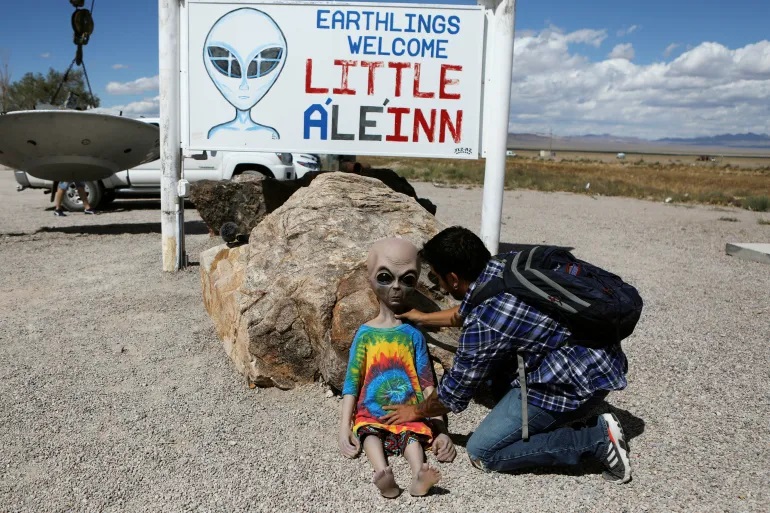
First it was Obama and now its President Trump. Both are implicated in the Epstein Files, and both are releasing their accumulated UAP files. Epic revelation, or epic 'distraction'? Here's a sobering look at aliens from a Syrian sci-fi author currently residing in Egypt whose stories appear in all the top Arab children’s magazines or on screen as cartoons. An opportunity we simply couldn't pass up.
By Emad Aysha
Scholar Lina Keilany almost needs no introduction. A native of Damascus, she is one of the country’s top SF authors and one of the most distinguished children’s SF authors in the Arab world. A scientist by training, she worked in the Arab League till 1990, then dedicated herself to publishing and promoting science fiction.
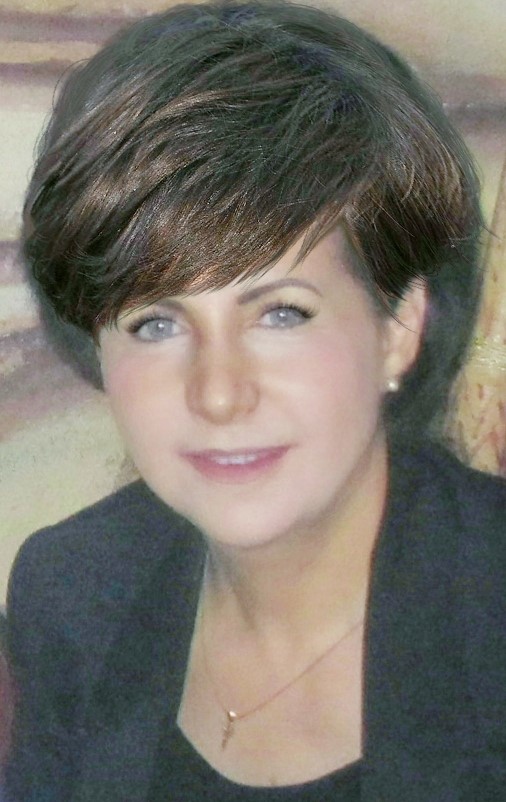
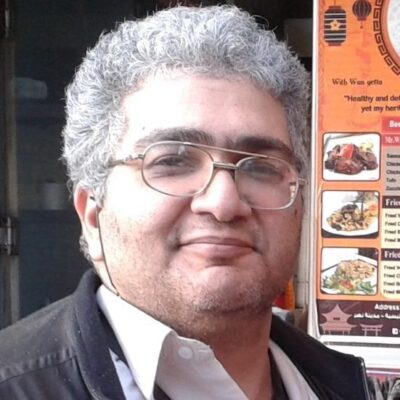
AUTHOR PROFILE: Our guest Lina Keilany, an educator who uses both old-school fantasy and new age science fiction to communicate the virtues (and vices) of the future.[Photo provided by interviewer]
What drew you to writing and to science fiction?
“My journey began in my earliest years. My mother was always my exemplar, my first teacher, as an author along with her colleagues in the field. Our family home was always awash with the intelligentsia —some of the most famous authors in the Arab world, along with foreign intellectuals—the perfect milieu to become a writer.
During school days, I began publishing stories in official newspapers in Syria and gained recognition as the country's youngest author, writing children’s stories. This was the only thing that prevented me from joining the Writers’ Union, which I did apply for. And there were no computers or the internet at the time.
My university studies naturally slowed me down, but the Master of Science I earned (American University in Beirut) helped me tremendously in the end. It made me realise that the work of the creative artist was no different from that of the inventor, while science was just as deep and magical a source of inspiration as fantasy and legends.”
What positive functions can science fiction play at school? And are your stories in school curricula in Syria?
“If only science fiction were introduced into our schools! Then our children would not suffer from future shock, or at least get up to speed with the accelerating pace of change and the century we’re living in. Illiteracy today is no longer just reading and writing, but also digital and ‘civilizational’ illiteracy.
Some of my works are taught in Arabic language classes, not just in Syria, but also in Morocco and even in Iran at the elementary level. That being said, my target audience is young adults, and since 2006, the Syrian curricula have been using stories of mine that are not primarily science fiction but emphasise teaching morals, which is what children’s lit generally focuses on."
Do you write fantasy as well?
“For the child of today, the logical imagination is what is most convincing. Magic is laughed at, tales of genies and the impossible, especially in the era of information revolution and the dominance of the picture. Legends and myths still have their own special mystique, but we need to integrate them into today's world. I’d add that so much is happening today that we can make our own legends for today's children, given their elevated expectations.
Even in fantasy, I always lean towards a simple scientific idea as the basis for my storyline. In writing, my two chief objectives are: scientific knowledge (simplified), and enjoyment. Not to forget the values of humanism, ethics, the environment, and beauty, of course.”
You have a long history with the Egyptian Society for Science Fiction, and contributed to our children’s SF volume (المستقبليون). Are there any other examples of Arab cooperation?
“I’ve been doing this for a long time, advocating science fiction as its own independent literature as well as a means of communicating accurate scientific facts. That’s how you create a future, by combining science with the power of the imagination.
For a ready example, my novel The Choice (الاختيار), first published in 1997 as The Novel of the Future. It’s enjoyed five editions, in Syria, Egypt and the UAE. Ample evidence that the predictions I made in it are still coming true, as we speak. It almost doesn’t count as ‘fiction’, with the remaining predictions just around the corner.
My experience in this field of science promotion also extends to my membership on the editorial boards for Science Fiction magazine (published by the Syrian Ministry of Culture) and Scientific Literature (published by the University of Damascus). Without exaggerating, to my knowledge, these are the only two SF magazines in the entire Arab world.
This, in addition to my participation in the conferences organised in Damascus on Sci-Fi Literature. This was under the auspices of Dr. Taleb Umran, the pioneer of SF in Syria. We rewarded the pioneer of Arab science fiction, Egypt’s Nihad Sharif, in our first conference and formed the Arab sci-fi association (رابطة كتّاب الخيال العلمي العربي). Sadly, it has not been operationalised due to unforeseen circumstances."
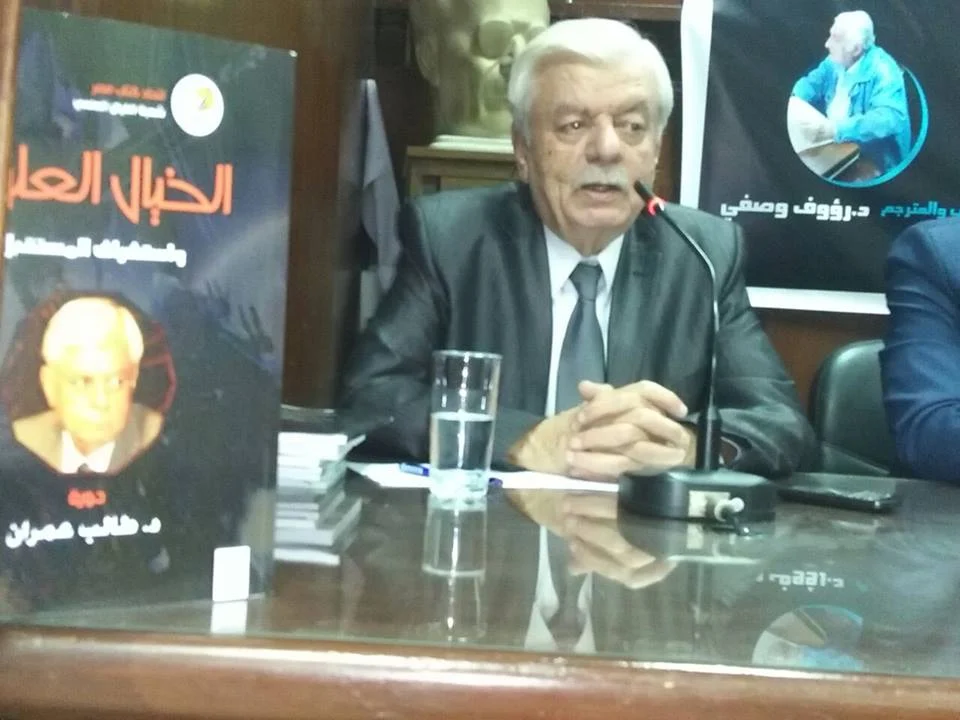
ARAB MENTOR: Author and scientist Dr. Taleb Omran, the man who put Syrian science fiction on the Arab and now increasingly global literary map.
Arabic science fiction has a love affair with the red planet. Please tell us about your novel A Vacation on Mars (إجازة في المريخ)?
“The novel came out in 2002, published by Dar Al-Hilal in Egypt. Five editions since then, from multiple printing houses. I tried to imagine a journey to this planet, shrouded in mystery. And also this angry planet, as indicated by the colour of its sands.
While grounded in scientific realism, I did allow my imagination to picture life there, resembling luminescent eyes, subsiding over the surface of the planet, hiding and communicating telepathically. I gave myself license to go from the very real world of trajectories and space travel, but justified it by the storyline. It could even be considered ‘magic realism’, but justified by the chain of events.”
Please tell us your views on extraterrestrials. Are space adventures especially appealing to children and young people? And are there UFO groups in Syria?
“Personally, even as a child, I did not believe in space aliens capable of communicating with us here on earth. I definitely believe in life out there, but my qualm is with the way Hollywood presents the existence of alien life, which depends on humanisation or anthropomorphising extraterrestrials.
It may seem convincing by appealing to moviegoers, but it is a conceptual trap. You have to think logically about how life evolves in congruence with the unique environments posed on different planets. But Western cinema insists on humanoid forms and vocal cords.
Why would aliens in another galaxy, who can communicate across the vastness of space electromagnetically, need to ‘talk' this way and enjoy the same body language, passions, and envies as we do? Why not imagine aliens who communicate through stench or skin colour?”
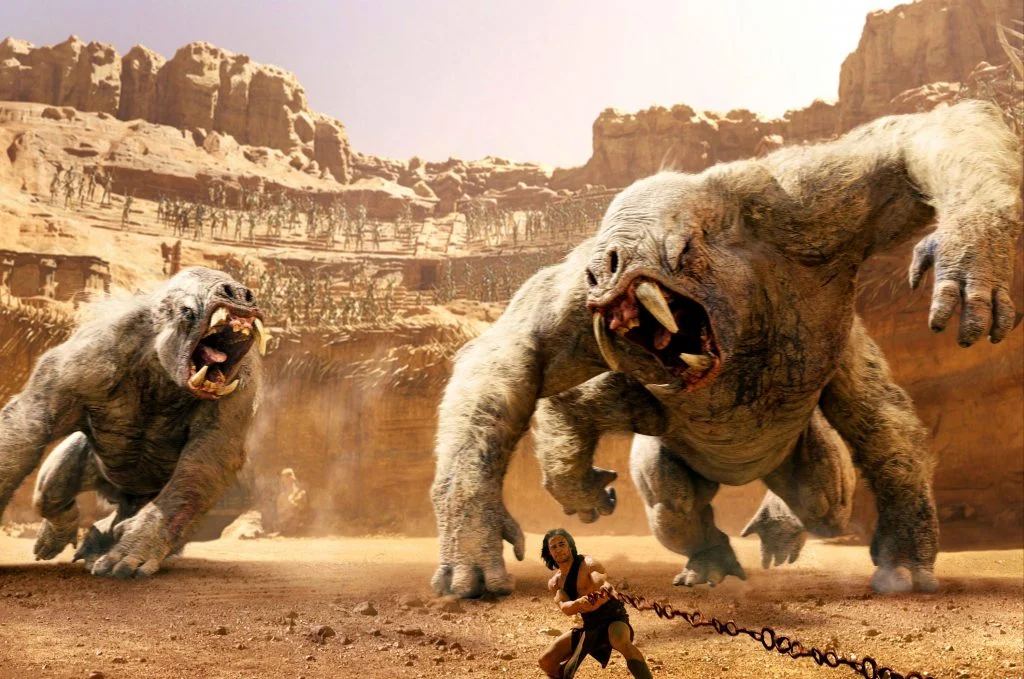
RED-STAINED PLANET: A screenshot from 'John Carter' (2012), transporting apes onto an alien world as well as the overrated human form.
Finally, have any of your books (fiction or non-fiction) been translated into foreign languages?
“Definitely. My works have been translated into many languages. This includes a 20-part series on the Biography of the Prophet Muhammad, which has been published in English, French and the five Scandinavian languages.
As for fiction, some have been translated into Farsi, including The Journey of Hope (رحلة الأمل), and added to their educational curricula. As for short stories, many have been translated into Spanish, Albanian, Russian, and more."