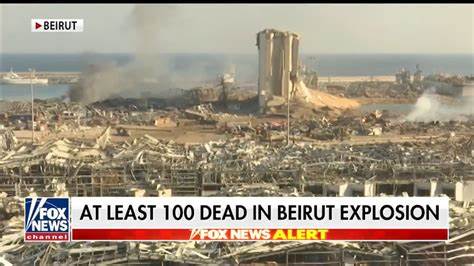
Black smoke was bellowing heavily on Thursday afternoon from the blast-hit silos at Beirut port.
Caretaker Interior Minister Bassam al-Mawlawi meanwhile tasked the Beirut Fire Brigade and the Civil Defense to immediately launch cooling operations in a manner that “does not threaten the safety of individuals and does not pose a risk to the silos.”
Caretaker Economy Minister Amin Salam had recently warned that the damaged silos, shredded in a massive ammonium nitrate explosion two years ago, are at risk of collapse because of a fire that ignited in early July and is still smoldering inside the structure.
The fires at the silos' damaged north block have been ignited by fermenting wheat and grains still trapped inside the building.
Plumes of smoke have been rising from the silos since early July. The fire has reignited trauma among Lebanese gearing up to mark the deadly blast's anniversary.
"We don't want to try to fix something, only to make it worse," Salam said at the time, adding that experts were trying to find a solution.
On Aug. 4, 2020, hundreds of tons of ammonium nitrate, a highly explosive material used in fertilizers that had been improperly stored for years in the giant silos exploded.
The tall structure withstood the force, effectively shielding the western part of Beirut from the explosion that killed over 200 people, wounded more than 6,000 and badly damaged entire neighborhoods.
"There have been fires like this before, and will continue as long as there are grains fermenting inside," Salam said, calling it a "tricky and complicated situation."
Emmanuel Durand, a French civil engineer who volunteered for the government-commissioned team of experts, says the latest fire has only worsened the already poor structural strength of the north block, damaging it in an "irreversible way."
He added that he had warned the authorities in numerous reports the silos' northern block is at risk of collapsing.
"In the last… days, basically since the current fire started, we're observing a very significant change in the rate of inclination in the north block. And it cannot be a coincidence," Durand told The Associated Press. "It's making the silo weaker and even more prone to tilting."
Last April, the Lebanese government decided to demolish the silos, but suspended the decision following protests from families of the blast's victims and survivors. They contend that the silos may contain evidence useful for the judicial probe, and that it should stand as a memorial for the tragic incident.
The Lebanese probe has revealed that senior government and security officials knew about the dangerous material stored at the port. The implicated officials subsequently brought legal challenges against the judge leading the probe, effectively leaving the investigation suspended since last December.
Lebanon's cash-strapped government has not yet put in place a reconstruction plan for the heavily damaged port. Over a year ago, a consortium of German firms presented a proposal to rebuild the port, but nothing came of it.
Earlier this year, the Lebanese government contracted a French shipping company to run the ports' container terminal.
Source: Naharnet.com