The streets of Jerusalem were alive with tension. Dust swirled in the late afternoon sun, mingling with the distant cries of merchants closing their stalls and children running home. The smell of fresh bread, sweat, and burnt wood clung to the air. Among the crowd moved a man whose presence unsettled the world without raising a hand. He spoke softly but with conviction, and his words struck deeper than any sword.
By Nadia Ahmad
Even centuries before, the prophets had whispered of him. Daniel had written: “After the sixty-two weeks, the Messiah shall be cut off, but not for himself; and the people of the prince who is to come shall destroy the city and the sanctuary. Its end shall come with a flood, and to the end there shall be war; desolations are decreed” (Daniel 9:26).
Jeremiah declared: “Behold, the days are coming, says the Lord, when I will raise for David a righteous Branch, and a King shall reign and prosper, and shall execute judgment and justice in the earth. In his days, Judah will be saved, and Israel will dwell securely. And this is the name by which he will be called: ‘The Lord is our righteousness’” (Jeremiah 23:5–6).
The air seemed to tremble with anticipation, as though history were holding its breath.
He was a rabbi, a Jew, familiar with the rhythms and rituals of his people. He carried no armies, no power, and yet the world seemed to lean toward him. Crowds followed, some with hope, some with curiosity, others with suspicion. Women whispered to one another, gripping their children, while men leaned on market stalls, debating quietly.
His teachings unsettled the Romans—not for rebellion’s sake, but because he spoke truth without compromise, exposing the illusions that comforted men and the silent hierarchies that kept society stable but blind.
The Romans noticed. A simple man, yet with influence, gathering crowds, speaking of a kingdom not of this world—this was a threat. Political expediency demanded action. He was condemned, not by a people, not by faith, but by empire.
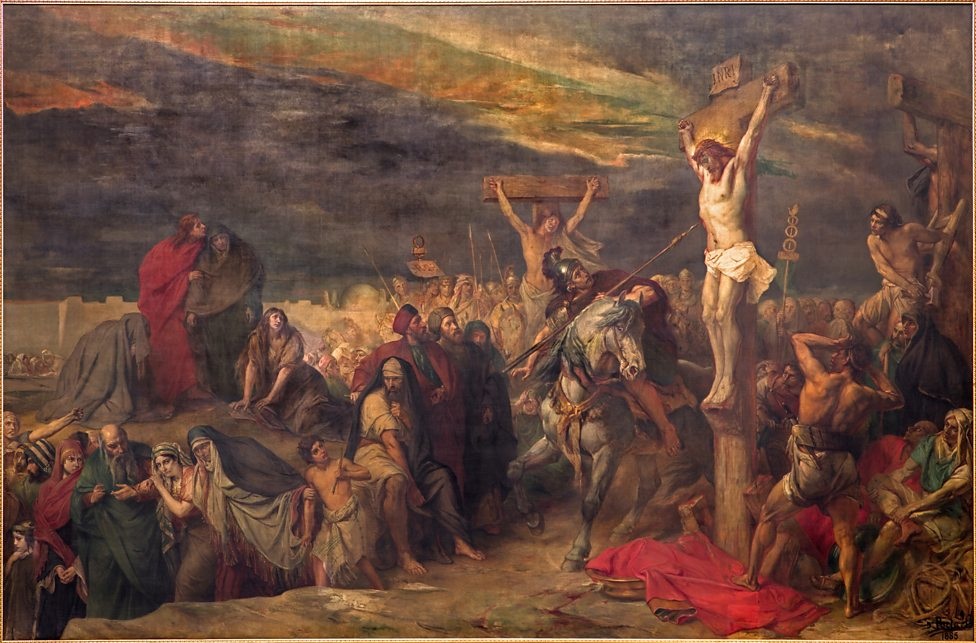
Above his head on the cross, the inscription was clear: INRI, Iesus Nazarenus Rex Iudaeorum, “Jesus of Nazareth, King of the Jews.” The Romans named the crime; the man became a scapegoat, a symbol of unrest, a target for the anxieties of empire.
The Jewish Paradox
Here lies the Jewish paradox: for centuries, the accusation of killing the Messiah was wrongly placed upon the Jewish people, becoming one of the first seeds of antisemitism. This error would echo across centuries. History distorted the truth, turning the machinery of empire into a moral accusation against a people.
In reality, the Jews themselves had no authority to carry out crucifixion; the Romans, as occupying rulers, condemned him. Even in rabbinic tradition, the coming of the Messiah was a central hope: the Talmud contains many discussions of messianic promise and expectation, linking the figure of the Redeemer to restoration and peace promised in the prophets, long awaited by Israel.
This context highlights the tragic misunderstanding: the people who most longed for redemption became scapegoats for the act they could not perform. In that moment, fear of truth and misunderstanding allowed scapegoating to take root, sowing patterns that centuries later would culminate in horrors such as the Holocaust, a crucifixion of an entire people.
Only in modern times did figures such as Pope John Paul II openly confront this distortion, moving toward reconciliation. In his 1986 pilgrimage to the Synagogue of Rome, he formally recognised the suffering imposed on the Jewish people and condemned the theological errors that had fueled antisemitism for centuries. Yet the shadow of misblame lingered, a reminder of how easily fear reshapes truth into accusation.
The crucifixion was not just a historical act. It was a pattern, a human reflex repeated across time. When clarity threatens comfort, when truth unsettles order, it is punished. People do not reject evil alone; they reject what exposes them. The cross stands as that reaction: the unbearable weight of reality resisted, silenced, struck down. Yet crucifixion is never the end. What is silenced does not disappear; it returns.
The streets of Jerusalem that day were not just crowded with people; they were crowded with fear. Dust rose beneath hurried feet as soldiers pushed forward and the cross scraped against stone, each dragging movement echoing through the narrow streets. Children watched without understanding, mothers pulled them closer, and men lowered their voices as if speaking too loudly might confirm what they feared was happening.
Jesus carried the cross not only as punishment but as a mirror. Every step, every stumble reflected humanity’s refusal to see itself clearly. Pain carved itself into flesh, but something deeper unfolded beneath the surface. The cross revealed its dual nature: a device of torture and, at the same time, something else entirely—a threshold between the human and the divine.
At Golgotha, the moment thickened. The soldiers worked with practised indifference, yet the atmosphere resisted them. When the nails struck, something more than flesh was pierced. For a fleeting instant, time itself seemed to fracture, and the ancient words of Daniel echoed, not as memory, but as reality unfolding: “the Messiah shall be cut off, but not for himself.” Then the moment collapsed back into the present—the hammer, the cries, the unnatural dimming of the sky.
The crucifixion became a living theatre of suffering. Thunder rolled faintly in the distance, the light dimmed as if creation itself recoiled, and even those who doubted felt the weight of something beyond comprehension.
A mother’s grief, a soldier’s unease, a crowd caught between fear and fascination—every face reflected a different encounter with the same moment. And above it all, he remained—broken in body, yet unbroken in presence.
Silence followed, heavy and uncertain. It seemed final. It always does. And yet, the third day came.
The stone did not move easily, as if even it resisted what was about to be revealed. When it finally gave way, light entered not as a gentle glow but with quiet authority. The darkness did not fight it; it dissolved. And again, time seemed to bend, and the words of Jeremiah surfaced—not recalled, but fulfilled: “I will raise unto David a righteous Branch.”
The resurrection was not simply a miracle. It was inevitable. What had been silenced returned. What had been denied stood undeniable. The pattern completed itself.
Here, the dual nature of Jesus becomes unmistakable. As a human, he experienced pain, betrayal, and mortality. As divine, he remained beyond destruction. This is the paradox at the heart of the cross itself: it can destroy the body, but it cannot touch the essence.
You cannot crucify the Son of God
The Son of God is not merely a man to be broken or a body to be nailed to wood. His nature is both human and divine—finite in form, infinite in essence. To crucify him is to attempt the impossible: to confine what cannot be contained, to silence what gives rise to existence itself.
His suffering reveals human fragility; his resurrection reveals what cannot be destroyed. Crucifixion reaches the surface, but resurrection reveals the depth. Like the covenant between God and his people, his reality cannot be undone.
This pattern continues in quieter forms. Individuals who speak uncomfortable truths are dismissed, attacked, or silenced. Systems—political, social, even personal—repeat the same reflex seen on that hill outside Jerusalem. Yet truth does not disappear. It returns, often stronger, often clearer, always persistent.
As Nietzsche declared, “God is dead. And we have killed him.” In this moment, the Christian who lived and died on the cross is the last witness of divine suffering in a world that forgets the sacred. We, humans, face a choice: either we leave him on the cross, letting truth remain silenced as Nietzsche warned, or we participate in resurrection—by rising ourselves, transcending limitation, and bringing the divine into human action once more.
The human meaning of Easter lies in this recognition. What is rejected today returns tomorrow. The cross is not only history; it is a symbol of denial. The resurrection is not only faith; it is the persistence of reality itself.
Even the Romans, with all their power, could not stop it. Empire could act, but it could not control the outcome. The man they killed returned—not only in story, but in consciousness, in influence, in the very way humanity understands truth and sacrifice. The resurrection is not a reward; it is a confirmation that reality cannot be erased.
Easter is not past. It is continuous. It appears wherever truth is silenced and wherever it returns. The story of the rabbi from Nazareth is not confined to history—it unfolds in every generation, in every society, in every individual willing to see it.
The day God was killed is not behind us. It is happening still; in the truths we avoid, the realities we postpone, the awareness we resist. And the resurrection is happening too, quietly and inevitably, wherever clarity returns.
You cannot crucify the Son of God.
Happy Easter.