The public debate surrounding the Middle East conflict exposes a deep, structural shift within the Western political arena. Traditionally, the progressive Left was seen as the natural protector of minorities and a staunch ally of the Jewish community in the post-Holocaust era. Today, that landscape has changed radically. The Left now finds itself in a complex electoral and ideological bind, in which space is created for the discourse of Islamic jihadists. Paradoxically, in the pursuit of moral high ground and electoral gain, the interests and safety of European Jews are being effectively marginalised.
By Ken van Ierlant
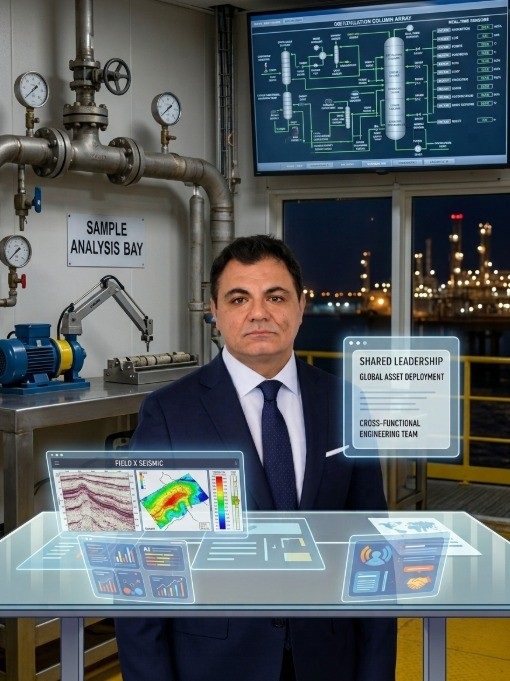
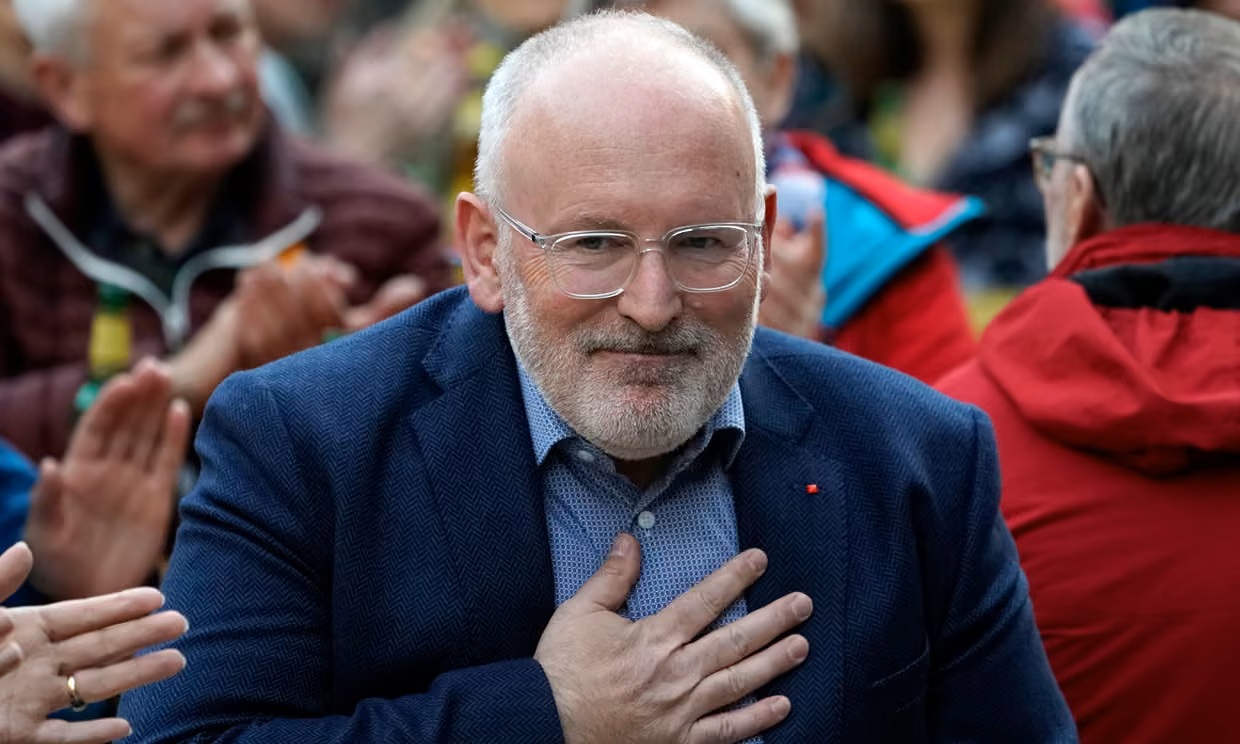
This ideological drift of the “progressive” Left was personified in July 2026 by Frans Timmermans. The former European Commissioner (2014 – 2023) for Climate Action and Executive Vice President of the European Commission for the European Green Deal and European Commissioner for Climate Action, and briefly leader of the Dutch Green-Left/Labour coalition (2023-2025)
Merely days after being granted the prestigious lifelong honorary title of Minister of State by King Willem-Alexander, Timmermans gave a highly controversial interview to De Morgen. In it, he asserted that a whole people is being exterminated in Gaza and drew a direct parallel to Nazi Germany, claiming that Israel's right-wing leadership is applying the same logic to Palestinians as the Nazis did during the Holocaust.
Timmermans' rhetoric offers a textbook case study of how high-ranking progressive leaders have adopted extreme frameworks that upend traditional post-Holocaust moral consensus.
Postcolonialism, anti-imperialism, and historical inversion
To understand why contemporary leftist discourse sometimes aligns with the rhetoric of religious extremists, one must look at dominant academic frameworks: critical theory and intersectionality. Within this worldview, society is strictly divided into "oppressors" and the "oppressed."
Israel is categorised as a Western, colonial, and "white" occupying power, while the Palestinians are viewed as the ultimate oppressed party.
When a Minister of State and prominent progressive leader like Timmermans publicly declares that Israel is doing "the same" to another people as was done to the Jews during the Holocaust, it represents the ultimate manifestation of this binary logic.
Through historical inversion, the reactionary and theocratic nature of groups like Hamas or Palestinian Islamic Jihad completely fades into the background. Radical leftists frame the conflict through a traditional anti-imperialist reflex where core leftist values, such as LGBTQ+ rights, feminism, and secularism, are temporarily sidelined in favour of a shared struggle against a perceived imperialist enemy.
Furthermore, cultural relativism plays a major role. For fear of being accused of Islamophobia, progressives frequently withhold criticism of Islamism, systematically stripping the conflict of its religious-fundamentalist component.
Instead, mainstream leftist leaders validate radical narratives by using extreme, polarising terminology that effectively demonises the Jewish state under the guise of human rights.
Electoral reality and the consequences on the streets
This ideological position is not purely theoretical; it has a hard, pragmatic cause rooted in Western European demographics. In urban areas, leftist parties rely heavily on voters from migrant backgrounds, for whom the Palestinian cause is a deeply emotional and religious symbol.
To avoid losing this growing constituency, the tone of political discourse is carefully managed, and mainstream leaders increasingly feel pressured to match the radical rhetoric of their base.
This political shift has concrete, dangerous consequences for safety in European cities. By deploying comparisons to Nazi Germany from positions of immense political authority, such as that of a Minister of State, leftist leaders inject highly volatile rhetoric directly into the public sphere.
When the political establishment downplays the theological antisemitism originating from radical demographics to protect its voter base, European Jews are left uniquely vulnerable.
While leftist parties emphasise that their criticism is directed solely at the State of Israel (anti-Zionism), the reality on the ground shows a dangerous blur. The Jewish diaspora is routinely held directly responsible for the actions of the Israeli government by pro-Palestinian activists. Inflammatory statements from figures like Timmermans erase nuance, signalling to the streets that Israel is an absolute moral evil.
Consequently, Jewish schools and synagogues now require permanent, heavy security. The historic promise of "never again" appears to be applied selectively: it serves as a warning against the far-right of the past. Still, it offers little protection against the current threat of Islamic and radical-left antisemitism fueled by mainstream political validation.
Media representation and the creation of the Alibi Voice
This dynamic of exclusion extends directly into the media landscape. Within progressive and left-liberal media outlets, the Middle East conflict is a highly sensitive moral issue. To preempt accusations of bias or antisemitism, a specific mechanism has emerged: the selective utilisation of Jewish intellectuals to legitimise the media's own critical framework.
This has created a strict division in the media between the "tolerated" and the "cancelled" Jew:
When a prominent political figure uses his platform to accuse Israel of mimicking the Holocaust, it accelerates this media polarisation. Nuanced, mainstream Jewish voices are entirely drowned out by the sensationalism of the Left's moral outrage.
The broad, pluralistic spectrum of the Jewish community is reduced to a one-dimensional caricature. At the same time, the political establishment uses its institutional weight to legitimise the total isolation of those who defend Israel's right to exist.
Rhetorical escalation: The destruction of taboos and the mechanism of propaganda
The public discourse surrounding the Middle East conflict has reached a critical tipping point. When high-ranking political figures cross the threshold into utilising Nazi analogies, it triggers a dangerous cycle of rhetorical escalation.
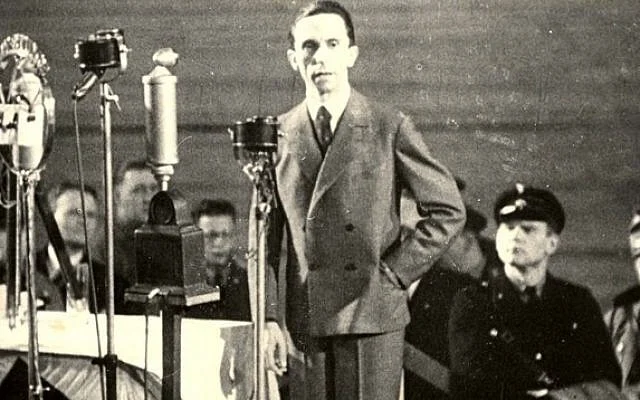
When a Minister of State like Frans Timmermans publicly invokes the Holocaust to condemn Israel, it shatters a foundational post-war taboo. This normalisation of extreme rhetoric inevitably provokes an equally severe counter-response, leading critics to compare his framing methods to the systematic propaganda techniques of Joseph Goebbels.
This dangerous spiral of rhetorical escalation operates through three distinct, compounding mechanisms:
1. Rhetorical inversion (the reversal of history)
The escalation begins with a fundamental inversion of historical memory. By equating the actions of the Jewish state with the systematic industrial genocide perpetrated by Nazi Germany, the Holocaust is weaponised.
It is no longer treated as a historic, universal warning against the dangers of antisemitism. Instead, the ultimate historical trauma of the Jewish people is turned against them to achieve maximum emotional and political damage.
This inversion strips the debate of any geopolitical nuance, transforming a complex territorial and existential conflict into a narrative of absolute, cosmic evil.
2. The mechanics of mass manipulation
When critics draw a parallel between this modern leftist discourse and the propaganda machinery of figures like Goebbels, they are pointing to a specific psychological mechanism: the Big Lie and the systematic conditioning of public opinion.
Goebbels' doctrine relied on the continuous, unapologetic repetition of extreme, emotionally charged accusations from positions of absolute state authority.
When a prominent leader and Minister of State repeats the claim that Israel is systematically exterminating an entire people, it bypasses rational, fact-based debate. The immense institutional authority of the speaker legitimises the extreme accusation, embedding it into the mainstream consciousness.
The goal of this rhetorical strategy, whether intentional or a byproduct of opportunism, is to socially and morally isolate the target, leaving no room for dissent or defence.
3. From state authority to the street
The ultimate danger of this rhetorical escalation lies in its real-world consequences. Language from high-ranking political establishment figures does not remain confined to academic halls or media studios; it cascades directly onto the streets.
When mainstream political icons validate the comparison between Israel and Nazi Germany, they inadvertently provide a moral blank check for radical elements on the ground. If Israel is framed as the ultimate evil, equivalent to the Nazi regime, then any action taken against its perceived supporters is viewed by extremists as justified resistance.
Consequently, the rhetorical escalation initiated by the political elite directly translates into an immediate, physical threat to the Jewish diaspora, leaving synagogues, schools, and individuals entirely defenceless against a radicalised public sphere.
The alliance between progressive discourse and elements of Islamism has profoundly altered the position of the European Jew. Driven by electoral opportunism, postcolonial blind spots, and selective media representation, the traditional bond between the Left and the Jewish community has been severely damaged.
The defence of Timmermans' statements by his supporters, and his retention of the Minister of State title despite widespread public outcry and demands for his resignation, underlines how deeply embedded this worldview has become within the political mainstream.
For a large portion of European Jews who feel fundamentally connected to the survival of Israel, the current political and journalistic dynamic no longer feels like a misunderstanding: it feels like a direct betrayal of their safety, history, and identity.