
I have spent over two decades in project delivery across energy, oil and gas, and process industries, and if there is one truth I have learned, it is this: projects rarely fail because of the big, dramatic mistakes. They fail because of the small, everyday habits nobody bothers to call out.
Inspired by a post from the Association for Project Management: a set of "red cards" for project management, the kind of light-hearted list that makes you laugh first and wince a moment later.
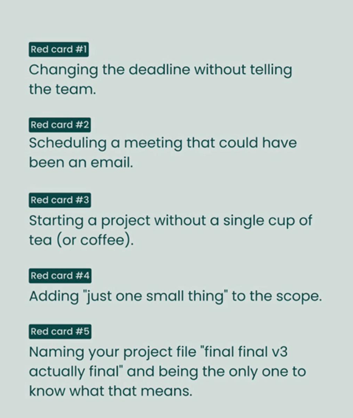
Changing the deadline without telling the team. Scheduling a meeting that could have been an email. Starting a project without a proper conversation over coffee. Adding "just one small thing" to the scope. Naming a file "final final v3 actually final" and being the only person alive who knows what that means.
It is funny because it is true. And it is true because these are not technical failures — they are behavioural ones.
Harvard Business School's research on organisational behaviour has long argued that execution breakdowns are rarely about strategy; they are about the discipline, communication, and habits that sit beneath strategy. A brilliant plan, executed by a team operating under silent assumptions and scope creep, will still collapse.
The red cards are a reminder that project management is, at its core, a discipline of small, consistent choices.
Let me pull out three of them that I believe deserve more attention than they get.
First, silent changes are more dangerous than bad decisions. Changing a deadline, a scope line, or a priority without telling the people executing the work is not efficiency: it is erosion of trust. Harvard's studies on team accountability consistently show that transparency, not perfection, is what keeps teams aligned under pressure. A team that is informed late will forgive you. A team that discovers a change on its own will not forget it.
Second, "just one small thing" is never small. Every project professional has heard this phrase, and has learned, usually the hard way, that scope creep rarely announces itself as such. It arrives disguised as a favour, a quick fix, a reasonable ask.
The discipline is not in refusing small requests; it is in recognising that a scope boundary exists precisely so that small requests do not silently become large ones. Protecting that boundary is not bureaucracy. It is leadership.
Third, unnecessary meetings are a tax on your best people. A meeting that could have been an email is not a minor inconvenience: it is a quiet drain on the people whose time matters most to your delivery. The best project leaders I have worked with treat meeting time the way they treat budget: something to be spent deliberately, not habitually.
If a decision does not require real-time dialogue, it does not require a meeting.
None of these three points is complicated. That is exactly the point. Project management is not primarily won through sophisticated frameworks or the latest software — it is won through consistency in the fundamentals: clear communication, disciplined boundaries, and respect for people's time. The organisations that struggle are rarely the ones lacking talent. They are the ones that have normalised the red cards — where silent changes, scope drift, and meeting fatigue have become part of the culture rather than the exception.
So here is my closing thought. The next time you catch yourself about to change a deadline quietly, add "just one small thing," or book a meeting out of habit rather than necessity, pause.
That pause is where good project management actually lives. It is not glamorous, and it will not make headlines. But it is the difference between a team that trusts its leadership and a team that tolerates it. In a profession built on delivery, that difference is everything.