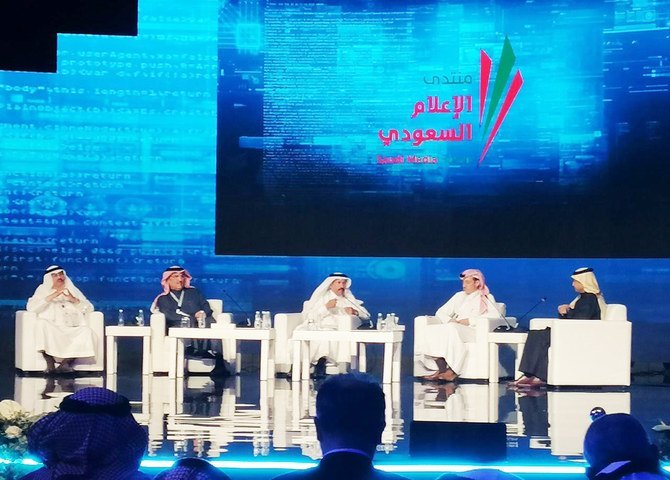
The Saudi Journalists Association (SJA) and the organisation of the Saudi Media Forum look back on a successful first edition of the international media forum, held in Riyadh early December.
By Arthur Blok
The red carpet was rolled out at the prestigious Hilton Residence earlier this month for the 2-days event in the Saudi capital. Over 2000 spectators, including prominent Arab and local Saudi journalists, political analysts, politicians and media consultants – including The Liberum - from all over the world gave ‘acte de presence’ to this first-of-a-kind and well-organised event in the Kingdom.
Reporters and editors from leading Western outlets, such as the Guardian, Le Figaro, and the Frankfurter Allgemeine Zeitung, were included in the speaker lineup. Their managing editors took part in workshops and panels discussing a broad range of topics such as ‘the risks posed by fake news’, ‘are the Western media fueling or containing political conflict in the Arab World’ with their reports, and the need for more ‘balanced reporting’ in the region.
At the same time, several business opportunities were discussed in panel discussions and various workshops. Which opportunities could the current wave of digitisation of the media offer your company? How does digitisation influence the way you report news? How does it influence the way you do business in 2019?
Controversies
Even a controversial topic like Islamophobia in the West was openly discussed. Sheikh Mohammed Al-Issa - Kuwait’s former minister of Media and current Secretary General of the Muslim World League - presented the audience with a rather progressive speech on how to combat this new phenomenon in the Western discourse.
He emphasised - on several occasions in his speech - that European Muslims should adapt more to the society they live in, or move back to the countries they come from. Expecting that Western societies adapt to their interpretation of Islam makes it, in his perspective, quite easy for Islamic critics to blame and attack Islam, and de facto all Muslims, for failed integration and Islamic extremism.
Despite this broad spectrum of topics, some Western critics saw the event as just another phase in Saudi Arabia’s massive public relations campaign aimed at rebranding a nation that has a bad name when it comes to press freedom and freedom of speech. International Human rights watchdogs aren’t yet convinced that there will be genuine reforms on issues such as press freedom.
Veteran Saudi journalist Ibrahim Al-Ogaily feels that many critics in the West have no idea what is currently going on in Saudi Arabia. “Let me start by saying that the international forum was a wonderful initiative. It brought together a distinguished group of journalists and media workers from Saudi Arabia and many Arab and non-Arab countries.”
Al-Ogaily, who works for the Saudi Press Agency and is himself a member of the Saudi Journalist Association, continues: “To all individuals who continue to criticise Saudi Arabia: there is nothing to gain. Please note the reforms introduced over the past few years by our King and Crown Prince, Mohammed Bin Salman. We are on an unstoppable path of reforms, development and modernisation: if you like it or not.”
Press Freedom Index
Saudi Arabia currently ranks 172 out of 180 in the World Press Freedom Index from the NGO Reporters without Borders (RSF). Despite international criticism and a low score on the Press Freedom Index, this month's media forum could also be seen as an indication that things are changing for the better in a country once fully closed to Westerners and foreign journalists. An event that is in line with other reforms that were introduced more recently by Crown Prince Mohammed Bin Salman.
Is it ever too late to open your society and debate topics that are on everyone’s mind? Why not discuss them at an annual international media forum in Riyadh? Media Forum President Mohammed Fahad Al-Harthi asks himself the same questions on the organisation's website: “This is one of the most influential capital cities in the Middle East, which means it represents one of the largest media and advertising markets in the region.”
Al-Harti continues: “Better late than never. The Saudi Media Forum was an initiative launched by the Saudi Journalists Association, one of the kingdom’s key civil society institutions, independent from the government, with an elected board of directors.”
An essential part of the ambitious Saudi Vision 2030 is to create a more open and modern society, reduce the nation’s dependence on oil, diversify its economy, and further develop public service sectors such as health, education, infrastructure, recreation, tourism, and media. At the same time, the government supports cultural innovation to unlock the potential of the nation's young population, where nearly two-thirds are younger than 30.
“If you follow the latest developments, you can see that Saudi Arabia is making great improvements on all levels of society. Many people have a wrong and inaccurate idea about the country and the people that live in it”, said veteran journalist Al-Ogaily.
He concludes: “Since September, everyone is welcome to come and visit our nation. I challenge every critic to come and see for themselves who we are and what we stand for. They will realise that some channels are saying and broadcasting inaccurate statements and often attempting to undermine our country. Our country is open to the whole world and to all cultures. Please come see it for yourself before judging us.”

?????
So happy.
?????
Thank you everyone.
Angel NicGillicuddy ??