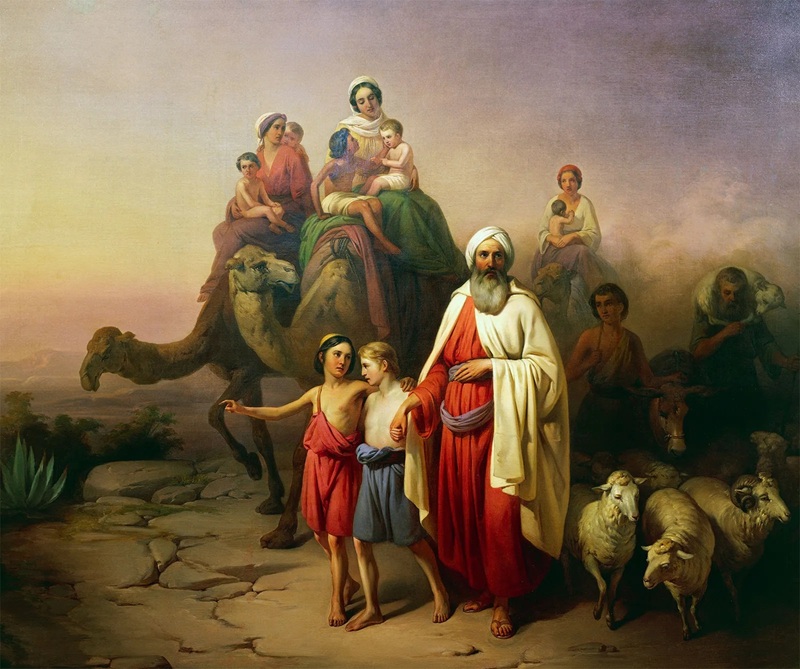
The accepted historical narrative of the Judeo-Christian and Islamic world is tied to the story of the Prophet Abraham. Deviations in interpretation between biblical and Qur’anic accounts have affected social divisions, historical accounts, and geopolitics across centuries. The enduring influence of the sons of Abraham on politics, culture, and society is particularly prevalent, but not exclusive to, the Middle East.
By Nadia Ahmad
The Prophet Abraham has altered the destiny of nations. The “first Prophet of Monotheism” serves as both the unifier and divider among Jews, Christians, and Muslims. Isaac, son of Abraham, is recognised as the ancestor of the Judeo-Christian world, while Muslims are the self-proclaimed children of Ishmael.
Through Isaac, the Judeo-Christian world unites, split by his sons Jacob and Esau: Jacob, the forefather of the Jews, and Esau, the father of the West and the Christian world. Ishmael’s severance from this genealogical lineage is reflected in the disconnection between the Islamic world and the Western Judeo-Christian civilisation.
Since the fall of the European monarchies, biological genealogy and ancestral rights have been supplanted by the principle of ideological and spiritual legacy. The monarchs and aristocrats of Europe embodied the notion of inheritance on biological grounds by passing their wealth, titles, and power to their sons, centralising power within biological units, families.
The decline of monarchies and their dwindling relevance in the modern world has led to the succession of a new hereditary principle: ideological and spiritual inheritance.
The nations of Isaac and Ishmael
The cultural division between Judeo-Christianity and Islam is often referred to within the context of cultural and political discourse. Islamic values are woven from a distinct fabric, exclusive to Muslims, leading Western and Islamic values to present as oil and water.
This schism is a manifestation of the historical divide within the lineage of Abraham. At the same time, Esau and Jacob were united in brotherhood; Ishmael, the forgotten uncle, was severed from Isaac and his lineage. Theologians have corroborated the notion that civilizational divides are biological, biblical, and divine.
However, it is unfeasible to claim that Muslims are biological descendants of Ishmael, as is proclaimed within the Islamic narrative. How could 1.3 billion Muslims descend from a man who lived and died thousands of years ago?
Nor can 2.3 billion Christians trace their ancestry to Esau, whose lifetime predates that of Jesus by thousands of years. The imperialism of the Islamic and Christian world has made biological ancestral claims virtually impossible.
Both the Christian and Islamic worlds spread their religions across nations and civilisations, becoming rival empires. Societal transformation is central to the history of both faiths, making it impossible for all Christians and Muslims today to claim common genetic ancestry.
Metaphysical forces would have had to conspire to ensure that every man and woman with the blood of Esau accepted the message of Christ, with the same logic applying to Muslims. It is unrealistic to assume that 2,600 years after Abraham, the word of Muhammad was accepted exclusively by those with Hagar's blood in their veins.
Esau, Rome, Christ
The ancient biblical Kingdom of Edom was the symbolic foundation of the Roman Empire. The Edomites, who traced their lineage to Esau, were figural precursors of the Romans. The ultimate Christianisation of the Roman Empire, which is the pillar of the West, has made the Western Christian world the mnemonic descendants of Esau. The Roman Catholic Church is the rock on which the West was built, and Edom is its figurative forefather.
Unlike Judaism, which propagated itself through biological reproduction, Rome spread across nations through structural expansion. Through infrastructure, Roman law and order, and the Legion, the symbolic nation of Esau grew.
Roman pragmatism remains pervasive in Western nations today, with their institutions and people inheriting the practical foundations on which Edom was built, and Rome expanded: a Kingdom turned Empire turned civilisation.
While Jacob was the recipient of the unmanifested, metaphysical, invisible blessing of Abraham’s covenant, his inheritance from Abraham was largely future-oriented. In contrast, Esau inherited the land, swords, and nation.
The clash between Jacob and Esau ultimately manifested as the historical Jewish-Christian divide, in which Jacob’s weakness would outlive Esau’s strength. As the West was built by the hands of Esau, it was guided by the voice of Jacob.
Jacob’s influence in Christianity remained central long after the fall of Rome and the spread of Christianity across the West. Christianity adopted Hebrew scripture, the Old Testament promise of the Messiah, as well as Jewish ethics, within the confines of Roman law. Roman universalism reset and closed time, making zero A.D. the linear reference point for the West and, ultimately, the world.
The Islamic Empire
Since Muhammad, the Islamic world has stood apart from the Judeo-Christian civilisation. Ishmael left Isaac and his sons behind to forge his own path, settling in Arabia where Islam was eventually founded.
Historically and interpretatively, little ties these three civilisations together, as there is no consensus between Jews, Christians, and Muslims on the relevance of Ishmael, his holiness, or his righteousness as a man or a Prophet.
By emphasising themselves as descendants of Ishmael, Muslims are setting themselves apart from the Judeo-Christian narrative. Islamic groups such as Hamas and Hezbollah proudly proclaim their descent from Ishmael, and have opposed the Israeli state not only politically, but also religiously.
These groups also oppose Western culture and regional presence, with the presence of a Jewish Middle Eastern state labelled “Western colonialism”. For Muslims, the Middle East is the land of Ishmael, Abraham's heir.
The insistence that Ishmael was the lamb of Abraham, a role which supplanted Isaac, is a point of theological and civilizational contention. Two thousand six hundred years after Abraham and his sons, Muhammad declared Ishmael, not Isaac, the heir of the covenant, declaring Abraham a Muslim in the process.
The Islamification of history and biblical accounts is a central tenet within Islam, which views all books save the Qur’an as tampered with by man. Since 600 A.D., Islam has stood apart from the West, rewriting biblical historical and spiritual accounts by declaring Ishmael supreme, focusing on the genealogical lineage of Ishmael-Muhammed. Even Jesus of Nazareth was a descendant of Ishmael according to Islamic interpretation.
Jacob, Zion, and Israel
Since the founding of the modern state of Israel, religious genealogy has been brought to the forefront of political discourse. The emergence of a Jewish state, based on a continuity of biblical and historical presence tied to the blood of Abraham, introduces a certain ethnoreligious logic, which is inapplicable to the Christian or Muslim world. In contrast, the Jews, who never founded an empire or sought to convert nations en masse, are more likely to have preserved their Jacobian lineage throughout history.
The preservation of Jewish lineage and the principle of matrilineality has allowed Judaism to remain a global minority. While Muslims and Christians number in their billions, Jews are less than 0.5% of the worldwide population. Esau’s pragmatism and Muhammad’s role as propagator and disseminator of Allah’s message have spread Christianity and Islam far and wide, while Judaism remains a minority global religion.
However, the notion of spiritual heredity appears among the Israelites, the sons and daughters of Jacob. Whether the promise of Zion is of the heavenly city of Jerusalem or the one located in Israel is disputed within Jewish communities. What is less contentious is that the covenant between Yahweh and the Jews was a spiritual promise, inherited by Jews across generations.
For Muslims and Christians, Abrahamic ancestry is neither genealogical nor biological. There is no traceable predetermination of adherents of these faiths in the biblical period of the prophets. Christians and Muslims are not an ethnicity, as to them, Abrahamic ancestry is a spiritual lineage.
Thoughts beget thoughts, and so the Christian and Islamic nations of the world have been formed through mutual thought and belief, not genealogy or blood ties. The covenant between Jesus and Muhammad is spiritual; its bond is woven through thought, not blood.
The Book of Genesis teaches that holiness without limits becomes an empire, and land without a covenant becomes Babylon. The history of Abrahamism in the region has validated the biblical lesson. As religions become imperial and nations become consumed with earthly power, spiritual ignorance ensues, leaving the covenant behind in history.
Despite the diversity of biological or spiritual ancestry, the modern notion of Abrahamism has encouraged followers of Abraham to pursue peace and to emphasise intergroup ties. Whether these ties are biological or spiritual, unity in Abraham can promote the view that the peace of Abraham is not exclusive to a single group but is shared by all who claim him.




Uhm, I liked previous article a lot, but this one has a problem. Christianity doesn't lean on Esau at all... That's factually incorrect. Abraham, then Isaak, and then Jacob - Jews, and Esau - Edomites (disappears). Christianity leans on the tribe of the Jews and Jezus, who taught 'the way' without having the intention to create a religion as we have known for centuries. Long story short, Esau has been used in the Roman Empire and Christian Europe much later in symbolic polemic. But there's no biological or religious tribe coming from Esau. The saying was: 'Just as Esau persecuted Jacob, so Rome persecuted Israel'. Alright. I'll take off my rabbi beard now. 😉