Across Europe, there’s a persistent, comforting belief that what has taken shape in the United States around Immigration and Customs Enforcement could never take root here. In general, Europe has no federal immigration police with sweeping powers, no single centralised enforcement culture, and no exact equivalent of the American political climate. This belief feels reasonable, even sophisticated, but is dangerously naïve. ICE isn’t an American aberration but a destination; not by sudden leaps, but by long, unexamined journeys.
Such an apparatus doesn’t emerge because a single government wakes up one morning craving repression. It appears because norms are allowed to decay while institutions remain. When standards are blurred, enforcement is delayed, and political responsibility is endlessly deferred, the law is forced to compensate through force.
The little-read French thinker Jean-Joseph Goux observed that institutions harden precisely when their symbolic legitimacy dissolves. Law continues to exist, but no longer persuades. It must then compel. ICE isn’t just the cause of moral collapse in the United States; it’s its residue.
What we now witness in America is a self-reinforcing spiral of hostility. ICE was conceived as a technical executor of immigration law, yet it has become a magnet for mutual hatred. Agents are threatened, attacked, and sometimes targeted with explicit intent to kill. At the same time, the catalogue of mass abuse by ICE itself has grown, making it impossible to dismiss, even leading to death.
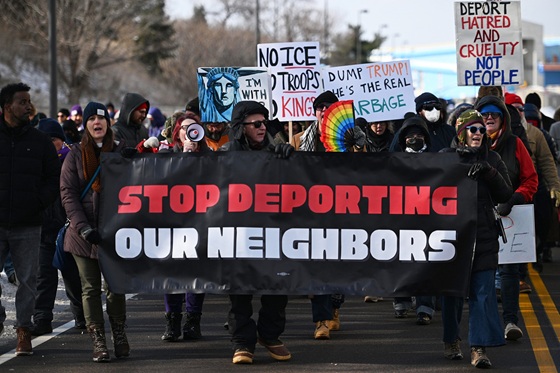
People dragged across concrete, sprayed with toxic agents, run down by vehicles, detained for months despite legal residency, and we’re even starting to hear of ‘spontaneous’ shootings or chokings of people in detention centres. Pregnant women, children, pastors, citizens: not anomalies, but patterns. What emerges isn’t discipline, but cruelty embedded in routine. I don’t care if readers are left or right; this is as inhumane as it gets.
This is how enforcement rots from the inside. The Spanish philosopher María Zambrano argued that violence appears when reason is denied time. In a permanently hostile environment, law enforcement ceases to be mediation and becomes confrontation. The other side is no longer a human or even a subject, but an enemy. That transformation dehumanises everyone involved. Unsurprisingly, ICE increasingly operates not merely harshly, but unlawfully. When power loses legitimacy, legality becomes optional.
The broader system follows. Whistleblowers leak thousands of names. Governments respond not with reform or accountability as they should, but with propaganda. Judges, lawyers, and civil servants resign. The German thinker Günther Anders described this state as moral overheating; institutions still function mechanically, but the ethical circuits have burned out. ICE today isn’t primarily a legal controversy. It’s absolutely a moral exhaustion made visible.
Europe should recognise itself in the prehistory of this outcome. For years, immigration has been framed primarily in the language of identity and moral symbolism, while concrete problems have been postponed or euphemised. “Wir schaffen das“, sagte Angela Merkel. A cliché reference, but effective. Crime, trauma, incompatible worldviews, and religious extremism are treated as awkward footnotes rather than structural challenges… The Portuguese sociologist Boaventura de Sousa Santos warned that societies unwilling to name conflict early will regulate it brutally later out of panic.
Europe, too, has absorbed populations marked by severe trauma and normative frameworks that sometimes clash with democratic assumptions. Acknowledging this isn’t xenophobia but governance. A political order that fails to establish clear limits, meaningful integration, and consistent authority doesn’t become compassionate; it becomes brittle. And brittle systems don’t bend but snap, dear readers.
Signs of strain are already visible. Confrontations with police, organised intimidation of emergency workers, the normalisation of mob violence, and the erosion of respect for basic boundaries. What would have shocked now circulates as spectacle. The Italian philosopher Roberto Esposito spoke of immunity as a condition of political life. The ability of a community to protect itself without destroying itself. When that immunity collapses, repression fills the vacuum.
Europe remains trapped in a false dichotomy. Either dialogue and inclusion, or firm enforcement and punishment. As if listening excludes acting, or authority negates humanity. In reality, only societies that listen early can enforce proportionality. Half-measures, delayed decisions, and moral posturing create precisely the conditions in which excessive force later appears inevitable.
ICE is therefore not a warning about American excess. It’s a warning about European hesitation. It shows what happens when unresolved tensions are allowed to accumulate until institutions are asked to do what politics refused to do. Namely, draw lines under emergency conditions. At that point, the lines are never clean.
If I zoom in on the Benelux, we once prided ourselves on channelling conflict before it metastasised. That capacity isn’t guaranteed anymore. It must be actively maintained through clarity, proportionality, and the courage to articulate uncomfortable truths before they harden into crises.
Delay masquerading as tolerance isn’t humane but merely evasive. If Europe wishes to avoid its own versions of ICE, it must act while it still has choices rather than waiting until it only has instruments.