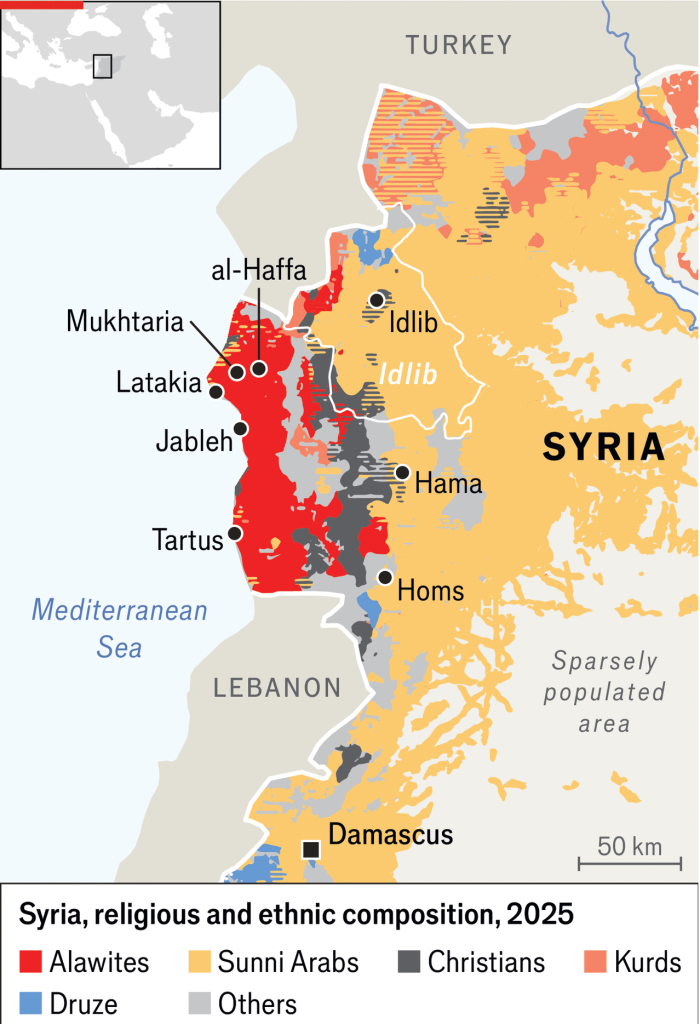
In Syria’s coastal regions, particularly Latakia, Tartus, and parts of Hama, between 7 and 9 March 2025, one of the most serious episodes of communal violence since the country’s political transition began was witnessed. For Syria’s Alawite minority, those three days have come to be known simply as “Black March.”
By Rafic Taleb
Independent investigations by international media and human-rights organisations confirm that more than 1,400 civilians were killed during the violence. A Syrian national inquiry reported 1,426 deaths across dozens of locations, while other documentation groups and investigative journalists have produced comparable figures.
Local community networks, meanwhile, claim significantly higher numbers — citing more than 3,700 victims — though major international bodies have not independently verified such totals.
What remains beyond dispute is that large numbers of civilians were killed in targeted attacks and reprisal operations, and that identity played a defining role in their vulnerability.
A minority at risk during transition
Political transitions are moments of profound fragility. Institutions are weak, command structures are uncertain, and grievances are easily weaponised. In such environments, minorities often become scapegoats for past or perceived injustices.
The events of March 2025 suggest that Syria’s Alawites — already burdened by years of war and political association narratives — faced precisely that risk.
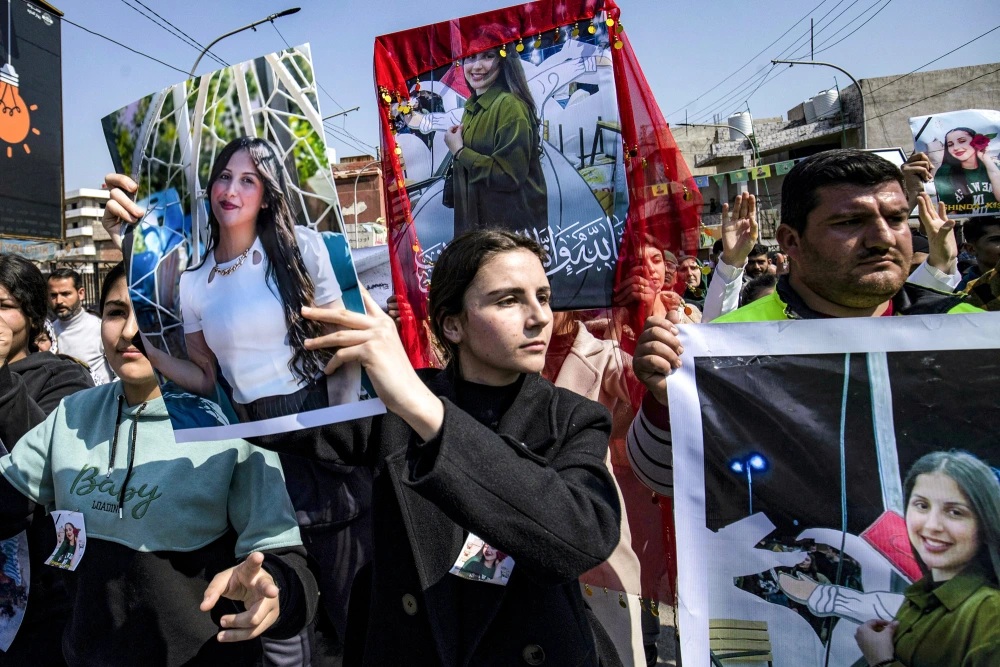
Reports indicate that entire families were killed, homes looted or burned, and communities left in fear. For many survivors, the absence of swift and transparent accountability has deepened the trauma. Justice delayed in such moments is not neutral; it reshapes trust in the state itself.
Arbitrary detention and due process concerns
In the months following the March violence, human-rights monitors raised serious concerns about arbitrary detention. Estimates from documentation groups suggest that between 11,000 and 30,000 individuals may be held in 2025 contexts without clear charges or fair judicial process.
While precise figures remain contested and difficult to verify independently, the pattern of detention without transparent legal review is widely acknowledged as a systemic concern.
The rule of law cannot function selectively. If individuals are detained without evidence, formal charges, or access to counsel, the legitimacy of transitional governance is undermined. Accountability for crimes must be individualised and evidence-based — never collective or identity-driven.
The abduction of women: between documentation and denial
Among the most disturbing allegations emerging from 2025 are reports concerning abducted Alawite women and girls.
Amnesty International has documented confirmed cases of abduction and criticised inadequate investigative responses. However, local activists and community documentation networks report far higher numbers, citing 213 abducted women, of whom only 44 cases were officially acknowledged. At the same time, authorities reportedly claimed that the remaining women had “left voluntarily.”
These competing narratives highlight a central problem: transparency.
Even if only a fraction of reported cases were confirmed, each unresolved disappearance constitutes a grave violation of human rights. Forced disappearance is prohibited under international law. It inflicts continuous suffering not only on victims but on families left without answers.
Dismissing allegations without credible, transparent investigations does not resolve them. It deepens mistrust and fuels grievance.
The responsibility of the transitional authorities
The new Syrian administration faces a defining test. Legitimacy in post-conflict societies is not measured solely by political change, but by equal protection under the law. Protecting minorities during moments of volatility is not optional — it is foundational.
This requires:
Failure to address these issues risks embedding sectarian fear into Syria’s next political chapter.
Advocating for justice for Alawite victims is not a sectarian act. It is a defence of universal principles. A stable Syria cannot be built on selective mourning. If any community believes it is unsafe because of its identity, reconciliation becomes rhetoric rather than reality. Justice must be impartial. Accountability must be transparent. Protection must be universal.
The legacy of Black March 2025 will shape how Syria’s Alawite community understands the new era now unfolding. Whether that legacy becomes one of rupture or reform depends on what follows.
If investigations are credible, detentions lawfully reviewed, and disappearances thoroughly examined, March 2025 may yet become a turning point toward equal citizenship.
If not, it risks becoming another chapter in a history of unresolved trauma. Syria’s future will not be secured by silence. It will be secured when every community, majority and minority alike, can trust that the state protects them equally under the law.
Only then can memory coexist with peace.