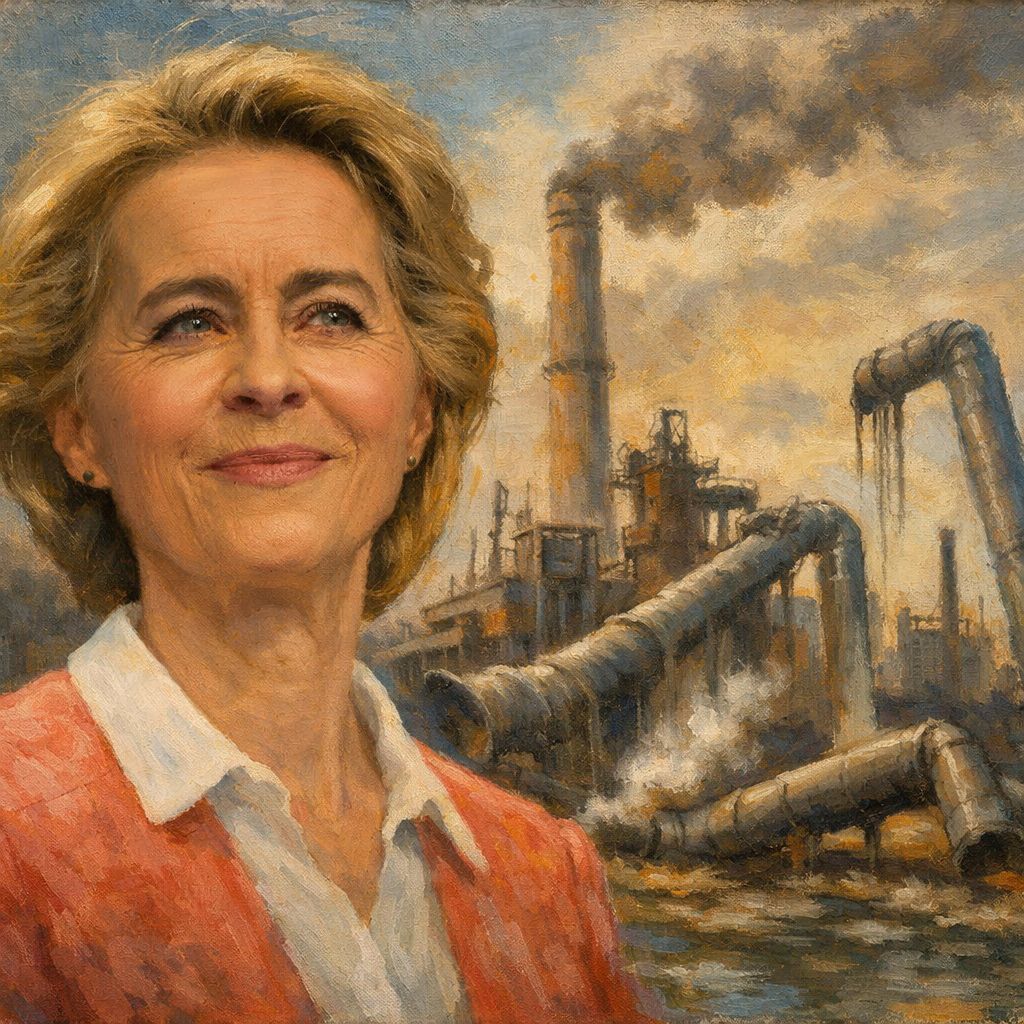
Some leaders build bridges. Others build industry. And then there’s Ursula von der Leyen: specialising in turning off gas taps while simultaneously declaring that the economy is booming.
Under her leadership, the European Commission has conducted an impressive experiment: how to make energy more expensive, make industry nervous, and make citizens poorer, and then call it “strategic autonomy.”
It began with a brilliant idea: Russian energy had to go. Not a little. Just go. Because of geopolitics, morality, values, and the usual words that tend to appear right before someone sends the bill to ordinary citizens.
The result? Europe suddenly discovered that natural gas also comes in liquid form, packed into gigantic tankers happily crossing the Atlantic. Naturally, at prices that make the average European factory start hyperventilating.
But according to Ursula, that’s not a problem. That’s a “transition.”
A magical word in Brussels. Everything that becomes more expensive is now called transition. Everything that disappears is called progress.
Factory closed? Transition.
A chemical company moved to Texas? Strategic repositioning.
Energy bill tripled? Green future.
Meanwhile, in Moscow, people watch the spectacle with mild astonishment. Somewhere, Vladimir Putin is sitting with popcorn, watching Europe tie itself into an economic Gordian knot.
And when Russia then suggests it might as well stop LNG deliveries to Europe altogether, Brussels reacts as if it were a completely unexpected development.
“Who could have seen this coming?” they probably ask, while at the same time having spent the last three years blowing up the energy relationship.
But Ursula remains unfazed. She gives speeches. About resilience. About solidarity. About a historic opportunity.
And to be fair, historic it certainly is.
It’s not every day that a continent voluntarily sends away its cheapest energy source, puts its own industry on a diet, and then looks surprised when the economy starts coughing because companies are leaving Europe.
Still, one thing must be conceded.
Not every leader manages to create an energy crisis, an industrial crisis, and a crisis of trust at the same time.
That takes talent.