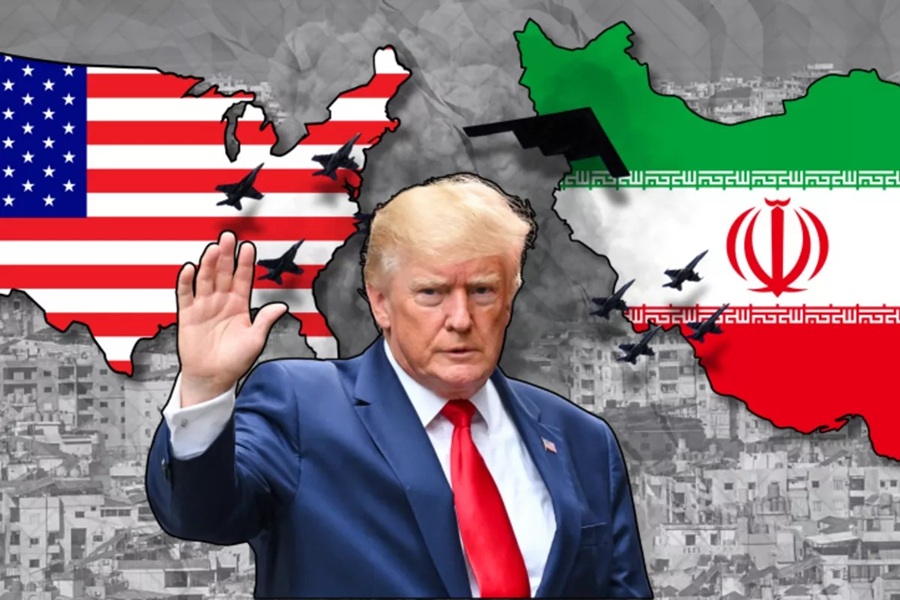
The announcement of a ceasefire between the United States and Iran has been widely portrayed as the end of a dangerous confrontation—a moment of de-escalation following what appeared to be a rapid and potentially catastrophic slide toward regional war. Yet such an interpretation misunderstands both the nature of the agreement and the reality on the ground. What has emerged is not peace, nor even a stable cessation of hostilities, but rather a strategic recalibration—a shift from confrontation to controlled, distributed conflict. The war has not ended; it has merely changed form.
By Rafic Taleb
At the heart of this transformation lies a tacit understanding between Washington and Tehran: neither side can afford a full-scale war. Yet, neither is willing to concede its strategic position. The ceasefire, therefore, functions less as a resolution than as a mechanism of containment. Its immediate objective is clear—to prevent escalation in critical areas, particularly the Strait of Hormuz, whose disruption would trigger global economic shockwaves.
Early indicators, such as the resumption of maritime traffic, suggest that this objective has been partially achieved. Oil flows, at least for now, have stabilised. Markets have exhaled, albeit cautiously.
However, beneath this surface calm lies a far more volatile reality. The ceasefire appears conditional, informal, and deeply fragile. Reports of continued drone and missile activity—especially targeting the Gulf—suggest that Iran is testing the boundaries of the agreement without crossing into outright provocation.
The United States, for its part, maintains a posture of overwhelming surveillance and readiness, signalling that any significant breach would be met with immediate retaliation. This is not a dynamic of reconciliation, but one of calibrated tension, in which both sides operate within a narrow corridor between deterrence and open warfare.
The divergence between American and Israeli strategic priorities further compounds this instability. While Washington has opted for containment, Israel has chosen continuation. The exclusion of Lebanon from any ceasefire framework is not incidental; it is central to understanding the current phase of the conflict.
Israel’s ongoing military operations against Hezbollah represent a deliberate effort to exploit the temporary disengagement between the United States and Iran. In effect, the battlefield has shifted northward, away from direct U.S.–Iran confrontation and into the complex terrain of proxy warfare.
Lebanon has thus become the primary arena of escalation. Intensive aerial bombardments targeting both infrastructure and leadership within Hezbollah suggest a campaign aimed not merely at deterrence, but at structural degradation. The scale and speed of these operations indicate an attempt to alter the balance of power decisively—perhaps even to sever the operational link between Iran and its most capable regional ally. Yet such ambitions collide with the reality of Hezbollah’s deep entrenchment. Decades of preparation, hybrid warfare capabilities, and profound integration into the Lebanese landscape render any swift victory unlikely. What is far more probable is a prolonged war of attrition—one that drains resources, further destabilises Lebanon, and risks drawing in additional actors.
In this context, Syria emerges as the most dangerous variable. Already a fragmented state shaped by years of conflict and external influence, it now stands at the intersection of competing strategic agendas. There are indications—some credible, others speculative—of mounting pressure on Syrian authorities to expand their role in the unfolding confrontation.
Whether this will happen through direct involvement in Lebanon or by facilitating Iranian supply lines, Syria’s potential entry into the conflict would mark a decisive escalation. Such a development could, in turn, provoke responses from regional powers, including Turkey, transforming a contained proxy war into a multi-state confrontation with unpredictable consequences.
The broader regional picture reinforces this sense of controlled instability. Attacks on energy infrastructure in the Gulf, even when limited, serve as reminders that Iran retains significant asymmetric capabilities. These tools—drones, proxy militias, and cyber operations—allow Tehran to exert pressure without engaging in conventional warfare. They also ensure that the ceasefire remains a tactical pause rather than a strategic defeat.
Despite claims of devastating damage to Iranian military capabilities, it is far more plausible that the country has absorbed targeted losses while preserving its core deterrent structures. Total military collapse, as some narratives suggest, is neither historically consistent nor strategically credible.
What, then, has the ceasefire truly achieved? It has not resolved the conflict, nor has it dismantled its underlying causes. Instead, it has redefined the battlefield. Direct warfare between the United States and Iran has given way to a more diffuse—and arguably more dangerous—configuration, in which multiple fronts operate simultaneously, each governed by its own rules of engagement, yet all interconnected. Lebanon burns as Hormuz reopens. Syria teeters as diplomacy murmurs in the background. The illusion of stability conceals a deeper, more complex instability.
In this new phase, the logic of warfare is no longer centred on decisive battles, but on strategic endurance. The United States seeks to manage the conflict, containing its spread while maintaining pressure. Iran seeks to outlast and outmanoeuvre, leveraging proxies and asymmetry.
Israel seeks to reshape its immediate security environment, even at the cost of prolonged engagement. Each actor pursues its objectives within a constrained framework, fully aware that crossing certain thresholds could collapse the entire system back into open war.
The result is a condition that can best be described as neither peace nor war—a state in which conflict persists without formal declaration, and peace exists without genuine resolution. It is a precarious equilibrium, sustained as much by mutual fear as by strategic calculation. And it is within this fragile balance that the region's future will ultimately be decided.
To call this a ceasefire is technically accurate. To call it peace is profoundly misleading