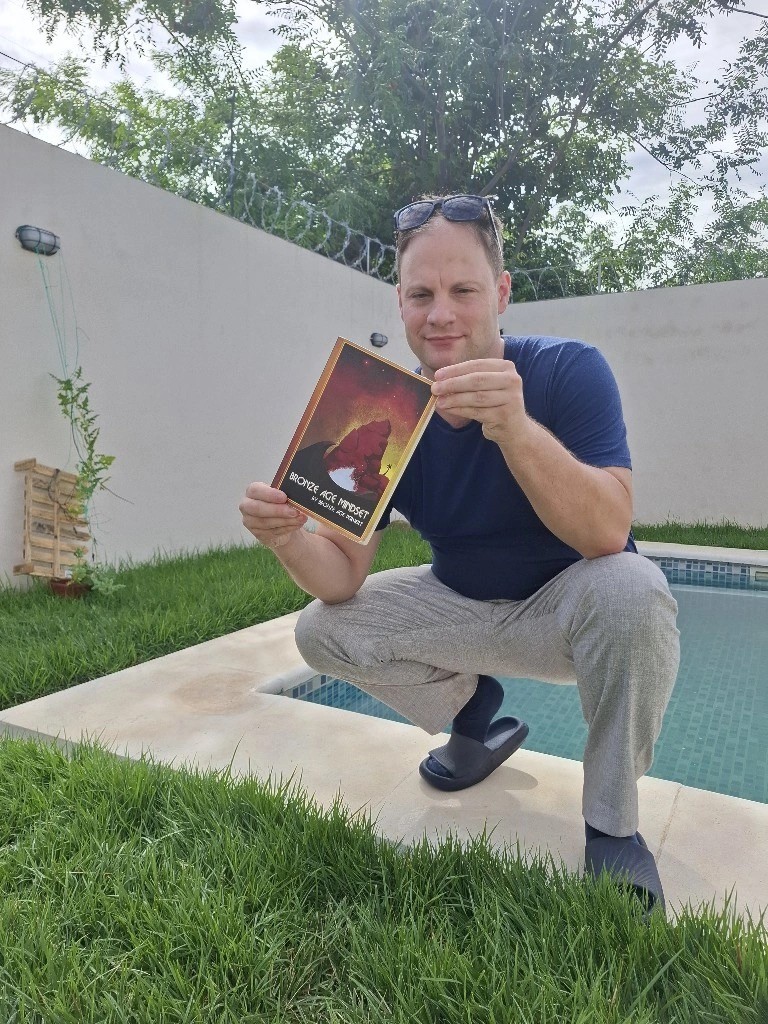
Hello everybody – my friend gave me a book of Bronze Age Pervert, also known as BAP. I call him BAP for brevity & clarity. My friend is valuable – he also writes books, crowdfunds them, and presents them together. So, I follow my valued friend’s recommendation to read Bronze Age Mindset.
But before that, I knew about BAP. In 2020, I was in a fancy study group of conservative thinkers. And they study, not the text of BAP directly, but study the article by C. Bradley Thompson, ‘The rise and fall of the Pajama-boy Nietzscheans’. So study BAP indirectly. And after meeting with the study group, I published.
My friend Joost Niemöller, today head of a big media group, but then an independent journalist, retweeted it (now X), so BAP himself read it, too. Who was kind of a priest-king on Twitter back then? I see now that the article includes a photo taken of the girlfriend (at the time) of Arno Wellens, a Dutch finance journalist. He left the group, but we kept the picture, because it was beautiful.
Strange English & BAP as ‘fascist’
Before we advance further, why do I write ‘strange English’? It is because of the BAP-narrative. I adopt, somehow, or at least am I influenced by it. Let me tell you the story of Juliana, a wonderful woman who lives in Brazil.
At the time, we played strategy games together and did video calls on MSN. Pajama-boy Nietzschean may not recall MSN, but that’s okay. But she does not speak English: only basic words. But together we speak the language of love. Enough to understand.
Then my friend Federico comes into the chat. We play a strategy game too. He asks: “Sid, you speak such erudite English, Oxford-level. You’re a fine intellectual. Why do you now speak so basic, so semi-illiterate?” With Juliana present, Federico was surprised by my sudden level change in idiom.
Explanation: I am not a native English speaker. So I copy the level of those I speak with. Can be Oxford, can be favela. An automatic process thus explains the disrupted level of English. Process is kind of meandering, creative. Reminds me of the Book of Muse I wrote, when the world had more hope.
Back to the group of conservative intellectuals in the Netherlands. They say after the colloquium on BAP: “He not only is a pervert – he is fascist. Why do you publish an article on fascism?” But actually, a ‘conservative’ is more like a closeted homosexual in a novel by Proust. Fleeting glances, eyes trying to capture eyes. Is the other also like me? Secrecy. No openly declaring their position. They have a cushy job. No courage. Gilded cage.
As I was working on the ‘fascist’ article, I listened to a BAP podcast for background information. My (then) partner came into my office and asked, “Why are you listening to this? Strange, deranged Balkan accent speaking about nonsense. Like some debilitated, roided out Slavoj Zizek. With weirdo jungle sambo music in the background – please stop.” I answer, maybe it is strange and debilitating, but maybe it is also interesting. I am a philosopher, a curious person.
Epistemological rigour
Anyway, now, years later, my friend gave me this book and said: Bronze Age Mindset is a good book. It promotes a spirit of manliness and heroism. I agree – and yet the fundamentals of a book are important.
In the first chapters, he writes extensively on evolution, biology, Darwinism, teleology, and theoretical physics. But – as I will show – in a confused way. Whilst thoughts on heroic manliness are important, sound fundamentals for an instructive text are even more important.
I do the same with this text by Descartes – I analyse his thinking and make internal contradictions visible to criticise. This is important when thinking about things on a serious level. Do it too with pervert.
I undertake this work – this account of intellectual integrity – not per se because BAP is serious, but because I am serious and have a serious mentality. As part of my academic career, I completed a good course in philosophy of science at university. Very rigorous, cleansing for the mind and soul. What is science, what is knowledge – these are things to think about systematically. Not just random intuition by looking at horses in nature that move to and fro, bristling and driven by some demonic-Dionysian spirit. I will not let chaotic thought go by unchecked; else I steal from my own life, my juvenile years I invested in knowing truth from untruth.
The Ominous Volcano
When discussing the Flame of Life, BAP rejects Darwin. He spends much time writing about biology as a ‘bogus science’ and says that Darwin has the mind of a bug-man. Nature is full of virulent, virile forces, and just thinking about life in terms of survival and reproduction gives no account of that.
If you are trapped in an endless cycle of procreation and survival, life becomes too mechanical. A state that recalls the “Last Man” of whom Nietzsche spoke: a condition in which the individual loses courage and becomes submissive.
It also brings to mind Ernst Jünger’s notion of a “zone of sensitivity”, where security, ease, and comfort become the essential core of life (On Pain, pp. xxxi & xxxv). BAP states it is then better to hurl yourself into a volcano to escape from that cycle and be reborn as a god. Heroic!
In the best moments of life, what humans do has nothing to do with survival and reproduction, he emphasises. It reminds us of Julius Evola, who wrote in 1950 that existence only reaches fulfilment in those who cast their gaze beyond it: “In those capable of subordinating mere living to something more than living.” Or, as Nikos Kazantzakis wrote in Friedrich Nietzsche on the Philosophy of Right and the State: “The struggle is not about how to stay alive, how to vegetate, but rather about how to live as good a life and as expansive a life and as intense a life as possible.”
Account of Darwinism
This notion of pure free acts – sprouting spontaneously from willpower and from the playful lust for life, risk and adventure – stands opposed to a clinical reductionism of life as examined through a scientific set of spectacles. This is why BAP stomps Darwin and biology in general. He equates their thinking with necessity, gravity, and cramped life, in one word: being unfree.
The Dutch historian Johan Huizinga introduced a beautiful word for what I think BAP is after: levensfelheid. To live fiercely!
These intuitions make sense in a way, but BAP edges into philosophy of science: he then seems confused. He does not provide a proper account of the concepts he uses, leading to a chaotic prose style. In his defence, he states in the beginning of his work that he aims to give an account of his “reveries” and the thoughts that motivate him. In short: “the problem faced by life in ascent and decline.” (p. 4)
Yet when it comes to philosophy of science, this road is bad for the innocent mind. I mean that his work is picked up by corporate salary manboys who never studied these fields in any serious capacity, who now seek to derive masculinity from BAP and have no filter to sift crap.
This dangerous epistemology is to a degree to be expected, as BAP opens Bronze Age Mindset with the statement that his work is “not a book of philosophy. It is an exhortation. I hardly have anything to say to most who aren’t like me – still less do I care about convincing.”
BAP writes (p. 12):
“Darwin had the mind of a calculator who likes to collect many small facts and synthesise some clumsy theory. The theory is clumsy and full of holes. This is the biggest reason Creationists, who are also wrong, have been able to challenge it, where they were never able to challenge theoretical physics.”
Still, a good evolutionary explanation must give an account of why humans are inclined to explain non-goal-driven processes in nature, nevertheless, in a teleological way. Teleology implies a goal-driven nature of things, whereas Darwin’s interpretation of evolution suggests that life is a synergy of random occurrences.
Sexual consent
Let us examine the case of a semi-rapist partner. It is described in a book called Social Day Love (2020), written by Guido Fox. He is a PhD criminologist who was sad and tired of his corporate job and became a professional book reviewer and dating coach. He is an interesting guy who describes problematic situations around sexual consent.
The woman wants consent – else you are a rapist – but the woman sometimes also becomes sexually excited from non-consent. She often wants, in a way, to give her man permission not to ask her permission. This process is anything but straightforward: it is an absolute minefield for men, murky waters, a dangerous territory to navigate. One misstep and the man is locked up for life. How do we explain this process?
This situation becomes clearer through evolution, as Fox explains in his book. The woman wants, at a level of genetic transference, her future sons to be able to pass on her genes. For this reason, she likes dominant men who can also push through when she hesitates. To some degree, women get aroused by men who do not seek permission, because it increases the chance that their son will carry on their genes.
This may be taboo, but one of the most common fantasies in women is the fantasy of non-consent intercourse. This does not mean that the woman really wants it to happen, but it can still appear to her in a dream or fantasy where she also climaxes.
Biology as an explanatory model
Such recurring, deeply anchored fantasies, as discussed here, can be explained by evolution in a way that finally makes sense. Deadly murky waters become clear and, perhaps, traversable. There is more to be said for biology as an explanatory model than BAP allows.
Given that he sets out to “discuss the problem of life in decline and ascent”, this is really a universal story going back to Rome’s history with the Sabine virgins. Among Latinas in South America, there is also this issue, as many of them descend from local populations mixed with Spanish Conquistadores.
Women who were able to submit to their conquerors were left alive and reproduced, whereas the women who could not, probably either killed themselves or were killed. Or they fled into the jungle to live a marginalised, reclusive existence.
A Dutch saying is: “meebewegen om schade te voorkomen”, which means to go along with something to avoid damage. In this way, sexual acquiescence to the conqueror boosts chances of survival, making it logical how orgasms from non-consent intercourse can aid the survival of the individual.
At an underlying subliminal level, the Western European tendency of women to vote for left-wing parties that let in immigrants from tribal and primitive cultures may be about calling this primal masculine energy back into their (sexual) existence. They experience a biological urgency to do this now that men in the West have become too tame and conditioned to exist in bureaucratic, consumerist metropolises. Tribal conflicts will be the likely result, which will spur their native men to become more ‘manly’ again.
Mendel completed Darwin
BAP’s critique of Darwin is well known within philosophy of science. Darwin launched his thesis in 1859 within an incomplete interpretative framework, in the book On the Origin of Species. Yet this incompleteness is not a good objection against using evolution as a framework for explanations.
This is because Mendel, an Austrian monk who bred peas and used selection methods to understand the inheritance of traits better, described what we today call ‘genes’ in 1865 in a study called Versuche über Pflanzenhybriden. This gave Darwinism the missing pieces of the puzzle, completing the interpretative framework.
On p. 14-15, BAP makes a caricature: “Darwin’s insight – natural selection – is actually a tautology: yes, only those animals who have managed to reproduce actually pass on their traits. Something every sheep breeder in history has known. But that this alone explains animal adaptation or behaviour is nonsense.” I emphasised “this alone” because it is really a strawman, as Darwin’s concept of evolution allows for subtlety and complexity since Mendel’s findings.
Aristotle and the Two-Headed Calves
We can talk more meaningfully about this if we refer to Aristotle: this should answer BAP’s confusion about teleology. Teleology, again, means the goal-driven nature of things. Aristotle made important philosophical statements about this. He states (Physica, II.8198 – 19835):
“The problem thus arises: why should we suppose that nature acts for something and because it is better? Why shouldn’t everything be like the rain? Zeus does not send the rain to make the grain grow: it comes of necessity. What has been drawn up is bound to cool, and having cooled, turns to water and comes down. It is merely concurrent that, this having happened, the grain grows.
Similarly, if someone’s grain rots on the threshing-floor, it does not rain for this purpose, that the grain may rot, but that came about concurrently.
What, then, is to stop parts in nature too from being like this – the front teeth of necessity growing sharp and suitable for biting, and the back teeth broad and serviceable for chewing the food? Not coming to be for this, but by coincidence?
And similarly with the other parts in which the ‘for something’ seems to be present. So when all turned out just as if they had come to be for something, then the things, suitably constituted as an automatic outcome, survived; when not, they died. Exactly as Empedocles says happened with the man-headed calves.
This, or something like it, is the account which might give us pause. It is impossible, however, that this should be how things are. The things mentioned, and all things which are due to nature, come to be as they do always or for the most part, and nothing which is the outcome of luck or an automatic outcome does that.”
Aristotle thus imagined the possibility of evolution two thousand years before Darwin. He considered: what if everything in nature comes about through a process of chance, where everything that is well-adjusted to its environment survives to procreate, and everything that is not, dies – exactly like the man-headed calves? But then he considered that nature does nothing without purpose.
Like BAP, Aristotle refused to accept the concept of chaos and chance being so crucial within a seemingly purposeful, well-balanced ecosystem of nature that man finds himself in.
Teleology
Essentially, Aristotle wants teleology to be the prime driver in nature. BAP basically says this, too, although he denies it in other parts. I quote: “Many of the mathematical models for how a trait will spread in a population have failed. The ‘design’ is there, but it is by no means benevolent or intelligent, nor comprehensible.” (p.16) The very reason that it is not “comprehensible” how something spreads is because of no innate teleology – traits get transferred within complex ecosystems that often escape human perception and do not match well with human intuitions.
This was illustrated by the example of how sexual non-consent, which women reject, can still excite them sexually at a primal level, because of different layers and different programming running simultaneously that can contradict each other.
One impulse is to care for the cub, and one impulse is to eat it: both impulses can serve survival, in the right circumstance. One impulse is to engage in a fight with an aggressor, and another is to reconcile, submit, play dead or run away. Limbic and paralimbic systems operate simultaneously, and whichever prevails is often due to environmental factors and chance. If both can run simultaneously, it provides flexibility to enhance survival opportunities.
To conclude: contradictory processes are not always comprehensible (or intuitive) to human logic. BAP could accept this fact of life better if he admitted that Darwin is right. Otherwise, he will secretly search for teleology to explain the mysterious workings of nature, leading to his disappointment and readers’ confusion.
Black butterflies
There are other important points to make here. Particularly, the emergence of black butterflies in Industrial Revolution England and the discovery of a new planet, namely Neptune. Butterflies first. BAP writes, p. 16: “I do not believe in the ‘miracle’ that modern science has invented, hiding under the word ‘random mutation’ and the handwaving of ‘incremental change’. There is not enough time, nor enough number of specimens, nor the kinds of ‘mutations’ observed to support natural selection.” This is deeply problematic, if not flat out wrong.
A good example is the black butterfly, which indicates that a black form of the peppered moth (Biston betularia) became more prevalent due to a genetic mutation known as industrial melanism. This dark mutation allowed the peppered moths to camouflage themselves in soot-stained urban environments, outcompeting their light-coloured counterparts, which were more visible against a dark background. This phenomenon, first observed in mid-19th-century Manchester, provided a classic example of rapid evolution driven by industrial environmental changes.
Theoretical Entities Becoming Reality
Because BAP has no reference to sound concepts used in philosophy of science – particularly no account of theoretical entities – it invites confusion. For instance, Newton’s laws of physics describe patterns of planets. Then, suddenly, a pattern deviated from what Newton’s laws prescribed. The mathematician who calculated the pattern had to suppose the existence of a planet not visible to the human eye.
This planet was thus a ‘theoretical entity’ that had to be postulated to keep the mathematical system logical. Then someone pulled out a telescope and BOOM – the planet turned out to exist! What was postulated as a theoretical entity turned out to be an empirical reality. One can become the other under changing conditions of observation.
Quoting BAP, p.15: “At some point, the incremental explanation becomes so convoluted it is hard to believe. Please remember that the Aristotelian-Ptolemaic system for calculating the motion of planets and so on worked quite well for a long time. It was abandoned because ever more convoluted explanations had to be invented to support the fundamental and wrong assumption of the geocentric model.”
Let us pause and reflect upon the meaning of the word convoluted here in relation to the growth of human knowledge. BAP seems to say: ‘I want a clean and elegant theory, not something that needs adjustment all the time so that my perception of the world can still tick like a clock. If you have to oil a clock all the time to make it work, you may as well not have a clock.’
But interpretations of the world cannot be without theoretical elements – how Neptune was discovered makes that so beautifully and elegantly clear. The planet Neptune was mathematically predicted before it was directly observed. Astronomers had detected irregularities in the path of Uranus that did not conform to Newton’s law of universal gravitation. These irregularities could, however, be clarified if the gravity of a farther, unknown planet influenced its path around the Sun.
Ptolemaeus had a pretty solid prediction of how the earth and sun were moving, BAP writes. Ptolemaeus was an agnostic instrumentalist. This means that he did not care if his theoretical entities had real existence. He just thought: “If it works to make correct predictions, it works for me.”
Much like Newton, who said: hypotheses non fingo. It seems BAP needs to do more study on why another model replaced the Aristotelian-Ptolemaic system for calculating the motions of planets. He makes a good point about the limitations of the geocentric model, but there’s more to it – essential to the Western canon of thought.
The Physical Versus the Metaphysical
BAP needs a crash course in Collingwood, who outlined that the presumptions of any model for conceiving physics are ultimately metaphysical in nature: suppositions that get traded for other sets of assumptions as epochs glide by. The philosopher Imre Lakatos, very important here, stated that in science, progress is primary to truth.
Progress means that new theories can resolve more refined, delicate, complex questions and challenges. They reach deeper into a problem than older ones can, as people work with the theories and tweak them, allowing for greater specificity and a broader scope of explanation. In this manner, the theory of evolution enables more progress than Creationism.
Reference to Collingwood touches on what I postulated in my book Wees Afgrondelijk (Be Abysmal): that political philosophy and epistemology flow from the same wellspring. And that a metaphysical upheaval – where one dominant cosmological interpretation of the worldtakes the place of another as epochs come and go and civilisations exchange hegemony – is at the deepest level connected with what questions people are asking the world, and whether these world-interpretations (Weltanschauungen) resonate with the deepest hankerings in their characters/souls.
If you are in harmony with your rhythm of life, you feel no need to ask beyond what your current cosmology can clarify. A Weltanschauung taking hold is therefore an existential phenomenon rather than an empirical one: just as the potency of empirical science is decided by metaphysical suppositions, just so a change of interpretive framework is decided upon existential, non-empirical grounds.
Metaphysical suppositions usually channel the empirical data that confirms their interpretation of existence. Creationism and Marxism are examples of this, as they always find ways to re-interpret data to make their ideologies immune to counterfactual observations. Piercing such a set of suppositions to make space for something else is thus an act of raw political power.
Spinoza’s Conatus
For a long time, I thought, “Sid, you are either crazy or this thought is too abstract to have meaning for anyone.” But then I met a guy from Friesland who summarised the same phenomenon in his own words. A morally reprehensible deed finds its excuse in the results. If the results are favourable, then the action will be excused, because the social and moral power fabric will have been realigned. The student had gathered it from a video lecture I gave to Flemish students before my book was released. It gave me confidence that what I was doing had purpose. Empowered by this, I continued my critique of BAP.
First, I must mention conatus, a concept used by Spinoza that explains the most important part. It is the inner core of one’s being, of one’s character or soul. Conatus is a goal-driven life force that propels whatever it inhabits forward. It determines both what we want from life and how we will imprint the content of our soul upon existence. It really takes an exceptional conatus to unfold a new Weltanschauung from his own authority. I should write more about this as I continue reading BAP’s book, or write another book of my own. Maybe the two activities are the same.
BAP says, p 17: “A truly objective or scientific approach to life would be to start without assumptions. Take an animal and study. Study what it does in nature, not in a lab, when left alone from humans. Study how it behaves, in the moment, which is the only thing that exists for an animal. Look inside its brain! Study its hormones and its internal states.”
Here too, by looking inside it, one would influence it, which is a paradox. Some degree of assumptions is probably inevitable when we study any given thing, because the assumptions already determine what data you register: this throws us into the example of the leaf blowing in the wind, which I will soon clarify. It is better to try to make your assumptions when studying as explicit as possible, rather than pretending not to have any assumptions at all.
Ironically, what BAP says Darwin does wrong also applies to BAP. His critique of Darwin is that he had to come up with an ever-expanding web of convoluted explanations to make his theory fit reality. And this is because Darwin started to “gather small facts like a bug-mind and tried to squeeze it all into one theory” (p. 12). In philosophy of science, we say: the gathering of facts presupposes a conceptual framework. Also, observations are influenced by presupposed theory.
This is easy to understand. A hundred thousand facts are happening every second. The pulse of one’s heart, some leaf blowing in the wind. But we do not take all those facts into account – we are specific in the facts we emphasise and the facts we ignore. It is not practical to observe all facts about most situations. What we filter out and what we select is influenced or even decided by what we previously experienced and what we already hold to be true.
Different groups of scientists can therefore construct different dinosaurs from the same piece of dinosaur bone. Knowing these shortcomings of empirical science, it makes more sense that Darwinism was at first considered a case of confirmation bias: of selectively piling up facts that conveniently supported the narrative, initially, before Mendel, who proved the gene as a solid fact.
Conclusion
The point is that most philosophers agree that knowledge is not generated by passively receiving empirical data from which a theory arises by itself. And no amount of data extracted from empirical observations will be meaningful if not for a theory that serves as the framework in which one lays the puzzle pieces.
About the truth of this underlying framework, one can be agnostic – see Newton and Ptolemaeus – but one is needed nevertheless. Otherwise, you will just copy the framework of someone else to interpret the world, and you will do so passively without being consciously aware of it. This passive adaptation is how a Weltanschauung increases its power, scope, and momentum until it becomes a geopolitical force. Eventually rewriting its own history and the narrative about the deeds, however reprehensible, that were required to push one particular Weltanschauung beyond its competitors, into dominance.
Conclusion of the Conclusion
The essence is the link between Conatus and Weltanschauung (world interpretation). A strong soul unearths a way to piece together the facts of the world that suits their own preferences. The rest of society, passively undergoing the imprint of this strong, active, dominant soul, starts to reproduce and confirm this Weltanschauung.
This is the essence of science, society, politics and epistemology. We tend to interpret facts in ways that already align with our given preferences, but those preferences are always partly the manufacture of what came before us. It is thus only a truly strong Conatus that can initiate something new since we are redirecting a current while already standing in the current.
If you value what Dr Sid Lukkassen does, support him through BackMe and follow him on X. Your support is appreciated!