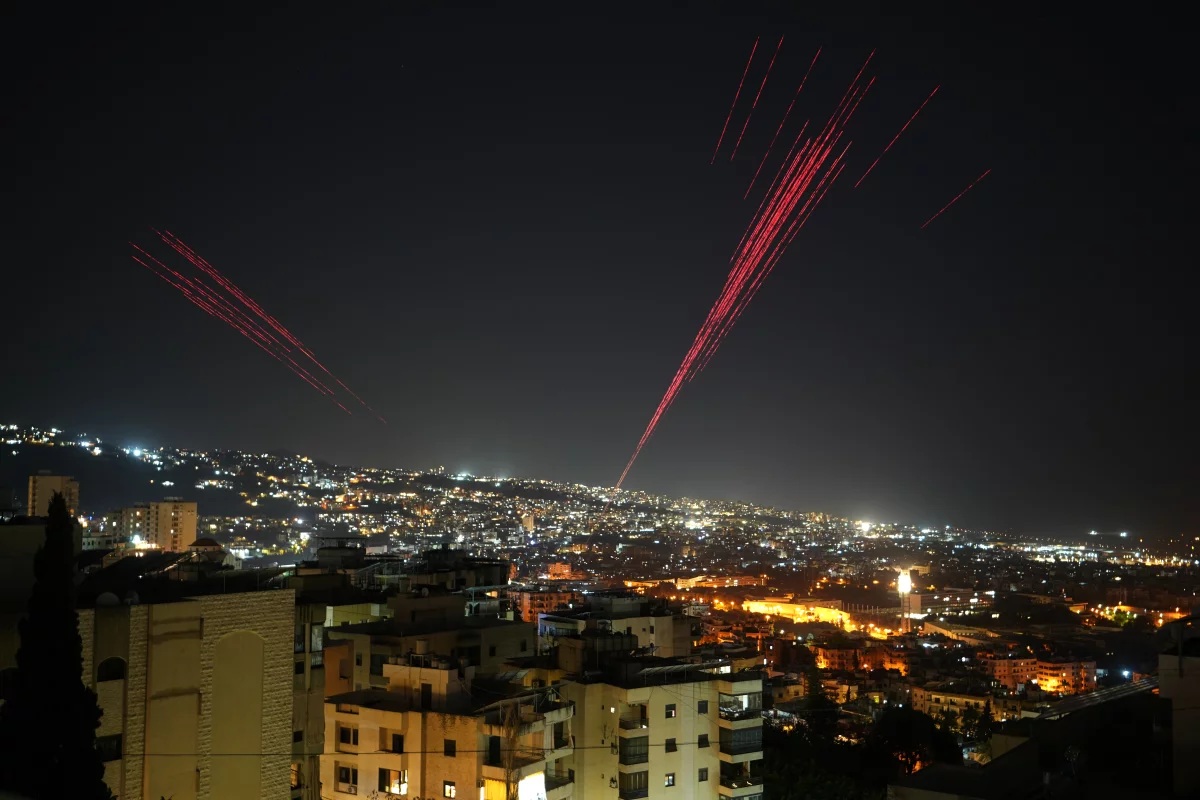
A ceasefire between Lebanon and Israel after forty-five days of war. An interruption of hostilities, a reduction in violence, a return, however fragile, to stability. The language is predictable, almost ritualistic. Escalation gives way to exhaustion, exhaustion to negotiation, negotiation to pause. But this ceasefire resists that sequence. Because what is being paused is not a conventional war between two states. And what is being stabilised is not a system that was ever fully stable to begin with. The ceasefire does not end the war. It reorganises it.
By Nadia Ahmad
To describe this as a Lebanon–Israel war is technically correct. But it is strategically misleading. The fighting has taken place primarily between Israel and Hezbollah, the dominant military force in South Lebanon, deeply rooted in the Shiite communities of the region and embedded in their social and political fabric.
The Lebanese state exists within this equation, but it does not control it. It does not decide when escalation begins. It does not determine when it ends. It does not command the primary military actor on its own territory.
This is what makes the ceasefire unusual. It is not a ceasefire between two states with clear chains of command, defined responsibilities, and enforceable commitments. It is a ceasefire between a state and a non-state actor that behaves like a state—militarily structured, territorially embedded, politically integrated, but not formally sovereign. That distinction defines the limits of the ceasefire itself.
In South Lebanon, the war has not been experienced as an abstract geopolitical confrontation. It has been local, immediate, and inseparable from the communities that live there. Hezbollah is not an external force operating in isolation. It is part of the social landscape of the South—present in villages, networks, and daily life. The ceasefire, therefore, is not simply an agreement to stop fire across a border. It is a pause imposed in a space where military presence and civilian life intertwine.
What follows from this is not demilitarisation, not disengagement, and not even the absence of readiness. The same structures that enabled the war remain in place, temporarily inactive but fully intact. This is not peace. It is a suspended activity within an unchanged system.
The second distortion lies in treating the conflict as local. Hezbollah is not only a Lebanese actor. It is part of a wider regional architecture—politically, militarily, and ideologically linked to Iran. This connection is not incidental; it is structural. Which means the ceasefire cannot be understood purely within the framework of Lebanon and Israel. It is one front within a broader confrontation that includes Iran, Israel, and, indirectly, the United States.
This is where the situation becomes difficult to interpret. There is no single ceasefire governing the entire system. What is paused in one arena is not necessarily paused in another. Each layer—Lebanon, Israel, Iran, and the wider regional dynamic—operates according to its own logic, timeline, and constraints. The result is not coherence, but desynchronization.
And desynchronization is not a stable condition. It produces friction between layers of reality that are no longer aligned. What appears externally as a single moment of calm is, internally, a patchwork of partial pauses. And partial pauses do not produce peace. They produce uncertainty.
From a distance, the most visible change is simple: the reduction of violence. But on the ground, the transformation is more complex. For forty-five days, life has been structured around a narrow rhythm—alerts, retaliation cycles, anticipation, displacement. Time itself has been compressed into immediate reaction. When that rhythm stops, reality does not simply return to normal. It expands, but unevenly.
Some areas experience relief. Others experience a tense quiet. Others remain psychologically anchored in the expectation of renewed escalation. The ceasefire, in this sense, is not only a military or political shift. It is a temporal one. It redistributes how time is experienced across different parts of the same conflict.
The most common mistake in interpreting this moment is to assume that stability has been restored. But stability implies that underlying tensions have been resolved. Nothing of that sort has occurred. Hezbollah’s military presence in the South remains. Israel’s deterrence logic remains. Iran’s regional posture remains. The structural absence of a unified Lebanese monopoly on force remains.
The ceasefire does not alter these conditions. It contains them. And containment is not resolution. It is management.
From a European perspective, there is a persistent tendency to interpret ceasefires as steps toward post-war order. This reflects a particular historical experience—wars that end with treaties, reconstruction, and gradual reintegration into stable systems. But that model does not fully apply here. In this case, conflict is not external to the system. It is embedded within it.
What follows, therefore, is not “after the war.” It is after intensity. A lowering of visible violence without a corresponding resolution of structural contradictions. What appears as progress may, in fact, be equilibrium at a different pressure.
At its core, this confrontation is no longer purely territorial. It is structured around a broader axis: Israel on one side, and a network of Shia political and military actors on the other, with Iran at its centre. South Lebanon is one expression of that system. It is not the whole of it.
The question, then, is no longer simply whether this round of violence ends. It is how long this configuration itself can continue—how long a conflict that operates across states and non-state actors, across borders and identities, can reproduce itself without resolution.
There will be a moment when the noise stops. But that moment should not be mistaken for peace. It is a transition from active confrontation to latent tension. The structures remain. The actors remain. The logic remains. Only the expression changes.
This is not one ceasefire. It is several, imperfectly aligned. And when ceasefires do not align, they do not end the war. They reorganise it across levels. The ceasefire does not end the war. It freezes one part of it. And until the wider system connecting South Lebanon to Tehran and beyond is addressed, the conflict will not disappear. It will return.
Perhaps not in the same place. Perhaps not in the same form. But within the same structure. Because what is being managed here is not a war between two states. It is a system no single actor fully controls.