There is a moment in every alliance when something shifts—not with a declaration, not with a rupture, but with a hesitation that lasts just long enough to be noticed. A pause where instinct used to operate. As the United States deepens its confrontation with Iran, the United Kingdom is no longer moving in automatic synchrony. A divergence worse than dramatic: it is procedural, rational, and increasingly habitual. For the first time in decades, Britain is not instinctively embedded in the opening phase of a major American Middle Eastern escalation.
By Nadia Ahmad
That alone signals something deeper than policy disagreement. It signals the slow deformation of what was once called the Anglo-Saxon strategic world. Not collapse. Not rupture. Drift, accumulating into structure.
When Washington acts, London is still expected to follow. That expectation survived Iraq, Afghanistan, and Libya. Britain hesitated before—but it still arrived. This time, it did not. Under Keir Starmer, Britain made a calculated decision: no participation in initial strikes, no automatic alignment, no symbolic military shadowing of American escalation. The decision was framed in bureaucratic language. But alliances are never defined by language. They are defined by reflex. And the reflex is breaking.
The Iraq War still sits inside British strategic memory like a permanent warning. It was not just a military intervention—it was a legitimacy shock. It exposed intelligence failure, strategic overreach, and the political cost of following Washington into wars without exit logic.
Today, that memory has hardened into doctrine. When senior figures like Rachel Reeves warn against conflicts without clear American exit strategies, they are drawing a boundary shaped by experience: Britain will not again become an auxiliary force in a war it does not control and cannot conclude.
But memory alone does not explain the shift. Economics does. Unlike Washington, London does not experience escalation as abstract power projection. It experiences it as immediate domestic exposure. Iran sits near critical global energy routes, and any escalation threatens oil flows, inflation, stability, and political pressure inside Britain itself.
What is strategic leverage in Washington becomes cost transmission in London. The asymmetry is structural: the United States externalises cost; Britain internalises consequence.
Public opinion reinforces this constraint. Two decades after Iraq, military intervention in Britain is no longer politically assumed—it is politically hazardous. It requires justification that no longer comes easily in an era of economic strain and institutional distrust.
So Britain settles into a new posture: support without participation, alignment without entanglement. It has not exited the strategic theatre; it has reclassified its role inside it. Defensive deployments replace expeditionary logic. Risk containment replaces coalition enthusiasm. This is not neutrality. It is a strategic self-limitation.
Beneath it lies a more uncomfortable truth: capacity. Britain today is not the Britain of 2003. Military depth, logistical sustainability, and economic elasticity are more constrained. This is not a collapse—it is a narrowing of bandwidth. And narrowing bandwidth forces selection. Selection destroys automaticity.
At this point, the divergence is no longer about Iran. It is about strategic identity. For decades, the Anglo-American relationship functioned as a reflex: Washington acted, London aligned. That predictability is gone. Britain is now calculating in real time whether alignment is strategically rational rather than historically assumed. Once calculation enters an alliance built on instinct, the alliance changes its nature permanently.
The United States operates on a doctrine of projection. Instability abroad becomes insecurity at home. Therefore, power must be deployed forward, continuously. Even restraint is temporary. Britain no longer shares that psychology.
Once imperial, now constrained, it has shifted from projection to calibration. It no longer asks how to shape global outcomes. It asks whether involvement is survivable domestically. That difference is no longer philosophical. It is operational.
Nowhere is this divergence clearer than in Iran. Washington interprets escalation as strategic messaging: deterrence, credibility, dominance. London interprets it as systemic risk: energy shock, inflation shock, political shock. The same conflict produces two incompatible logics.
Alliances cannot remain stable when partners no longer interpret reality through the same risk framework. This is the real fissure inside the Anglo-Saxon world. Not disagreement. Divergence of imagination. The United States assumes order is produced through action. Britain increasingly assumes action produces instability. One sees intervention as control. The other sees it as exposure.
The broader European context reinforces this shift. Across Europe, strategic alignment is becoming conditional rather than automatic. Energy insecurity and economic fragility have forced states to re-evaluate external commitments through domestic survival logic. Britain sits in a liminal position—no longer fully embedded in Europe’s strategic core, but not fully absorbed into American rhythm either. Brexit did not create this tension. It exposed it.
Alliances are no longer identities. They are calculations. Conditional. Adjustable. Reversible. That is the new grammar of Western alignment.
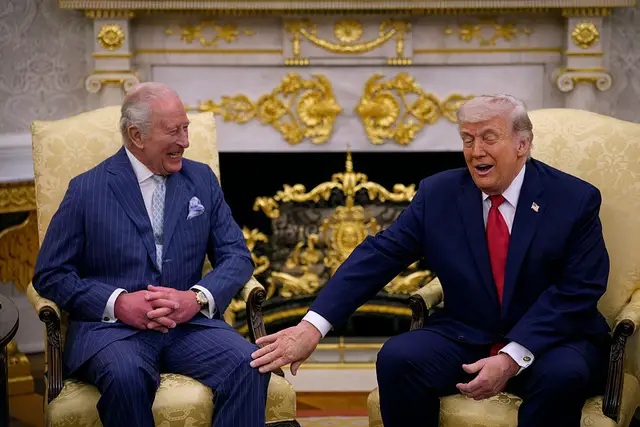
It is in this atmosphere that a small exchange between Donald Trump and King Charles III gains disproportionate symbolic weight. During a recent encounter, Trump reportedly remarked that without the United States, Europeans “would be speaking German by now.” Charles responded: “We would be speaking French.”
On the surface, it was a joke. In reality, it was a collision of historical memories.
The humour works because it compresses centuries into a single sentence. Before America became a global power, Britain’s ruling class was deeply shaped by the French language and Norman heritage following the 1066 conquest.
For centuries, English political and aristocratic identity was entangled with continental Europe, especially France. Charles’ response subtly reinserted that older European memory into a conversation dominated by modern American strategic narratives.
Trump’s framing reflects a distinctly American worldview: the United States as the decisive actor that saved Europe from totalitarian domination in the twentieth century and underwrites the Western order today. Charles’ reply belongs to a different civilizational logic—one built on irony, historical layering, and the refusal to reduce geopolitical history to a single act of salvation.
Two memories of the West. Two strategic psychologies. Two assumptions about power.
And in miniature, the exchange reflects the broader Atlantic condition. America speaks in the language of strategic certainty and dominance. Britain replies in ambiguity, irony, and historical distance. One is accelerating. The other is recalibrating.
This divergence is also inseparable from Europe’s broader strategic repositioning. Across the continent, states are slowly rediscovering the cost of automatic alignment with external powers. The European strategic condition—especially after repeated energy shocks and regional instability—has forced a return to economic realism in foreign policy. Europe is not breaking from the United States, but it is increasingly filtering its alignment through domestic resilience.
Britain sits in the middle of this transformation. It is no longer structurally anchored inside European strategic integration, yet it is not fully absorbed into American strategic rhythm either. It occupies an unstable in-between space, constantly balancing two gravitational fields: Atlantic loyalty and European geography. This liminality intensifies sensitivity to divergence. Britain cannot fully align without cost, nor fully disengage without consequence.
In this sense, the Anglo-Saxon fissure is not isolated. It reflects a broader global transition from bloc politics to conditional alignment. Alliances are no longer binary; they are layered, reversible, and increasingly dependent on internal constraints rather than historical identity.
What emerges is not a single disagreement, but a shift in the grammar of alliance itself. The post-war model of automatic alignment is giving way to something more conditional, more transactional, more attuned to domestic pressures and economic asymmetries.
Britain’s posture reflects this evolution: align where interests converge, diverge where costs become disproportionate. This is not rupture; it is recalibration. Yet history suggests that recalibration, when sustained, rarely remains neutral—it accumulates, deepens, and eventually redefines the relationship it seeks to preserve.
Which brings us back to the underlying question. Are we witnessing a fissure in the Anglo-Saxon political world? Not a collapse, not a dramatic break, but the early stages of a gradual misalignment between two powers that once moved almost instinctively together.
The signs are subtle but consistent: refusal to join the opening strike, open scepticism toward American strategy, diverging economic interests, and a domestic landscape that no longer tolerates automatic alignment. None of these alone constitutes a fracture. Together, they begin to outline one.
It would be premature to declare the end of the special relationship. Intelligence cooperation remains deep, military interoperability remains intact, and diplomatic coordination continues. But relationships do not need to break to change. Sometimes they evolve quietly, through hesitation, recalibration, and the slow accumulation of differences that are never formally declared.
For decades, Britain did not need to ask whether it would follow the United States into war. It simply did. Today, it hesitates. And once hesitation enters an alliance built on reflex, it does not leave quietly. It accumulates, deepens, and reshapes everything around it.
The Anglo-Saxon world is not collapsing. But it is no longer synchronised. And in geopolitics, loss of synchronisation is often the first visible stage of a much larger historical transition.