Every organisation builds two architectures simultaneously. -The first is visible — the hierarchy, the strategy deck, the KPI dashboard pinned to the boardroom wall. -The second is invisible — the unwritten rules about who speaks freely, whether failure is punished or learned from, and whether people bring their full selves to work or merely a cautious, edited version.
For too long, leaders have poured their energy into the visible architecture. They restructure reporting lines, refine compensation frameworks, and cascade objectives downward through layers of management. And yet, with alarming regularity, these finely tuned machines underperform. The reason is almost always the same: the invisible architecture is broken.
In my previous article, “Happy team or a high-performing team?’, we explored how a happy team precedes a high-performing one — the chicken before the egg. That insight raises a deeper and more urgent question: whether emotional conditions precede performance, then what, precisely, are leaders actually being paid to build?
"Culture eats Strategy for breakfast — but most leaders are still skipping the meal and wondering why they are hungry by noon."
The answer, increasingly supported by research from the world's leading business schools, is this: leaders are architects of conditions, not commanders of outcomes.
The shift in framing is small. The implications are enormous.

Harvard Business School professor Amy Edmondson, whose work on psychological safety has reshaped modern management thinking, demonstrated that teams do not merely benefit from safety — they require it as a baseline operating condition. Without it, individuals self-censor, innovation stalls, and performance regresses toward the mean regardless of individual talent or incentive structure.
My research has pointed to 3 foundational pillars that distinguish organisations that merely function from those that truly flourish:
High-performing organisations cultivate a culture where uncomfortable truths surface early rather than being filtered upward through layers of reassurance. Leaders who reward the messenger — even when the news is bad — build teams capable of correcting courses before small problems become existential ones. Transparency is about creating conditions where reality is never rationed.

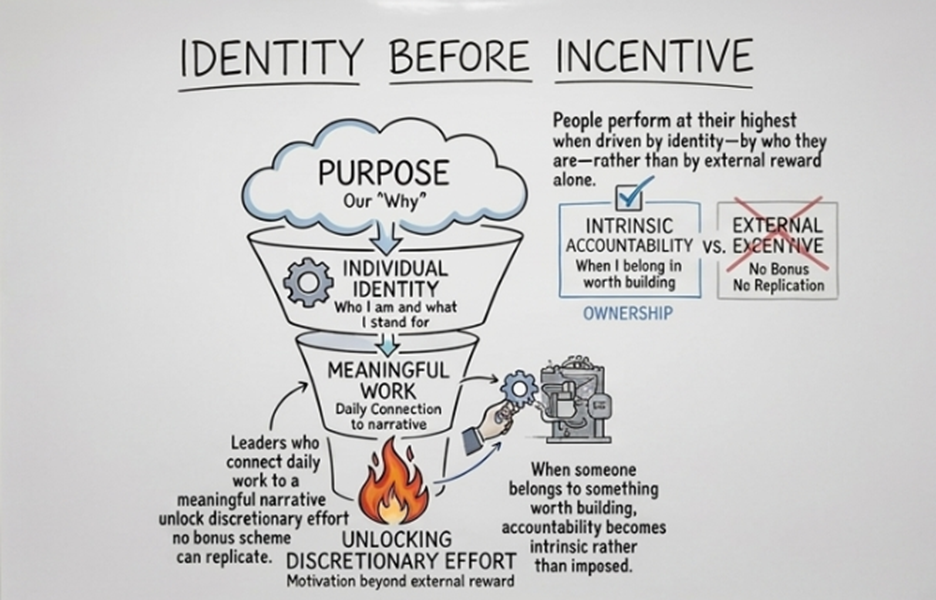
Motivation research consistently shows that people perform at their highest when they are driven by identity — by who they are and what they stand for — rather than by external reward alone.
Leaders who help their people connect daily work to a meaningful narrative unlock discretionary effort that no bonus scheme can replicate. When someone believes they belong to something worth building, accountability becomes intrinsic rather than imposed.
The most resilient organisations are not those that never stumble — they are those that stumble well. Leaders who build deliberate mechanisms for reflection, recovery, and learning from failure create teams that grow stronger through adversity rather than being diminished by it. In a volatile world, the capacity to recover quickly is itself a competitive advantage of the highest order.
None of these principles appears on a standard strategy map. None of them generates a quarterly metric that meets the requirements for an investor call. And yet their absence is precisely what explains why so many well-resourced, intelligently designed organisations consistently fail to reach their potential.

I found that the most urgent leadership task of this decade is not digital transformation, cost optimisation, or AI integration — though all of these matters. It is the courage to invest in what cannot be easily measured: the quality of human relationships within the organisation.
The Silent Architecture of Greatness is the invisible infrastructure that determines whether everything else works.
I believe that leaders who understand this do not just build better companies.
They build places where human beings can do their best work. And in doing so, they discover something that every performance dashboard eventually confirms: when people thrive, results follow without exception.