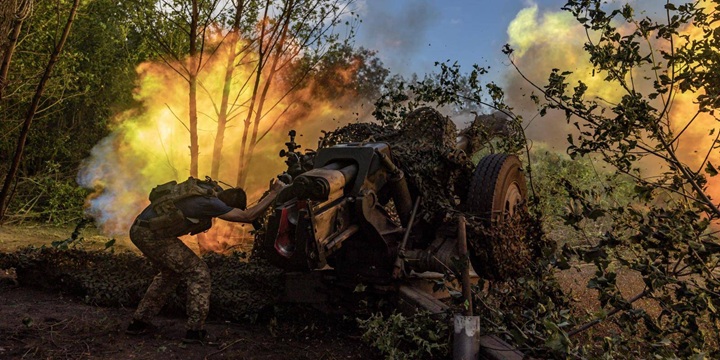
Fully aware of Russia’s military and political impotence, Ukraine is sovereignly preparing to achieve major strategic gains. Unless the West, for whatever reason, prevents Kyiv from humiliating Moscow on the battlefield, the Ukrainian Armed Forces may have an opportunity in the coming weeks and months to recapture significant portions of territory currently under Russian control.
By Nikola Mikovic
Throughout the winter months of 2025 and into early 2026, Russia focused on attacking Ukrainian energy infrastructure. Its primary targets were transformers and backup generators. As a result of Russian strikes, the Ukrainian population endured long periods without electricity, often sitting in cold apartments during the winter.
However, these actions did not have a serious impact on the Ukrainian army and the military-industrial complex, both of which rely extensively on diesel generators.
Russian strikes also had no significant impact on the battlefield situation. Its military achieved only limited tactical gains, while in some sectors of the frontline Russia even lost territory. Thus, from a purely military perspective, Russia’s attacks on Ukraine’s energy infrastructure proved inefficient.
In the meantime, the Ukrainian military-industrial complex—largely spared from Russian attacks—developed thousands, if not hundreds of thousands, of drones. It is now Ukraine that has the initiative – at least when it comes to drone warfare.
Over the past weeks, the Eastern European nation’s military has been conducting daily drone and even missile strikes against key Russian energy infrastructure, namely oil refineries. Reports suggest that Ukraine has also severely damaged key bridges connecting Crimea and the Russian-controlled Kherson region. For political reasons – most likely out of fear of a potential, though not very likely, severe Russian retaliation – Ukraine has not yet destroyed the Crimean Bridge linking the peninsula to mainland Russia.
Regardless, the situation for Russia continues to deteriorate. Life for the civilian population in the Russian-controlled parts of southeastern Ukraine – from the Donbas to Crimea – has become particularly difficult. Following Ukrainian strikes on Russian oil refineries, fuel shortages have become the norm, while the land corridor connecting Crimea to Russia remains under constant Ukrainian drone attacks.
All these actions suggest that the Ukrainian Armed Forces are attempting to isolate territories they intend to recapture strategically. If they dare to launch such an operation and achieve a significant breakthrough, it will mean that even in the era of first-person view (FPV) drones, large-scale offensives are still very much possible.
But what is Russia doing?
Given that, four and a half years into the war, Russia still lacks an analogue to Starlink, its drone strikes are not nearly as efficient as Ukraine’s. The Russian military primarily uses Geran (Shahed-style) one-way attack drones, which effectively function as very cheap, slow-moving cruise missiles. Although they can undoubtedly cause significant damage to the Ukrainian Armed Forces – primarily to its logistics – in reality, the results of their attacks are rather modest.
While Ukraine uses drones and missiles to destroy Russian oil refineries, bridges, and aircraft at military airfields – something that is not particularly difficult, given that to this day the Russian Defence Ministry has not built concrete hangars at many of these sites – the Kremlin seems to have completely different priorities.
Russia is striking random gas stations in Eastern Ukraine, while in other parts of the country its major targets seem to be locomotives, garages, as well as Ukrainian postal terminals. There are also almost daily reports of the Russian military wasting expensive ballistic missiles on shops, green markets, residential buildings, tennis courts, and sheds.
Indeed, on June 4, Russian President Vladimir Putin openly admitted that Russia fired a hypersonic Oreshnik missile – the per-unit cost of which is between $30 million and $50 million – to strike sheds in Ukraine. In parallel with that, Russian forces remain focused on capturing pigsties, farmyards, chicken coops, and abandoned basements in ruined buildings in the Donbas. They are doing so at an extremely high cost.
Russia is losing hundreds, if not more, of soldiers daily, aiming to seize strategically insignificant villages in Eastern Ukraine. Even if the Russian military eventually manages to establish full control over the Donetsk region, it will change nothing strategically. Meanwhile, as Russia loses its men storming Ukrainian well-fortified positions, Kyiv seems to be preparing to recapture far more territory in the southeast than it might lose in the Donbas.
Whether the Ukrainian Armed Forces will achieve their ambitions depends less on their military capabilities than on approval from their Western allies. Ukraine’s major problem is its overdependence on the West. Without their green light, Kyiv is unlikely to launch a major offensive.
While Western media constantly emphasise Ukraine’s alleged lack of manpower, in reality it seems to be politics, rather than Ukrainian military capability, that prevents the West from pushing Kyiv into an action that could result in another serious debacle for Russia.
Some Western political circles may fear that, if Moscow is too humiliated – whether by Ukraine’s potential destruction of the Crimean Bridge or the recapture of significant parts of Russian-controlled territory in the southeast – it might respond by launching nuclear attacks.
Given the Kremlin’s modus operandi – harsh rhetoric, empty threats, and very weak actions – in the event of the destruction of the Crimean Bridge, Russian officials are likely to issue statements claiming that it is “another confirmation of the terrorist character of the Kyiv regime.”
If Ukraine manages to make important territorial gains, Russia could respond by increasing missile strikes on Ukrainian energy infrastructure – although this time it will be more difficult than in the past, as concrete hangars have protected many transformers and generators.
Therefore, the coming months could bring many unpleasant surprises for Russia ahead of the parliamentary elections it is scheduled to hold in September. But the direction of Ukraine’s military efforts will ultimately be shaped less in Kyiv than in Washington and European capitals.