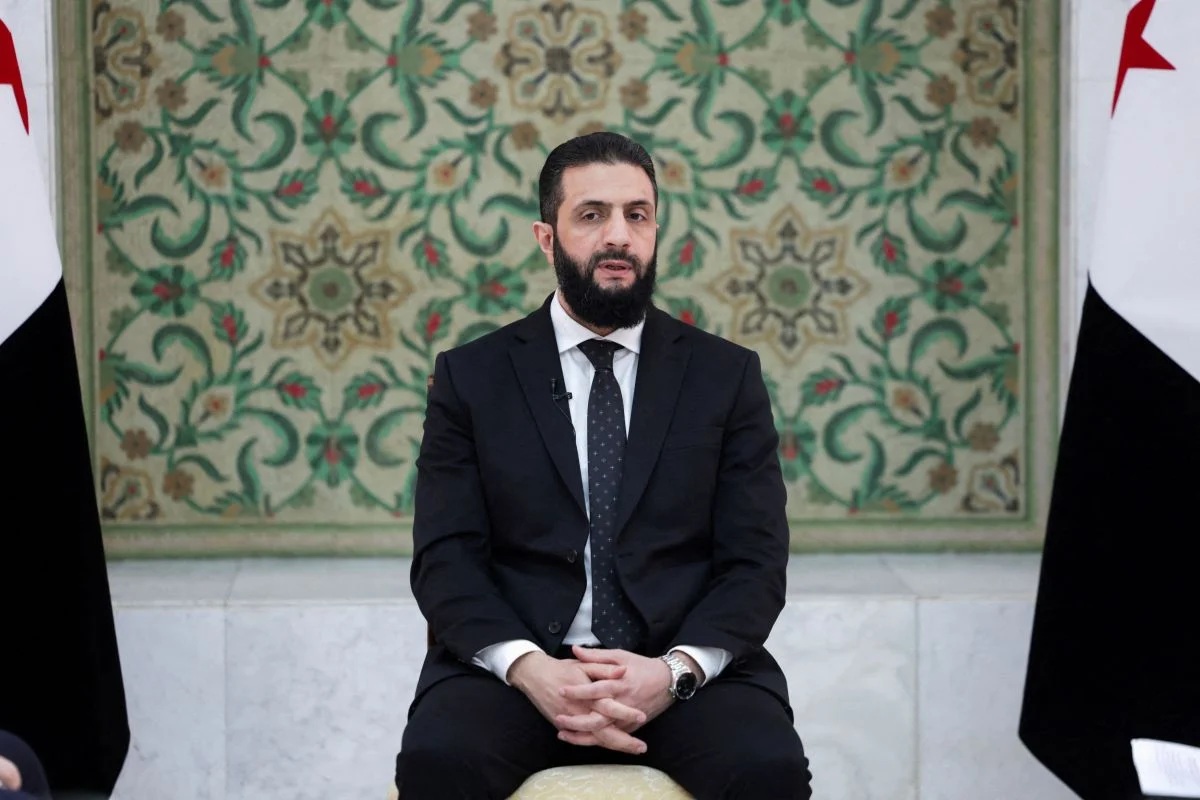
The Syrian transition is being sold to the world as a story of reunification. The government of Ahmed al-Sharaa is restoring state authority, the Syrian Democratic Forces (SDF) are being absorbed into national institutions, and Damascus is simultaneously pursuing a security arrangement with Israel designed to prevent another war on Syria’s southern frontier. On paper, the country is moving from fragmentation towards sovereignty.
By Rafic Taleb
In reality, the emerging settlement looks considerably more complicated: Syria is being reunified institutionally while power remains divided through military structures, foreign guarantees, intelligence channels and economic arrangements.
The most revealing evidence comes not from the carefully worded communiqués issued by Damascus, but from intelligence concerning the origins of the relationship between al-Sharaa’s movement and the Kurdish forces that eventually became the SDF. In July 2013, an expanded Shura Council meeting of Jabhat al-Nusra brought together the organisation’s senior leadership, including al-Sharaa and commanders who would later occupy prominent positions in Syria’s armed opposition.
The meeting followed an extensive field tour during which al-Sharaa repeatedly attempted to persuade Abu Ahmad Zakour to abandon his position in Aleppo and take responsibility for the organisation’s economic portfolio.
The reason was strategic. At the time, Nusra controlled infrastructure around the al-Suwaidiyah field, while the Kurdish-led PYD controlled the Rumailan field. The intelligence describes an extraordinary economic proposition: Kurdish forces offered to divide the proceeds from the Rumailan fields, reportedly generating about $17 million a month, in exchange for Nusra opening the wells at al-Suwaidiyah so Rumailan could operate at capacity.
The proposal was rejected.
The intelligence is explicit about the internal debate. Al-Sharaa was the only senior figure present who supported accepting the arrangement. The prevailing argument was that giving the Kurdish forces access to oil and revenue would allow them to strengthen themselves militarily.
Abu Ahmad al-Shami, then the emir of Hasakah, reportedly proposed sending ten vehicle-borne suicide bombers and subsequently storming Rumailan. Al-Sharaa, faced with that maximalist position, remained silent and ultimately allowed the prevailing view to stand.
Within a month, fighting erupted around Ras al-Ayn. Nusra lost Ras al-Ayn, al-Suwaidiyah and the surrounding territory to the Kurdish forces.
That episode matters because it exposes the original strategic dilemma, now returned more than a decade later under a different name. The question was never simply whether Kurdish forces should be permitted to administer local institutions. The question was whether Syria’s northeast would contain a Kurdish armed authority possessing its own territory, economic resources, security apparatus and political leverage.
Over the following decade, the answer was yes.
The Kurdish movement survived, expanded and ultimately became the backbone of the US-backed SDF. It acquired control over large areas of northern and eastern Syria, including strategically important energy infrastructure. It built an administrative system that operated independently of Damascus and maintained its own military and security command.
By the time Assad fell in December 2024, Damascus was therefore not negotiating with a conventional militia. It was negotiating with an entrenched territorial power. That historical context explains why the language of “integration” has always been inadequate.
The March 2025 agreement between Damascus and the SDF was presented as the beginning of the end of Syria’s military fragmentation. But the fundamental question was never whether SDF personnel could technically receive positions within the Syrian armed forces. It was whether the SDF would surrender the independent military and political power that made its autonomy meaningful in the first place.
The intelligence supplied to us identifies the real test with unusual precision. The question remains whether the Syrian defence ministry moves an SDF battalion from Hasakah or Qamishli to Hama or Homs without seeking permission from the Kurdish command.
Many other questions remain: Can Damascus discipline an SDF soldier directly? Can Syrian security services arrest an individual in Qamishli or Hasakah without coordinating with SDF authorities? Can state security prevent an SDF arrest of an Arab citizen in the northeast? Can Damascus exercise direct customs authority at the Semalka crossing? Can central ministries dismiss employees belonging to the autonomous administration? Can weapons originally supplied by the United States be transferred from Kurdish-held depots to Syrian military bases elsewhere in the country?
Those questions provide a far better definition of integration than photographs of tanks being handed over.
Public developments eventually made the contradiction impossible to conceal. In January 2026, after heavy fighting, Damascus and the SDF reached a ceasefire and integration agreement. The agreement provided for the withdrawal of SDF formations east of the Euphrates and the transfer of Raqqa and Deir ez-Zor to Syrian government control, while integrating SDF-administered institutions and forces into the Syrian state.
By August, the SDF had formally announced the dissolution of its independent military structure and its integration into the Syrian army. Reuters described the move as the culmination of a phased agreement, with Kurdish forces entering the national military framework and former SDF commander Mazloum Abdi announcing the end of the organisation’s independent military mission.
But formal dissolution does not mean the disappearance of political power.
Indeed, current negotiations over the Kurdish Women's Protection Units show how much remains unresolved. Even after the SDF's formal integration, questions remain over the status of the YPJ, the participation of Kurdish women in Syria's new security institutions and the extent to which former autonomous structures retain organisational identity.
The deeper issue is therefore whether Damascus has acquired sovereignty or merely acquired a new administrative vocabulary for a negotiated distribution of sovereignty.
The same question applies to the economics of the northeast. Control over Syria's oil and gas fields has always been inseparable from military power. Intelligence on the 2013 negotiations places the value of the resources then under discussion at roughly $17 million per month.
The claim that Kurdish control of Syrian oil has subsequently generated billions of dollars is part of the intelligence picture supplied to us; it should be understood as an intelligence assessment rather than confused with an independently audited public accounting of every barrel produced or every dollar received.
Yet the strategic point requires no such accounting. Whoever controls the fields possesses leverage over Damascus. Whoever controls the border crossings possesses leverage over trade. Whoever controls the armed formations possesses leverage over the state. And whoever retains weapons supplied by Washington retains leverage over both.
This is why the SDF question cannot be reduced to Kurdish autonomy versus Syrian nationalism. It is a contest over the architecture of the Syrian state.
And then there is Israel.
While Damascus was negotiating the reintegration of the northeast, its relationship with Israel was moving in the opposite direction: from confrontation towards structured security dialogue.
Since the fall of Assad, Israel has maintained military freedom of action inside Syria and has expanded its presence around the Golan frontier. Damascus, meanwhile, has deliberately avoided military confrontation.
In April, al-Sharaa said Syria was seeking a new security agreement that would restore the 1974 disengagement lines and establish new rules governing the frontier. In July, he went further, publicly confirming that Damascus was actively working towards a security agreement with Israel with the participation of several other countries.
The self-proclaimed president said such an agreement could eventually open the way towards comprehensive peace, while insisting that Syria would not abandon its claim to the occupied Golan Heights. The public record confirms the negotiations. The intelligence we received suggests what may lie beneath them.
According to that intelligence, Syrian authorities sought a channel through Jordan and US envoy Tom Barrack for direct communication with Israel. The Israeli side, it says, demanded the creation of a security coordination office attached directly to the Syrian presidency.
Its proposed function was extraordinarily broad: information on armed groups, tribal structures, political tendencies, individuals agitating against Israel, organisations promoting resistance to Israel and the wider security picture in southern Syria.
If accurate, this would amount to considerably more than a conventional ceasefire mechanism.
It would constitute the beginnings of an Israeli-Syrian intelligence architecture embedded inside the post-Assad security system.
That possibility is especially significant because Damascus is simultaneously attempting to consolidate authority over Daraa and Suwayda. The south is politically fragmented, heavily armed and deeply sensitive to any perception that Damascus is attempting to impose itself by force. Israel, meanwhile, has demonstrated that it considers developments south of Damascus a matter of national security.
The result is a remarkable inversion of Syria's traditional strategic posture. Under Assad, Damascus publicly treated Israel as an enemy and maintained a state apparatus designed around resistance rhetoric.
Under al-Sharaa, Damascus is attempting to rebuild a Syrian state while negotiating with Israel precisely because it does not yet possess the military capacity to impose its preferred security order.
That does not necessarily make the policy irrational. It may be the only realistic strategy available to a government attempting to rebuild a devastated country.
But it carries a profound risk.
A government can regain territory while losing strategic autonomy. It can rebuild an army while becoming dependent upon foreign security guarantees. It can proclaim national sovereignty while permitting external powers to influence who operates along its borders, which armed formations are acceptable and what intelligence is shared.
The intelligence concerning Suwayda adds another dimension. It describes Israeli efforts to reshape the internal balance of power within the National Guard, including the use of financial incentives and attempts to marginalise figures considered corrupt or unreliable.
The intelligence specifically identifies Salman bin Hikmat al-Hijri as central to a corruption problem and claims Israeli officials concluded that the existing leadership required professional restructuring.
These claims go beyond what has been publicly established and should therefore be understood as intelligence reporting rather than ordinary open-source fact. But their strategic implication is unmistakable: whoever shapes the security hierarchy in southern Syria will possess influence over the future relationship between Damascus, the Druze community and Israel.
The intelligence further describes a substantial dossier allegedly assembled by the United States and France concerning abuses committed during the Syrian government's operations in Suwayda, with Israel said to have helped move the material internationally.
The dossier allegedly contains video evidence concerning the use of military facilities and the movement of forces disguised as tribal fighters. Whether every element of that dossier ultimately survives public scrutiny is a separate question. What matters politically is that Damascus is operating under the assumption that its commanders and officials can accumulate liabilities that foreign governments may later use as leverage.
That is the emerging pattern.
The SDF is being integrated, but the real issue is whether its military autonomy has actually disappeared. Israel and Syria are negotiating, but the real issue is whether the resulting security architecture will restore Syrian sovereignty or institutionalise Israeli influence.
Damascus is expanding its territorial control, but the real issue is whether the central government controls the instruments of power or merely inherits institutions whose loyalties and capabilities remain divided.
The answer will determine whether the Syrian transition becomes state-building or simply a more sophisticated form of power-sharing.
Al-Sharaa's administration has achieved something that appeared almost impossible during the worst years of the civil war: Damascus is once again at the centre of Syria's political system. But political centrality is not the same as sovereign control.
The SDF's formal dissolution is historic, yet its legacy- armed Kurdish political organisation, local institutions, foreign relationships and social structures- cannot be dissolved by decree. Likewise, an Israeli security agreement could reduce the risk of war while simultaneously creating mechanisms through which Israel acquires enduring influence over southern Syria.
This is why the most important Syrian question is no longer “Who controls which territory?”
It is: “Who controls the people who control the territory?”
The answer is still being negotiated.
And that is why the apparent reunification of Syria should be treated with caution. The country may be moving from a map divided among rival armies to a state divided by overlapping chains of command, foreign security relationships and negotiated spheres of influence. The uniforms may change. The flags may change. The ministries may change.
Power, however, is proving considerably harder to integrate.