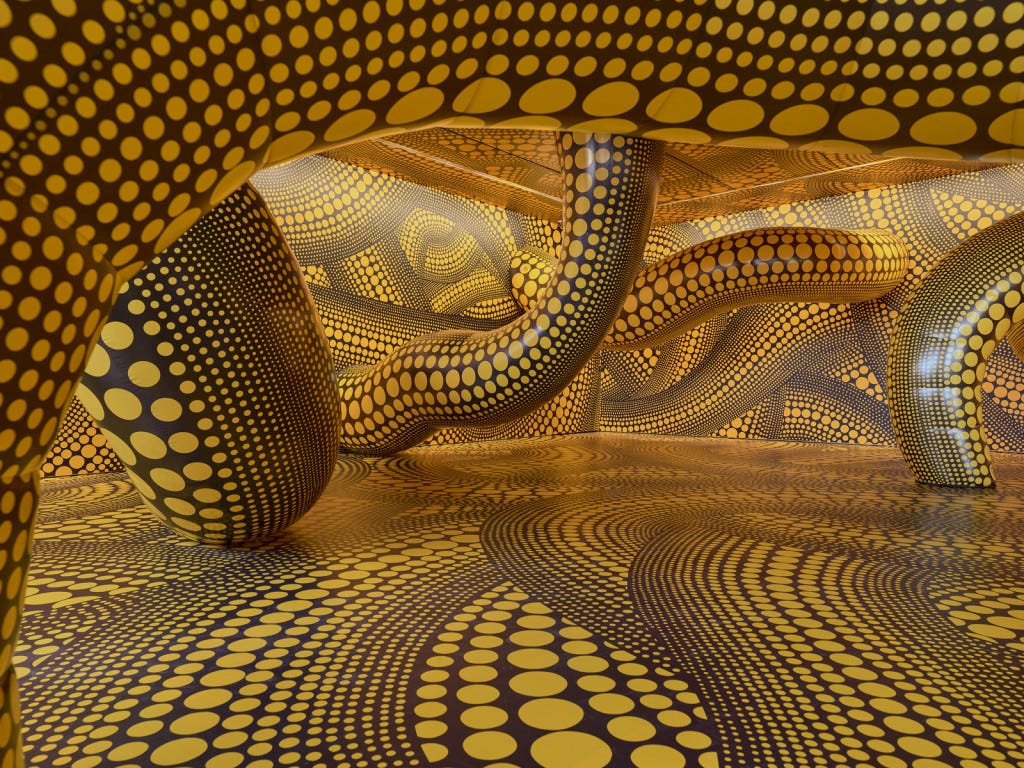
I went to see Yayoi Kusama yesterday. I went for the art and stayed for the existential crisis which, in retrospect, was probably always going to happen.
You walk into a Kusama exhibition, and everything is immediately beautiful and slightly insane. Dots everywhere. Mirrors. Pumpkins. Lights multiplying into infinity. Rooms that make you lose your sense of proportion, direction and, for a few seconds, possibly your dignity while trying to take the perfect photograph as the security waves at you that a selfie stick is not allowed.
It is impossible to visit a Kusama exhibition without expecting mirrors, polka dots, infinity, colour, repetition, a little vertigo and the obligatory moment of wondering whether you have accidentally stepped inside someone else’s hallucination.
Because Kusama’s work is, on the surface, about infinity. But with the mirrors and the dots, it begins to feel like an exhibition about the opposite.
The very smallness of the self
We spend an extraordinary amount of our lives trying to make ourselves significant. We build identities, careers, relationships, opinions, homes, reputations. We collect evidence that we were here. We want to be remembered, chosen, loved, understood. We spend years constructing this thing called “me” and then spend an equally impressive amount of time protecting it.
And then you enter one of Kusama’s infinity rooms
Suddenly, there is no centre. Just you, multiplied into the distance, reflected at you until you can no longer quite tell where your body ends and the room begins. The ego, which normally occupies so much real estate, becomes almost ridiculous. One tiny human being standing inside an endless field of reflected light.
Big enough to shrink the ego
We are so accustomed to looking at ourselves from the inside that we rarely get to see the self as something almost incidental. A temporary arrangement of thoughts, memories, fears, desires and stories. We take our personal dramas very seriously because, from inside our own heads, they are enormous. Then occasionally life gives you a moment of perspective, and you realise: ah. I am one person on a planet spinning through an incomprehensibly large universe.
Humbling… and oddly liberating
Kusama’s obsession with repetition made me think about the mind too. We often imagine growth as the moment when we finally understand something and move on. But the mind is less cooperative than that. It returns. Same fear, different relationship. Same wound, different year. Same insecurity wearing a new outfit.
We think we have dealt with something because we have intellectually understood it. Then life puts us in a slightly different room and, surprise, there it is again.
Repetition is how the mind learns
There is also something deeply human in Kusama’s relationship with dots. A dot is almost nothing. Until you put another beside it. And another. And another. Suddenly there is a universe.
Most lives are made this way. One insignificant morning. One conversation. One person we happened to meet. One decision made when we were tired. One apartment. One heartbreak. One ridiculous mistake. One brave thing we almost didn’t do. We keep adding dots until, years later, we look back and call the pattern a life.
The cultural part of the exhibition is fascinating precisely because Kusama’s work refuses to stay neatly inside “art.” It carries traces of Japanese visual traditions, postwar culture, avant-garde experimentation, performance, fashion and popular culture, but it also belongs unmistakably to our contemporary appetite for experience. We no longer only look at art. We photograph ourselves inside it. We enter it. We become part of the image.
We become both the audience and the subject
Even in a room designed to make you feel infinite, part of you is still thinking about the photograph you will take afterwards. Because maybe we don't transcend the ego by pretending we don't have one. Maybe we become aware of it.
Kusama’s life and work also make the line between discipline and obsession difficult to ignore. Repetition can be meditation. It can also be compulsion. It can soothe the mind or consume it. The same act can be sanctuary and prison depending on what is happening inside the person doing it.
That is one of the more uncomfortable truths about creativity: we romanticise the tortured artist because we like the mythology, but behind the mythology is often a human being trying to make something out of whatever is happening inside them.
Kusama did. She took what could have remained private and gave it form. Dots. Pumpkins. Mirrors. Infinity. Things that look playful until you stay with them long enough.
Then the existential questions begin. What happens to the self when there are infinitely many versions of it? How much of our identity is actually ours? Why are we so frightened of disappearing? Why do we spend so much of our lives trying to leave a mark when the universe seems perfectly comfortable erasing everything?
And the most interesting question of all:
What if disappearing, occasionally, is exactly what the ego needs?
Maybe the point of infinity isn't to make us feel infinite but to remind us that we aren't.
Depressing? Not really. I think it feels like permission. Permission to stop making every mistake a referendum on who we are. To stop treating every ending as proof that we failed. To loosen our grip on the identity we have spent decades constructing. To understand that we are important without being the centre of everything.
A dot is tiny. Put enough of them together, and you get a universe.
Life works the same way.