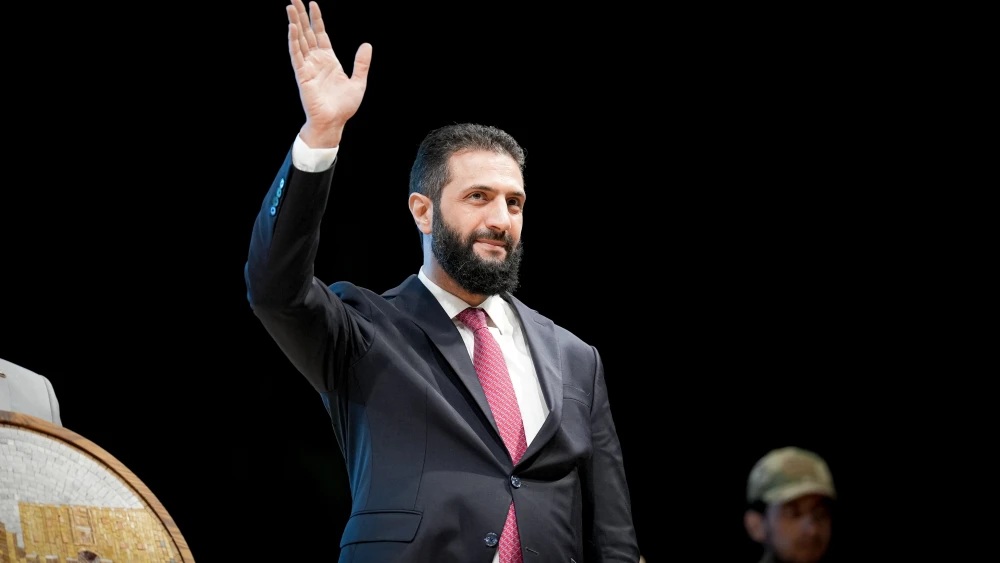
The central reality of the Syrian conflict is no longer the fall of Bashar al-Assad. The real story is what is being built in its aftermath, and, more importantly, what is being deliberately destroyed. Syria is undergoing a vast process of political, military and ideological restructuring in which the old weapons infrastructure, jihadist networks and independent armed formations are being systematically dismantled. Ahmed al-Sharaa was brought to the centre of this process precisely because he could do what few other Syrian actors could: dismantle the jihadist and military ecosystem from which he himself emerged.
By Rafic Taleb
For more than a year, the operation has involved a comprehensive cleaning of warehouses, military camps, weapons depots and everything associated with Syria’s old armed landscape. The explosions that have repeatedly destroyed weapons warehouses are not random accidents. They are part of this process.
Israeli aircraft have carried out most of these strikes, with American aircraft participating on some occasions. Some operations have taken place in coordination with the authorities in Damascus, as in the case of the Sarmada depot; others have taken place without their knowledge.
The objective is to remove the weapons and ammunition accumulated over years and ensure that Syria cannot emerge from the collapse of the Assad regime with an independent military arsenal.
The killing of Abu Suleiman of Dara Azza fits directly into this strategy. He was an old jihadist dating back to the days of Abu Musab al-Zarqawi, as was his family. He had been entrusted by the leadership of Hay’at Tahrir al-Sham with purchasing and collecting weapons and subsequently selling them to the organisation.
His debts to the new authorities reportedly reached millions of dollars. His elimination therefore served two purposes simultaneously: an old jihadist figure disappeared, and the authorities were relieved of his outstanding financial claims. The process is not simply about destroying weapons; it is about eliminating the people, networks, debts and institutions connected to the old jihadist economy.
The explosion at the al-Ais warehouses is even more revealing. Israeli drones had been visible in the sky, and surveillance had reportedly continued for two days. Yet the guards escaped before the explosion with a Porter vehicle and three motorcycles. How did they know? Did their commanders warn them shortly before the strike?
The question is not a minor detail. It points toward the extraordinary degree to which Israel and the coalition have penetrated Syria’s new security and military structures. The level of penetration is now many times greater than it was when Hay’at Tahrir al-Sham controlled the territory.
This is the essential contradiction at the heart of Sharaa’s Syria. The man presented as the leader of a new sovereign Syrian state is simultaneously presiding over the dismantling of the armed infrastructure that could make that state genuinely sovereign. Syria is being stripped of weapons, its former military installations are being destroyed, its jihadist factions are being disarmed or absorbed, and its armed forces are being kept away from the southern frontier.
The obvious question follows: if Sharaa were genuinely considered a dangerous jihadist threat to Israel, why was he not assassinated?
Israel had every opportunity. When Sharaa reached the presidential palace, Syria was still chaotic. Sanctions remained in place. The victory conference had not yet taken place, despite Sharaa's claim that the factions had delegated authority to him. The country was politically fragmented and unstable.
Pro-Gaza slogans were being raised in Damascus and in southern Syria. Israel could have killed him with a drone and simply attributed the operation to an unidentified aircraft. It had already demonstrated its ability to destroy Syrian military facilities with extraordinary precision.
It did not.
The silence was the clue. Israel’s relationship with Sharaa is deeper and older than his relationship with Britain. The Israeli problem with him is not that he represents an unacceptable strategic threat. The problem is that he has not yet completely dismantled the remaining jihadists and has not sufficiently removed the Syrian army from the south. Sharaa is useful precisely because he can perform this work while retaining enough revolutionary legitimacy to impose it on forces that might otherwise resist.
That is why the next stage is expected to be a security agreement imposed through American mediation. In New York, Sharaa will be presented with a draft with severe conditions. He will either sign it openly or Syria will face renewed destabilisation.
The message is straightforward: dismantle the remaining jihadist infrastructure, keep the Syrian army away from the south and accept a security architecture in which Israel and the United States possess unprecedented access to Syrian territory and institutions.
The New York meeting must therefore be understood within the much larger American strategy toward Iran. Washington originally requested a meeting with the region's countries while excluding Syria. Qatar proposed inviting Syria, and Washington accepted because there was a message everyone needed to hear.
That message is Iran.
The United States is preparing to undertake something very large against Tehran. Trump’s message to the region's governments is that those who refuse to stand with America in the coming confrontation cannot expect American protection. Every government must choose. The Syrian question is consequently no longer an isolated issue. Syria is being integrated into the broader American strategy for the next phase of the Middle East.
This explains why the relationship between Trump and Sharaa has begun to change. The American project that helped bring Sharaa into the international system is now becoming conditional. His regional backers' enormous financial and political investment has not produced the expected return. Trump has effectively abandoned Sharaa, and the money of the Al-Khayyat family has gone to waste.
The coming month will therefore be decisive. Major events are expected, but the unresolved question is whether they will occur before or after the elections. The timing matters because Syria is no longer being managed as a post-Assad transition. It is being positioned for a confrontation involving Iran, Israel and the United States.
The origins of Sharaa’s rise are critical to understanding this transformation. Anyone who believes a ruler in this region reaches power purely through popular mobilisation, a military coup, or elections without prior Western-American intelligence coordination does not understand how the regional system operates.
Sharaa’s journey began in 2005 with the British. The patrol that arrested him was British, not American. In 2008, the Americans took him in. But the more important revelation is that his channel with Israel predates his relationship with Britain.
That explains Israel’s extraordinary restraint. Had Sharaa represented even a minor danger to Israeli interests, Israel could have eliminated him during his years in Idlib. Instead, it waited while he transformed from a jihadist commander into an internationally recognised political leader.
The transformation has been extraordinary. Sharaa did not meet Trump in a traditional bilateral presidential meeting. Through Qatar, he participated in a wider Arab gathering with Trump. Trump then delivered a 47-minute speech covering the world's major issues without mentioning Syria. That omission was politically significant.
Sharaa has also claimed that, during an earlier visit to the White House, he joked with Trump by asking why Trump did not give New Jersey to Israel. Yet when Trump later stated publicly that he had given the Golan Heights to Israel, in Sharaa’s presence, Sharaa lowered his head and offered no substantive response. The subsequent decision to speak openly about the Golan as Syrian territory therefore represents a change in political circumstances. Sharaa understood that his position with Trump had weakened and consequently raised his rhetoric.
Even then, his response to questions from Brett McGurk exposed the limits of his position. Instead of discussing the legal and political status of the Golan, he struggled to articulate the issue, essentially reducing it to the statement that it was land belonging to people. For a leader who once emerged from a movement that spoke openly about Jerusalem, this represents an extraordinary transformation.
It also raises a question for the Arab nationalist current and for the former HTS members who supported Sharaa. The movement once promised that from the olive trees of Idlib it would reach Jerusalem, not merely Damascus. Its former leader now speaks about understanding what happened to civilians on October 7 and operates within an international system increasingly centred on American diplomacy and Israeli security.
The ideological transformation is equally striking. The argument that Sharaa was merely thirteen years old during the September 11 attacks has become almost irrelevant. Elements of HTS still celebrate the old jihadist mythology, including songs glorifying the destruction of American targets. Yet the movement has undergone an extraordinary reversal: jihadists who once celebrated attacks against America now celebrate the fact that America accepts their former leader.
The same transformation is visible socially and culturally. Sharaa has been placed in meetings with Western leaders, including a Dutch prime minister, appears alongside Western women and at cultural events, and has overseen the normalisation of music performances, conventional banking and diplomatic engagement with Jewish religious figures.
Jewish religious properties are being restored while the former jihadist leadership seeks international legitimacy. A movement that once defined itself through confrontation with the West is now seeking recognition from Washington and accommodation with the regional order.
Yet the political foundations beneath Sharaa are becoming weaker. He sought a meeting with Emir Tamim of Qatar and was told by the Emir’s aide that the schedule was full. Qatar subsequently refused to cover the Syrian delegation’s travel and accommodation costs as it had previously done. Saudi Arabia has stopped its financial support for the Syrian authorities. The underlying reason is the perception that Sharaa is being pushed toward the Emirates.
But the Emirates has not replaced Qatar and Saudi Arabia as Damascus’s financial saviour. Abu Dhabi hosted a delegation representing Syrian minorities at the same time as Sharaa’s visit, signalling that it is cultivating its own Syrian relationships rather than simply financing Sharaa’s government.
Sharaa has therefore entered the most dangerous phase of his rule. He has lost part of the regional support structure that sustained him without obtaining an equivalent financial and political substitute. His relationship with Washington has become conditional. Israel expects him to dismantle the jihadists and keep the army away from the south.
America expects Syria to participate in the emerging regional order against Iran. Qatar is distancing itself. Saudi Arabia has withdrawn financial support. The United Arab Emirates is hedging its position.
The Syrian people should therefore expect neither immediate stability nor the end of conflict. Syria is heading toward another period of war and destruction. Sharaa and his faction were brought forward as the vehicle through which a much larger regional transformation could be implemented, but that transformation risks keeping Syria permanently trapped in conflict. The country is being turned into the arena in which American, Israeli, Iranian, Turkish, Gulf and Syrian interests collide.
And Sharaa’s own survival increasingly depends on satisfying the external powers that enabled his rise. He is prepared to burn Syria to remain in power, alongside al-Shibani and Anas Khattab, while sacrificing other members of his own leadership whenever necessary. The political bazaar has already begun.
Trump’s Syria project, therefore, is not ultimately a project for restoring Syria as it was. It is a project for creating a fundamentally different Syria: stripped of its old military infrastructure, severed from Iran, constrained in the south, penetrated by Western and Israeli security structures, and governed by a leadership capable of dismantling the jihadist forces that once brought it to power.
The final question is whether Sharaa remains useful once that transformation is complete. The answer may determine the fate not only of his government, but of Syria itself.