A quote crossed my feed recently that stopped me mid-scroll: "What are you afraid of? Death? Guaranteed. Shame? Forgotten in a week. Lost everything? Rebuild. There is nothing to fear. Keep climbing.
It's a blunt, almost provocative piece of wisdom. But after two decades navigating projects, bids, boardroom negotiations, and the inevitable setbacks of a career built across oil & gas, energy, and industrial markets, I've come to believe it captures something that the best business research has been trying to say more formally for years: fear of failure is far more costly to our careers than failure itself.
Harvard Business School professor Amy Edmondson has spent much of her career studying exactly this. Her research began, fittingly, with her own doctoral failure in 1993, a setback that redirected her entire academic path toward understanding how people and organisations relate to mistakes.
What she found while studying high-performing medical teams surprised her: the best teams didn't make fewer errors. They reported more of them. Not because they were sloppier, but because they had built enough psychological safety to admit mistakes early, before they compounded into disasters. The lesson generalises far beyond hospitals, and it's one every leader, salesperson, and project manager should sit with.
Here are three truths from that body of research that I've seen play out, almost exactly, in my own career:
1. Not all failures are equal, and the right kind is a strategic asset
The most successful professionals do not spend their careers avoiding mistakes. Instead, they embrace intelligent risks and treat every new challenge as an opportunity to learn.
A new market entry, an innovative bid approach, or an ambitious account pursuit may not always succeed, but each attempt provides valuable lessons that strengthen future decisions and performance.
2. Reflection beats defensiveness, every time
When something goes wrong, the instinct is to explain, justify, or quietly move on. The people who recover fastest ask, "What did I do or not do?" instead of "Who's to blame?" I've sat across the table from colleagues and competitors alike who could not admit a miscalculation, and I've watched that instinct cost them far more than the original mistake ever would have.
Accountability isn't weakness; it's the fastest route back to credibility.
3. Psychological safety is a competitive advantage, not a soft skill
Teams and organisations that make it safe to say "this isn't working" outperform those that punish honesty with silence. In my own experience leading regional sales and project teams across the Middle East, Africa, and Central Asia, the deals that fell apart quietly- the ones nobody flagged until it was too late- cost far more than the ones where someone raised a hand early and said, "we have a problem." Building a culture where people can do that, without fear of shame, is one of the highest-leverage things a leader can do.
Which brings me back to that quote. Death is guaranteed, shame is forgotten in a week, and even losing everything can be rebuilt. What Edmondson's research adds is a practical discipline underneath that same defiant optimism: fail on purpose, in small doses, reflect honestly, and make it safe for others to do the same. That is not recklessness; it is how resilient careers, and resilient organisations, are actually built.
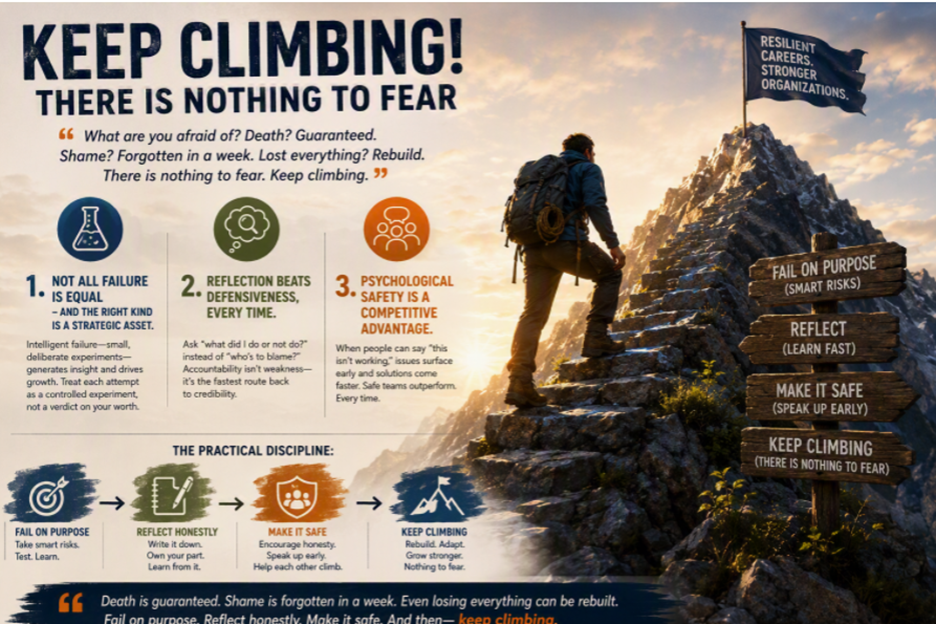
Success is not built by avoiding failure, but by learning from it faster than others. The courage to take intelligent risks, reflect honestly, and admit mistakes creates lasting growth. Every setback contains valuable lessons for those willing to confront it with humility and accountability.
So the next time a bid falls through, a market doesn't open the way you hoped, or a decision doesn't pay off, resist the urge to protect your ego by hiding it. Write it down. Own your part in it.
Learn what it has to teach you. And then, as the quote insists, and as the research quietly confirms, keep climbing!