Nine kinds of intelligence: Why the best teams don't hire just one

Early in my career, I believed the smartest person in the room was the one with the sharpest numbers. After twenty years on projects, service contracts, and regional deals across the Middle East, Africa, and Central Asia, I know better. The smartest team in the room wins, and teams are smart in many different ways.

In 1983, Harvard psychologist Howard Gardner challenged the idea of a single, measurable IQ. In Frames of Mind, he proposed that people have several distinct intelligences: linguistic, logical-mathematical, spatial, musical, bodily-kinesthetic, interpersonal, intrapersonal and naturalistic.

He later considered a ninth, existential intelligence. A popular infographic now pairs each one with an icon: Shakespeare for words, Einstein for logic, da Vinci for space, Oprah Winfrey for understanding people, Marcus Aurelius for self-awareness.
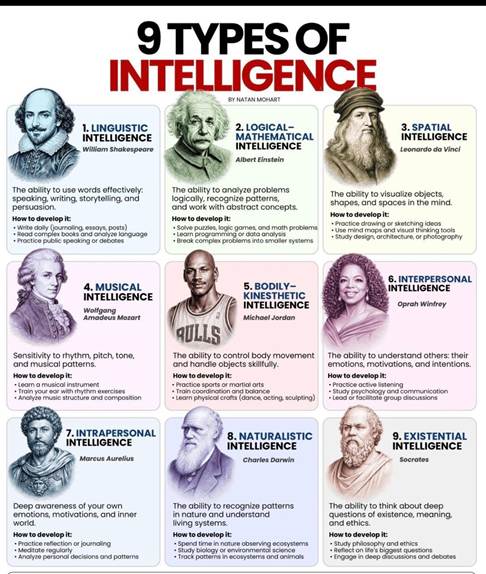
It's an elegant image. It also describes almost every project team I have ever led.

Harvard Business Review has long made a similar point about leadership. Daniel Goleman's classic article, What Makes a Leader? argued that technical brilliance and IQ are "threshold capabilities". They get you into the room.

What separates outstanding leaders is emotional intelligence: self-awareness, self-regulation, empathy and social skill. In Gardner's terms, that's intrapersonal and interpersonal intelligence. Yet many organisations still recruit, promote and reward mainly for one or two kinds of smart.

Here's how I see multiple intelligences playing out in the corporate world:

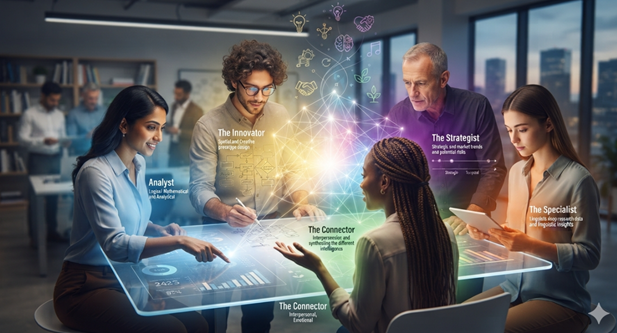
  • Diverse intelligence beats uniform brilliance. A tender team full of logical-mathematical minds will produce flawless spreadsheets and a proposal no one wants to read. Winning bids need the analyst who builds the model, the spatial thinker who sees the layout, the linguist who tells the story, and the interpersonal leader who knows what the client is really worried about. When I assemble a team, I no longer ask "Who is the best engineer?" I ask, "Which intelligence are we missing?"
  • The interpersonal and intrapersonal intelligences are the real leadership multipliers. I've watched technically strong managers fail because they couldn't read a room, manage their own reactions under pressure, or understand why a client's procurement head kept saying "maybe". I've also watched quieter professionals transform a project because they listened, built trust across cultures and reflected honestly on their own mistakes. In the region, where business runs on relationships, these intelligences aren't soft skills. They are commercial skills.
  • Intelligence can be developed, so leaders must develop it deliberately. The most encouraging part of Gardner's work is that these capacities aren't fixed. Engineers can learn to write persuasively. Sales leaders can learn to analyse data. Analysts can learn to present with presence. The infographic even suggests how: journaling, debate, mind-mapping, active listening, studying psychology. I've seen this firsthand while coaching project managers through their Chartered Project Professional journeys. The breakthrough rarely comes from more technical knowledge. It comes from a new kind of awareness.

For leaders, the practical message is simple. Map your team's intelligences the way you would map its technical skills. Put the storyteller next to the analyst, and the empath next to the strategist.

Reward the colleague who calms a tense client meeting as much as the one who closes the spreadsheet. And invest in your own weaker intelligences, because the one you neglect is often the one your next challenge will demand.
Organisations don't fail for lack of clever people. They fail when they recognise only one kind of clever. Gardner gave us the framework, and Harvard Business Review's research on emotional intelligence gave us the leadership case. Our job is to put both into practice in hiring, in teams and in how we grow ourselves.

Shakespeare, Einstein and da Vinci never worked on the same project. Your team can bring them all together.


 

Emile Fakhoury

Corporate Expert Writer, Business Professional in Energy/Water/Oil/Gas, Specialist in Coaching/Training, Association of Project Management UK Fellow Member. The professional who believes that adaptation to various social or corporate environments is the only way to survive and strive. Master the rules of the game in order to reach the top and change the rules.
See full bio >

Leave a Reply

Your email address will not be published. Required fields are marked *

More articles you might like

by Emile Fakhoury on 21/09/2026

Keep Climbing!

A quote crossed my feed recently that stopped me mid-scroll: "What are you afraid of? […]
- by Rami Audi on 17/09/2026

Abraham is not Zion: Can Israel avoid Europe’s crisis of identity?

A strange irony underlies the enthusiasm surrounding the Abraham Accords. For Israel, they represent one […]
- by Rami Audi on 14/09/2026

The Fourth Reich: The Christian shield against a new age of empires

Europe has spent eighty years trying to ensure there would never be another Reich. Perhaps […]
by Murielle Hebbo on 03/09/2026

What do your eyes give away?

We spend so much of our lives learning how to control what we show people […]
by Emile Fakhoury on 31/08/2026

The Adaptive Advantage: What career mobility really builds

For years, a resume full of moves was treated as a warning sign. Hiring managers […]
by Emile Fakhoury on 18/08/2026

The quiet intelligence of disagreeing well

A quote crossed my desk recently that stopped me mid-scroll: *"A true sign of intelligence […]